

Britain Israel Communications and Research Centre. Providing timely and accurate news, analysis and briefings on Israel and the Middle East since 2002.
London, England
Joined May 2008
- Tweets44.4K
- Following3.2K
- Followers7.7K
- Likes2.2K



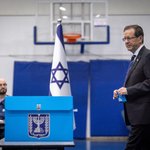



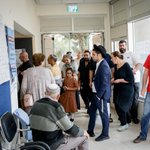

🗳️ Israel’s elections are in full swing. Yashar leader and the main challenger to the current government, Gadi Eisenkot, cast his vote in Herzliya earlier today.
Eisenkot pledged this morning: “I commit to reconnecting Israel, to winning the wars and ensuring security for this wonderful people. This is the mission of my life.”
📸 Chaim Goldberg/Flash90


🗳️ Prime Minister Netanyahu and his wife Sara cast their votes at a polling station in Jerusalem.
Netanyahu urged voters to vote: “We are the majority - go out and vote!!! If we don't go out to vote now, we'll regret it in the retreats and the dangerous laws that will come.”
📸 Yonatan Sindel/Flash90


🗳️ President Isaac Herzog and First Lady Michal Herzog voted at a polling station in Jerusalem.
Herzog said, “I hope and wish for this to be a genuinely festive day for democracy. This needs to be a festive day for democracy, and we won’t let anyone ruin or sabotage it. Most of all, I call on all the citizens: We are all equal today. This is our day. To go and to influence and to vote.”
📸 Yonatan Sindel/Flash90


BICOM 🇬🇧 🇮🇱 retweeted

By 12:00 PM, 2.3 million Israelis had already exercised their democratic right to vote - a 31.5% turnout, the highest in 53 years! 🇮🇱
Across more than 12,000 polling stations, Israeli society is showcasing the beauty of true democracy🗳️

👋 Greetings from Jerusalem, where our Chief Executive Richard Pater has just voted in Israel’s general election. 🗳️🇮🇱


🗳️🇮🇱 𝑰𝒔𝒓𝒂𝒆𝒍 𝒗𝒐𝒕𝒆𝒔 𝒕𝒐𝒅𝒂𝒚
With the results predicted to be closely fought between the blocs, there are a number of factors to look out for.
📸 Rachel Alroey/Flash90
🧵 1/n

At exactly 22:00 (20:00 UK time) Israel’s main TV networks release their exit polls, which are usually fairly accurate.
The actual votes are counted during the night, and a clearer picture of the results should emerge by early Wednesday morning, but counting the double ballots will take longer.
8/n
Only once all the votes are counted and verified will President Herzog begin his consultation with the parties and at his discretion, based on the endorsements, assign one of the party leaders the mandate to try and form the next government. The candidate selected by the president initially receives 28 days to build a coalition, with the possibility of an additional 14-day extension.
📸 Yonatan Sindel/Flash90
9/n

BICOM 🇬🇧 🇮🇱 retweeted

Who will win the upcoming elections?
All
🟦Netanyahu Bloc: 30%
🟥Opposition Bloc: 28%
🟪No clear winner: 30%
Netanyahu Bloc Supporters
🟦Netanyahu: 60%
🟥Opposition: 4%
🟪Neither: 25%
Opposition Bloc Supporters
🟥Opposition: 52%
🟦Netanyahu: 6%
🟪Neither: 33%
via Midgam/Chan12, Oct. 22-23
🚨 𝐊𝐧𝐞𝐬𝐬𝐞𝐭 𝐩𝐨𝐬𝐭-𝐞𝐥𝐞𝐜𝐭𝐢𝐨𝐧 𝐰𝐞𝐛𝐢𝐧𝐚𝐫
Israel heads to the polls in just four days.
Join BICOM Chief Executive Richard Pater and Fathom Editor Calev Ben Dor for a discussion on Israel’s political future, exploring the key parties and personalities, possible coalition scenarios and the challenges facing the country’s next government.
The webinar will take place on Zoom on Wednesday, 28 October at 19.30 UK time. Register your interest and we will email you the joining link in advance: mailchi.mp/bicom.org.uk/uhkr…

The World’s Best Smart Hospitals 2027 list has just been released by @Newsweek, and 🇮🇱 Israel’s Sheba Medical Centre is ranked sixth in the world.
This recognition is a testament to Israeli ingenuity and a tribute to the country’s cutting-edge healthtech sector.

🚨 Benny Gantz and his Blue & White party withdrew from the election today, just eight days before polling day.
Gantz is a former Chief of the General Staff of the Israel Defense Forces and served as Israel’s alternate prime minister from May 2020 to June 2021.
Ten days ahead of the election, Prime Minister Netanyahu presented Israel’s new National Security Doctrine on Sunday evening.
In the preamble the new two page document that was formulated with the National Security Council noted, “The October 7, 2023 attack compelled Israel to wage a fierce war. Through continuous combat – from Gaza to Yemen, from Lebanon to Iran – Israel warded off an imminent existential nuclear threat and removed the chokehold of the Iranian axis. The Government and the Security Cabinet made well-considered decisions, the IDF and security branches struck with immense force, and the civilian home front stood firm.”
The new doctrine prioritises:
❗ Prevention and offense over containment and defence, including launching pre-emptive strikes to thwart evolving threats.
❗Upholding advanced warnings but obtaining and maintaining a continuous and effective intelligence picture of the possibility and intentions of the enemy.
❗Strengthening home front defence against new threats. Including containing threats of invasion at the borders, by maintaining buffer zones.
❗Cementing Israel’s status as a regional power, whilst promoting regional and international alliances.
❗Building maximum independence in munitions. ❗Advancing production technology, and reducing dependence on external sourcing.
❗Ensuring superiority in the most advanced technologies.
❗Intensifying the fight against global waves of antisemitism and anti-Zionism.
❗Ensuring victory by breaking the enemy’s power and his belief in his ability to pose a real threat.
❗Safeguarding the “spirit of the people” – national cohesion and agreement on fundamental principles, chief among them: Israel as the nation-state of the Jewish people, democratic government, willingness to fight for the security of the state while striving for victory, encouraging independent thinking, settling the Land of Israel and cultivating the heritage of Israel, maintaining contact with Diaspora Jewry and encouraging immigration.
The document further noted the key threats which include: nuclear weapons, precision guided missiles, drones, cyber, AI, quantum computing, illegal weapons inside Israel and the ability of Israel’s enemies to rearm at rapid pace.
The main threat arenas include: The Shiite Axis, Palestinian territories, terrorism and internal security threats, delegitimisation and isolation from allies and the northern, eastern and western borders.
💬 Leader of Yashar, Eisenkot criticised Netanyahu for publishing his "security doctrine" ten days before the elections. According to Eisenkot, Netanyahu decided to do this “three years after the most severe failure and disaster in Israel's history, when all war fronts remain open. Two hollow pages, full of slogans that have nothing to do with a security doctrine. Therefore, I will remind Netanyahu: on October 7, 2023, the greatest failure since the establishment of the state occurred. That same failure he is trying by every means to bury, refusing to investigate and learn from it in order to prevent the next disaster. That same night, Netanyahu defined four war goals, in all of which he has failed despite the achievements of the security forces and the sacrifices of the people of Israel.”
📸 Ma’ayan Toaf (GPO)

From the Yom Kippur War to October 7, BICOM’s Senior Research Associate Dr Amira Halperin reflects on her uncle Rami’s death in 1973 and how grief and remembrance connect generations: blogs.timesofisrael.com/octo…
