






Michael Brodiak retweeted

Thatcherism stands for sound finance; it stands for honest money, not inflation; it stands for living within your means; it stands for incentives, because we know full well that the economic strength of a nation comes from the efforts of its people, and its people need incentives to work as hard as they possibly can. All of that has produced economic growth.
It stands for something else: It stands for the wider spread of ownership of property, of houses, of shares, of savings; it stands for being strong in defence, a reliable ally and a trusted friend.
People have called those 'Thatcherism'. They are, in fact, fundamental commonsense, and having faith in the enterprise and abilities of the people.
It was my task to try to release those. They were always there. They have always been there in the British people but they couldn't flourish under socialism.
Michael Brodiak retweeted

We're at the part of the Ponzi scheme where the guy running it starts sweating.
The US has $40 trillion in debt. It grows by $6 billion per day—not per year, per day. The US added $1 trillion in debt in just 71 days last year.
Here's the problem: The US paid $1.2 trillion in interest on that debt in 2025. That's more than defense spending.
So how do you fix it?
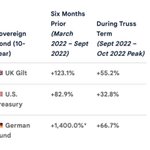
1) Raise taxes? The wealthy leave (see: Britain)
2) Cut spending? Political suicide
3) Default? Game over
There's only one path:
Print Money.
Devalue the debt by making dollars worth less.
Ray Dalio: “If you devalue money, you devalue debt.”
Translation: Your savings, salary, and retirement get quietly confiscated to pay for government debt.
The S&P was up 18% last year. Against gold? Down 28%. That 46% gap is the real inflation rate they're not telling you.
Currency devaluation isn't coming—it's official policy.
Michael Brodiak retweeted

“He jailed socialists, so he wasn’t a socialist.”
This is the argument every single person in my replies thinks is a mic drop. It’s actually the weakest one available, and it collapses in five seconds.
Lenin banned the Mensheviks and the Socialist Revolutionaries. Both were socialist parties. By your logic, Lenin wasn’t a socialist.
Stalin shot Bukharin, Zinoviev, Kamenev, and sent an ice axe through Trotsky’s skull. All of them were founding fathers of the Bolshevik revolution. By your logic, Stalin wasn’t a socialist.
Mao purged Liu Shaoqi, the President of the People’s Republic, and let him die in a cell. Pol Pot murdered his own cadres by the thousands. Robespierre sent Danton to the guillotine, then got the guillotine himself.
There’s a reason Vergniaud said the Revolution, like Saturn, devours its own children. Purging rival socialists isn’t evidence against collectivism. It’s one of its most reliable signatures.
Why? Because when the state decides everything, there can only be one plan. Two factions with two plans for the same economy can’t coexist. One has to disappear. In a free society, disagreements get settled by markets and elections. In a planned society, they get settled by the secret police. Hitler crushing the SPD and the KPD, then murdering Röhm and Strasser in his own party, is exactly what you’d predict from a regime competing for the same thing: total control of the economy and of society.
And that’s the real question. Not “what did he call himself” and not “who did he arrest”. The question is: who runs the economy? Under the Nazis, independent unions were abolished and replaced by a state labor front. Prices and wages were frozen by decree. Investment was directed by a Four-Year Plan. Private property existed on paper, as long as owners did exactly what the state told them to do.
Hayek saw this in real time. He dedicated The Road to Serfdom “To the socialists of all parties” precisely because he understood that the planners of the left and the planners of the right were the same species. Collectivism isn’t a color on the political spectrum. It’s the belief that a central authority can and should direct the economy. Once you accept that, the purges, the camps and the one-party state aren’t accidents. They’re the operating manual.
So no, “he jailed communists” doesn’t refute anything. Communists jailed communists for seventy years.
Read Hayek. Then come back.

This probably hits hard if you failed history in high school.
Hitler was a far-Right fascist whose party was named the National Socialist German Workers' Party to attract working-class voters.
Then he banned the Social Democratic and Communist parties, and sent socialists and communists to concentration camps.
Michael Brodiak retweeted

Questa è una registrazione storica.
Chi è questa persona?
Il video mostra l'attuale Segretario di Stato degli Stati Uniti🇺🇸 @SecRubio nel 2014, mentre esprime indignazione per il fatto che gli Stati Uniti abbiano costretto l'Ucraina 🇺🇦 a rinunciare a 1900 testate nucleari, e assicura che gli Stati Uniti 🇺🇸 "difenderanno l'Ucraina per sempre".
Sono passati 12 anni.
Ora Marco Rubio,
sotto la pressione di @realDonaldTrump
è uno dei primi a convincere l'Ucraina ad accettare la capitolazione davanti al aggressore russo…
Michael Brodiak retweeted

🥴Trump: The Russians had a thousand tanks, they would have been in Ukraine in four hours. And this very stupid general stuck in the mud.
The night before the Ukraine War started, they had the heaviest rainfall they had in 10 years. The land was soaking wet.
Michael Brodiak retweeted

The French 'school' protesters complaining about their education have looted everything ... fashion, jewellery, cars, liquor, games ... everything except a bookstore. 🤔
Michael Brodiak retweeted

🚨BREAKING: This new chart from @TheStudyofWar overlays Ukraine’s strikes on Russian refineries with the price of diesel fuel. There is NO CORRELATION between strikes on Russian refineries and spikes in the price of diesel here in the U.S. They are not driving up prices here.

Michael Brodiak retweeted

This is a comedy sketch that recreates the Battle of Hastings in 1066 in the style of modern soccer commentary, reminiscent of the British sports show Match of the Day. Famous soccer legends such as Gary Lineker, Geoff Hurst, Peter Shilton, and Martin Peters take on the roles of historical figures, creating a witty and unusual way of telling the story.
This scene is from the British comedy program The Nearly Complete and Utter History of Everything (BBC, 1999–2000).

Michael Brodiak retweeted

I don’t usually join panels, but given the news and my presence on the ground, I was asked to weigh in. Here’s my response to a panelist who appeared to be defending Vladimir Putin amid Russia’s ongoing war against Ukraine:
“Do you want to save Ukrainian civilian lives, or would you rather hinder and kneecap what’s supposed to be your ally in its fight for survival against Russia? That’s simply what it comes down to now.”
Michael Brodiak retweeted
If Iran ever acquires a nuclear weapon after President Trump leaves office, you can bet they will do so with assistance from Russia.
Russia wants Iran to have nuclear weapons. Their own state media says this on a frequent basis.
Iran must never have a nuclear weapon.
Michael Brodiak retweeted

Our warriors have completed another movement of Operation Vivaldi in the Donbas.
Zelena Dolyna, Lypove and Kolodiazi are free again, bringing 101 square kilometers back to Ukraine.
Across the whole operation, 16 towns and villages and 277 km² have been liberated, while the enemy has lost around 8,000 personnel.
Michael Brodiak retweeted

November 22, 1994: US President Bill Clinton thanks Ukraine for giving up its nuclear weapons. In return, the USA will stand by Ukraine's side to preserve its independence, sovereignty and territorial integrity in the future. Ukraine and the USA share a vision of freedom.


Michael Brodiak retweeted
As someone best-known for championing low-cost fuel, I want to say unequivocally that Ukraine has the right to bomb the shit out of Russian oil refineries.
And we should not be buying Russia's diesel, we should be facilitating Russia's surrender and withdrawal.

Q: "It's not just Trump, we also heard from Elon Musk saying Zelenskyy has gone too far. Why are they blaming you for the continuation of this war?"
Zelenskyy: "Because these people can't find a key to how to stop Putin. Because it's more difficult to stop Putin than to pressure others..."
The key to stopping Putin has always been the same: Russia’s ability to wage war must be destroyed, both economically and militarily. Right now, the US is doing the exact opposite.
Zelenskyy: "It’s simpler to talk about prices and connect them to Ukraine, when everyone in the world understands that prices are rising because of the war in the Middle East and the blocking of the Strait of Hormuz.
If we want to speak with people fairly, if we want to be clear, if we want to speak with our nations openly, people have to hear the reality. Don’t play games with people."
Because Ukraine is in a vulnerable position, it is an easy scapegoat for everything.
We are under attack and depend on our partners for support. We are forced to perform true miracles of patience and diplomacy. But blaming Ukraine didn’t work for Orbán in Hungary, and it won’t work for Trump in the US.


Michael Brodiak retweeted
Le grand problème de la plupart des gens qui votent à gauche, ce n'est pas qu'ils sont méchants. C'est qu'ils ne sont pas assez cyniques.
Ils croient que l'homme est naturellement bon et que c'est le système qui le corrompt. Tout leur projet politique repose sur ce postulat. Et ce postulat est faux.
L'être humain est, par essence, orienté vers son propre intérêt. Pas forcément méchant. Pas forcément cupide. Mais d'abord tourné vers lui-même, sa famille, sa tribu. C'est le produit de millions d'années d'évolution : ceux qui ne se préoccupaient pas d'eux-mêmes en premier ne sont pas nos ancêtres.
On peut le regretter. On ne peut pas le changer.
Et c'est là que tout bascule. Si tu refuses d'accepter cette nature, il ne te reste qu'une option : la corriger. Rééduquer. Amoindrir l'intérêt personnel par la loi, la morale d'État, la pression collective. Fabriquer un homme nouveau.
Tous les collectivismes ont tenté ça. L'homo sovieticus. La Révolution culturelle. L'année zéro des Khmers rouges. Chaque fois le même scénario : l'homme réel résiste à l'homme rêvé, alors le système accuse l'homme réel. Il devient saboteur, koulak, ennemi du peuple. Et on finit par éliminer ceux qui refusent d'être corrigés.
Les collectivismes ne finissent pas en boucherie par accident. Ils finissent en boucherie par construction. Quand ton projet exige de changer la nature humaine, la nature humaine devient ton ennemie.
La bonne question n'est donc pas "comment rendre les gens altruistes ?" mais : sachant que chacun cherchera d'abord à maximiser son propre intérêt, quel système transforme cet intérêt individuel en prospérité collective ?
Adam Smith l'avait déjà formulé en 1776 : ce n'est pas de la bienveillance du boucher, du brasseur ou du boulanger que nous attendons notre dîner, mais du soin qu'ils apportent à leurs propres intérêts.
L'école autrichienne a poussé le raisonnement jusqu'au bout. Et la démonstration se fait par A + B.
A. La valeur est subjective (Menger). Personne ne peut savoir à ta place ce qui compte pour toi.
B. Le savoir est dispersé (Hayek). Il est éparpillé dans la tête de millions d'individus. Le boulanger sait combien de pain il vendra demain. L'agriculteur sait quand sa terre est prête. Aucun planificateur, aussi brillant soit-il, ne peut centraliser ça.
C. Le prix est le seul mécanisme capable d'agréger ce savoir. Un prix qui monte dit "il en manque, produis-en plus" à des millions de gens qui ne se connaissent pas, sans qu'aucun d'eux n'ait besoin d'être altruiste.
D. Sans propriété privée et sans prix libres, le calcul économique devient impossible (Mises, 1920). Le planificateur pilote à l'aveugle. Ce n'est pas un problème de mauvaise volonté ou d'incompétence. C'est un problème d'information. Et il est insoluble.
Conclusion : la liberté économique n'est pas une idéologie. C'est la seule architecture qui épouse la nature humaine au lieu de la combattre. Chacun poursuit son intérêt, et pour l'atteindre, il doit servir celui des autres. C'est une symphonie sans chef d'orchestre, où chaque musicien joue sa partition et où l'ensemble sonne juste. Aucun système dans l'histoire n'a sorti autant d'êtres humains de la misère.
Mais accepter ce système implique d'accepter trois choses que la gauche a énormément de mal à avaler.
Un : l'individu exceptionnel existe.
Certains créent plus de valeur que des milliers d'autres. Un entrepreneur, un chercheur, un inventeur peuvent changer la vie de millions de personnes. Une société qui traite l'exception comme une anomalie à corriger se condamne à la médiocrité. Une société qui la laisse émerger tire tout le monde vers le haut.
Deux : confondre égalité des chances et égalité des résultats est le pire des cocktails.
L'égalité des chances, c'est donner à chacun la possibilité de jouer. L'égalité des résultats, c'est truquer le score à la fin. Les individus étant différents en talent, en effort, en choix, des chances égales produisent forcément des résultats inégaux. Et pour imposer des résultats égaux, il faut une force capable de prendre aux uns pour donner aux autres en permanence. On retombe sur l'homme nouveau. Par une autre porte.
Trois : il faut accepter que certains se comportent mal.
Dans tout système libre, il y aura des fraudeurs, des profiteurs, des tricheurs. C'est le prix de la liberté. La réponse saine : sanctionner les fraudeurs et ajuster les règles. La réponse malade : punir tout le monde préventivement. Chaque abus devient une nouvelle norme, un nouveau formulaire, un nouveau contrôle, qui pèse sur l'immense majorité qui jouait le jeu honnêtement. Couche après couche, on construit une bureaucratie qui étouffe ceux qui créent pour se protéger de ceux qui trichent.
C'est exactement ce qu'est devenue l'Europe.
Le libéralisme n'est pas une doctrine pour ceux qui méprisent l'humain. C'est une doctrine pour ceux qui l'acceptent tel qu'il est.
La gauche aime l'homme tel qu'il devrait être. Le libéral compose avec l'homme tel qu'il est.
Et l'histoire a déjà tranché.