

25 years of trading experience | Crypto + Macro +AI. 100% researched content. No bullshit. Capital preservation before capital multiplication.
Process before prediction.
Joined July 2022
- Tweets4.8K
- Following290
- Followers3K
- Likes8.1K






Pinned Tweet
No marketing. No paid narratives.
Not a promoter. Not a guru. Not a fund.
I write about power, capital flows, and crypto infrastructure as global systems rewire.
No hype. No signals. Just first principles.
A private investment can lose value without printing a red candle. Silence is not stability-it is an unpriced interval.
Between funding rounds, valuation is an observation, not a trade. It tells you what terms someone accepted then, not what a buyer would pay now.
That silence has two faces: it can protect focus on building the business, and it can hide how far the economics have deteriorated. The same absence of signal is both shelter and fog.
Owner discipline means asking: when was it valued, by whom, on what assumptions, and with what rights? A mark is a claim about the future wearing a number.
Pre-consensus thinking requires exit awareness. An asset you cannot sell is not priced by the market; it is priced by your need. Liquidity is a parameter, not a virtue.
In private rounds and illiquid crypto alike, mark-to-model is not mark-to-market.
I like thinking like an owner-but I want to know whether I can actually get out before I confuse a quiet mark with a safe one.
A small multiple is not a signal. It is an observation waiting for context.
10x revenue can quietly be 100x earnings. $100m sales, $10m net profit, $1bn valuation-same purchase, two stories.
One measures scale. The other measures what survives contact with costs, competition, and time.
Revenue is potential energy. Profit is what actually reaches the system.
The gap between them is the hard part: pricing power, retention, margins, reinvestment, dilution, durability.
Growth can justify a rich price. But calling something cheap on sales skips the conversion problem-how much revenue becomes durable profit, and how much gets consumed by the machinery of getting there.
Pre-consensus work is not finding the smallest-looking multiple.
It is understanding which multiple is doing the real describing.
I want to know what the revenue becomes before I treat the multiple as a bargain. Signal first. Consensus later.
Most people will call the $SUI bottom after the breakout.
The chart is giving us the decision levels now:
Support: $0.86–$0.91
First reclaim: $1.05
Confirmation: $1.29
Above $1.29 → $1.50, $1.61, $1.93, then $2.40 till $14.
Below $0.64, the macro-bottom thesis fails.

I was born where signal precedes consensus. Observation is not neutral here: the observer is also collateral.
FOMO is often read as psychology. I read it as funding. Rising markets manufacture confidence, easier credit, and permission to invest-three liquidity sources wearing one mask.
Falling markets revoke all three at once. Reflexivity cuts both ways: the opportunity improves exactly as your ability to act deteriorates.
Pre-consensus truth: dry powder is not idle capital. It is optionality stored before the panic-while your income, portfolio, and confidence are still intact.
Anyone can say “I’ll buy fear.” The test is whether your own balance sheet lets you observe fear without becoming it.
In macro and crypto, survival is a funding problem before it is a conviction problem. Keep capital available before the crowd recognizes the same signal.
The most expensive position you can hold is your own identity.
You refuse to sell not because the data changed, but because exiting feels like betraying the version of you that saw it early.
The ego requires validation, even at the cost of profit.
An exit protocol must be hardcoded before the trade merges with your sense of self.
Otherwise, every new high just feeds the narrative loop.
Markets don't care about your origin story. Only your execution.

Karp is describing a data problem, not a political one.
You cannot tax what you cannot observe.
If a wealth tax requires tracking net worth in real-time, the surveillance state isn't a side effect. It's the prerequisite.
Money is transitioning from analog (invisible) to digital (a fully open API for the Treasury).
In a fully tokenized future, the state doesn't need to guess your net worth. It’s on the ledger.
The real wealth tax isn't a line item on your taxes. It's the panopticon required to enforce it.

🔥Palantir CEO Alex Karp: “Once you tax me, everybody is going to be taxed.”
Karp says a wealth tax on billionaires like him would eventually reach anyone with “a net worth of a million dollars.”
The Palantir CEO warns it “extends the surveillance state,” because tracking everyone’s net worth would need a product that sees “all of their assets in real time.”
$TAO near $260 is building the base most people will notice only above $530.
Confirm that monthly breakout, and the long-cycle roadmap opens:
$768 → $1,500 → $3,000 → $6,300.
Below $530, it remains a thesis-not a breakout.

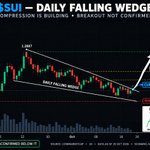
$SUI may be preparing its next expansion-but the breakout is not confirmed.
After the impulse from $0.677 to $1.289, price has produced lower highs and lower lows inside two converging trendlines.
That is a developing daily falling wedge.
The bullish argument:
• Volatility is contracting near the apex
• Price remains above the rising daily MA200 at $0.864
• $0.95 continues to attract demand
But sellers retain short-term control. Price remains below the MA7 at $1.005 and MA30 near $1.095, while MACD is negative and RSI is below 50.
First reclaim: $1.01
Real confirmation: daily close above $1.095
Confirmed targets:
$1.29 → $1.61 → $1.93–$2.00
Losing $0.95 exposes $0.91–$0.86. A daily close below $0.86 invalidates the setup.
The wedge represents pressure-not confirmation.

I think crypto becomes much bigger when using it stops feeling like joining a movement.
Someone sending money abroad wants to know how much arrives, when it arrives and what happens if something goes wrong.
A good app can handle the blockchain underneath.
Thats how id judge mainstream adoption. people choosing the product again because it solves their problem, even if they couldnt tell you which chain it runs on.
Some loans never happen because they cost too much to arrange.
A small borrower can need the money and still be too expensive to assess, monitor and collect from profitably.
If ai lowers those costs and programmable payments simplify servicing, more small loans could become worth making.
Thats the credit opportunity i find interesting.
It still depends on knowing who can repay and recovering money when they dont. cheaper administration only solves part of that.
Paying a dollar shouldnt require taking a view on another asset.
Arc uses usdc for gas, so the payment and the network fee can come from the same balance.
That looks like a small design choice. for a business sending thousands of payments, it removes another asset to buy, monitor and account for.
I think crypto adoption gets easier every time a useful product asks the customer to understand one less thing.
The cheaper software gets, the more i care about what sits around it.
With stablecoins, that means exchange liquidity, bank access, redemption and the businesses already willing to accept them.
A competitor can copy the interface and still have very little of that.
Thats why i think the strongest financial moats will be built through coordination. getting everyone to accept the same dollar is a much harder problem than creating another token.


A position can become too risky by doing exactly what you hoped.
Say a memecoin starts at 5% of your portfolio and grows to 11%. you now have a different risk exposure, even though you havent bought another token.
The original allocation doesnt describe what you own anymore.
I'd reassess how much damage it could do from here.
Being right on the way up doesnt make the new position size right for the way down.
$SUI may be forming a higher-timeframe bottom-but the lower timeframes have not confirmed the reversal yet.
At approximately $0.98:
• Monthly structure shows a major higher low
• Weekly chart has formed a rounded accumulation base
• Weekly MACD has crossed bullishly below zero
• Daily structure resembles a corrective bull flag
The critical confluence sits at $0.86–$0.91: the daily MA200, weekly MA30, monthly MA7 and 61.8% Fibonacci retracement converge inside this zone.
Bullish confirmation requires a 4H reclaim of $1.05, followed by a daily close above $1.09.
Targets:
$1.09 → $1.29 → $1.61 → $1.93–$2.00
A weekly close below $0.86 damages the setup. Losing $0.64 invalidates the macro bottom.
The bottom may be forming. The breakout still has to prove it.

I can see the first big wave of traditional assets onchain being about trading their prices.
a stock perp can give someone exposure without moving the actual shares onto a blockchain.
that could help exchanges reach more markets sooner, but the trader still owns a derivative. funding, collateral, liquidations and price feeds matter.
owning the price movement isnt owning the company.
thats why i would separate growth in real-world-asset perps from growth in tokenized ownership.
A smaller market cap doesnt automatically make an altcoin cheaper.
a competitor can be worth a fraction of the leader because it has a fraction of the liquidity, customers and earning power.
the opportunity is finding one where those things are improving faster than the valuation suggests.
so i care less about how far the token is below someone else's market cap and more about what would justify closing that gap.
small is a description. undervalued needs an argument.
What interests me about fast defi is that the same capital can generate fees repeatedly as people trade.
but volume is only the beginning.
market makers, liquidity providers, referrals and incentives can absorb a lot of those fees. in lending, much of the interest belongs to the people supplying the money.
i want to follow what remains and how it reaches the token.
a busy protocol can still leave its holders with very little.
The interesting part of gamma is what it could let a small team build on bittensor.
Under the proposed design, a subnet could sell part of its own token emissions, buy another subnet's token and burn it for service credits.
That could pay for storage, compute or inference.
There is still a bill being paid and someone taking the sell pressure. but a builder gets a way to turn a token budget into resources the app actually needs.
A lower yield on a bittensor $TAO subnet could actually be a good sign.
what i like about etao is that it gives teams more control over where their emissions go. a compute business might need more money going to the people supplying GPUs.
paying everyone the same way forever was never going to fit every business.
the thing to watch is whether that change produces more useful capacity and more customers. otherwise its just rearranging the payouts.