

Raising awareness of the scale of large Bully-related dog attacks and fatalities in the UK. We advocate for regulation of Pitbull type dogs.
United Kingdom
Joined July 2023
- Tweets2.2K
- Following42
- Followers5.3K
- Likes1K



Pinned Tweet
What next for dangerous dog policy?
A new Labour administration will still face the continued policy problem of how to effectively deal with dangerous dogs within communities. This is not a unique problem to the UK; dog fatalities have steadily increased in Europe and the United States. The data is consistent regarding the vastly disproportionate role of pit bull-type dogs in the rise of fatalities and as a proportion of serious attacks in virtually every country where their population has increased. However, other large, powerful dogs are also having an impact. The current situation has been exacerbated by successive Labour and Conservative Governments who have refused to give political time and capital to dog control policy as a whole.
It is our view that the single most effective and transformational policy change a Labour administration can make both to prevent dog attacks and to increase canine animal welfare is to regulate dog breeding by mandating that every single dog litter comes from a licensed breeder.
There is no doubt that dangerous dogs impacts working-class areas and communities the most. Looking at exemption data for XL Bullies, ownership of XL Bullies is concentrated in areas of high deprivation. Fourteen of the top 25 areas for ownership per capita are in deprived communities within Liverpool. We also know that dog bites are higher in areas of low socio-economic deprivation. The highest area of dog bites in Wales, for example, is in Swansea Bay, an area with some of the highest levels of deprivation in the entirety of the UK. Large social factors at play here can't be tackled in isolation, and Labour's policy agenda as a whole will help address this to some extent.
There are also clear connections between the ownership of powerful "status" dogs and anti-social behaviour. Someone can purchase or obtain a large dog with no checks and brandish it within dense urban communities in the same way one would brandish a knife or a gun. For instance, in Swansea just a few days ago, a man decided to walk his large Dogue de Bordeaux off-lead through a group of 90 primary school children picking litter off a beach. It turns out this dog had already attacked a number of other dogs before. While in theory, the Dangerous Dogs Act (DDA) could be applied in this situation, in practice, securing a conviction would likely be challenging (not to mention expensive). Taking intimidatory incidents like the above in aggregate, it becomes impractical under current regulations for police and dog wardens to manage the ownership of large, powerful dogs given finite resources for enforcement. Police can only realistically act after someone has been significantly injured. We see time and time again where communities know which dogs are dangerous, but police are unable or unwilling to act before an incident takes place.
In addition, dog control is costly. Local authorities are legally obliged to collect and kennel stray dogs. Police are legally obliged to seize and kennel dogs that are dangerously out of control. Kennelling costs can easily reach thousands of pounds for a single dog. Indeed, the Metropolitan Police spends millions of pounds each year on kennelling dogs alone. There is also the cost in terms of staff time to prosecute dangerous dog offences both to the police and the CPS, who can easily be tied up further or dismissed on technicalities if cases go through the appeals process. Additionally, there is the cost to the NHS in treating victims of dog attacks, and finally, the cost to rescue centers largely funded by public donations in rehabilitating dogs. What this means in practice is that the public are continuously subsidizing the ownership of large, powerful dogs.
The question, therefore, is what do you do to tackle this going forward? We firmly believe that all reform should be rooted within breed-specific legislation - a model which is now adopted by the majority of the world when it comes to dog ownership. Certain breeds should have additional barriers to ownership and further checks and balances. Breed-neutral legislation has, over time, been shown to be a radical policy position which hasn't produced the desired results it initially promised and is almost entirely rooted within American pit bull advocacy which peaked during the early 2010s. We'll actually go a step further - in countries where breed neutral approaches have been rolled out, most notably Italy, it has now become an unmitigated disaster. All of the arguments against it in terms of ineffectiveness and breed identification issues have been produced with the sole aim of lobbying for pit bull ownership.
Breed-specific legislation allows a targeted and preventative approach. The idea of cracking down on all irresponsible dog owners is a complete fantasy. We spend billions a year trying to tackle the fallout from irresponsible parents. The annual expenditure in the UK for children's social care is 11.1 billion pounds. Councils employ 33,000 social workers and 7,500 agency workers for children. Even then, we are still unsuccessful. NSPCC estimates 1 in 10 children will be neglected. 1 in 14 children will be physically abused. In comparison, there are roughly 400 dog wardens and 120 dog legislation officers covering the same number of dogs. That roughly works out to one person employed for every 20,000 dogs. A targeted approach allows us to funnel scarce resources where it can be most effective.
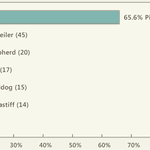
A roadblock for dangerous dog reform continues to be campaigning groups and animal welfare organisations who put forward ineffective and impractical policy solutions with no consideration of costs. The RSPCA and others have pushed for a Calgary-like licensing model because it's conveniently the only breed-neutral model which campaign groups claim has been effective. But there are two issues. First, the equivalent cost for the UK to adopt the Calgary model would be anywhere from £300 to £600 million pounds per year. Calgary meets roughly half this shortfall by charging a licensing fee - the rest is subsidized by the city of Calgary. (There is also a separate challenge for Labour - in light of pledges not to raise taxes, attempting to introduce a licensing fee could be interpreted by the public as a Dog tax.) Second, the Calgary model hasn't actually worked. It's under immense strain due to increases in the popularity of pit bulls. In recent years, it has tried to propose additional measures but has been rebuffed by campaign groups. Two years ago, a grandmother was mauled to death by her neighbor's three pit bulls. He was a pit bull advocate. Calgary publishes data on dog attacks and severity by breed. Despite only being a small population of the resident dog population, pit bulls are responsible for the most severe dog attacks by far.
So what is the solution? Inaction is unacceptable. Inaction is what led in part to the proliferation of the American XL Bully despite a longstanding pit bull ban in the UK. It's clear something needs to happen.
Regulate Dog Breeding
Fundamentally, the problem starts with breeding, and we believe pound for pound the best preventative public investment that can be made both for animal welfare and in reducing dog attacks is to crack down on breeders. We follow a number of backyard breeders online and have seen how they have been able to continue operating with impunity. Occasionally, some are prosecuted due to joint RSPCA and police investigations over animal welfare concerns where they receive pitiful sentencing. In practice, they can continue to operate freely.
Part of the problem is there is far too much ambiguity in the requirements for licensing of breeders. It currently stands that you need to either produce more than three litters a year or be able to pass a "business test." In reality, this provides far too much wiggle room for abuse. The threshold requirement for licensing should be reduced from three litters to one.
In addition to the licensing fee, we would propose an additional fee charged per litter of dogs registered. If we assume there are 70,000 litters per year, then this has the potential to raise £7,000,000 a year from licensing as well as additional income for local authorities through mandatory licensing. The funds can be used to hire an additional 150 licensing officers to manage registrations and work with local police and the CPS to crack down on backyard breeders of status dogs. We propose the Government seed fund for the first three years of the scheme's operation before it becomes self-sustaining and commit to a target of at least 200 prosecutions a year. The message has to be clear - if you breed status dogs for profit the police will be coming for you.
Demand for dogs is inelastic; the price people were willing to pay for dogs during Covid demonstrated that. The result of these changes would be to create the first steps in dog ownership infrastructure while simultaneously supporting improvements in animal welfare.
There are other policy decisions which would make a significant impact. We laid them out almost a year ago now in our report - consolidating existing dog control legislation, establishing a database of dog bite incidents, regulating dog training and bite work, reforming sentencing and penalties for dog-related offences, and introducing mandatory third-party insurance so that victims can effectively seek compensation, but we believe that a focus on dog breeding would produce the best outcomes over the long term and should be prioritised.
The victims of dog attacks throughout these past years deserve better. We hope a Labour Government makes sure that their sacrifices have not been in vain and finally addresses longstanding issues in dog ownership - the alternative of inaction can not be afforded once again.

In the Netherlands, three Bully XLs involved in a fatality and two serious injuries were found to have come from the same litter.
ad.nl/binnenland/dierenpolit…

An nine-month baby boy was killed by a 6-year exempt bully XL in Rogiet. Neighbours say the dog could have been spooked by fireworks.
This is the 24th person in the UK to be killed by an XL Bully, XL Bully cross or pit bull terrier since November 2021.

The RSPCA continue to be incredibly disingenuous. Out of 10 fatalities last year, 6 were caused by XL Bullies and 1 caused by a APT. Out of the 2 fatalities this year, both were caused by XL Bullies.
It's really hard to take their call for an evidence based approach seriously.

An 84 year old man in Warrington who was attacked by an escaped XL Bully while walking in February has sadly passed away from his injuries.
This is the 23rd person in the UK to be killed by an XL Bully, XL Bully cross or pit bull terrier since November 2021.

Morgan Dorsett from Shropshire is the 22nd person in the UK to be killed by an XL Bully, XL Bully cross or pit bull terrier since November 2021.
19 years old. Whole life ahead of her. Rest in peace Morgan.


The social media of the suspected owner shows them liking and being members of various bull breed advocacy groups and posts - even giving advice to other owners.
Now their cousin is dead.

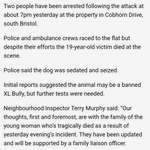
A 19 year old girl was killed by a suspected XL Bully in Bristol yesterday. This marks the 21st person in the UK to be killed by an XL Bully or XL Bully cross since November 2021.
Our thoughts go out to her friends and family.

XL Bullies due to their pitbull heritage have a high tendency of dog aggression. Its what they were bred for. We saw them regularly kill maim/other pet dogs. Let it stand on the record that
@RSPCA_official
is so blinded by BSL that it doesn't care for you own pet dog's welfare.

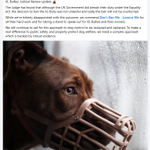
The high court judgement for the unsuccessful appeal of the XL Bully ban is now public. For months, we were labelled as misinformation and fake news. Let the record show there is now no doubt with the evidence in full that XL Bullies are disproportionately involved in fatalities.

Seven people have been killed by Bully XLs since the Government acted over the death of Ian Price last year.
There is no more debate to have over the danger these dogs pose. The fact people think this a somehow a media conspiracy is completely delusional.

Baby currently fighting for its life after being attacked by her family's 18 month old Bully XL. Police tried last year to get the owner to voluntarily surrender the dog and placed strict conditions on the owner when they refused.

The death of Michelle McLeod marks the 20th person in the UK to be killed by an XL Bully or XL Bully cross since November 2021. That number rises to 21 when you add the death of Akif Mustaq to a pit bull.
7 people have been killed by a pit bull or XL bully this year alone.

A woman in Scotland has been mauled to death by a large Bully type dog she owned for a year this past Saturday.
Michelle McLeod, 41, was killed in her Aberdeen flat. Neighbours say the dog had become increasingly aggressive and described it as an XL Bully.

The dog involved in the fatal attack of 42 year old Akif Mustaq is described as a "big American pitbull" by neighbours.
Only three weeks earlier it attacked a child on the street.
So why wasn't it seized by the Met for (a) attacking a child and (b) being a banned breed?


A 42 year old man has been killed by a dog in East London today. We do not know the breed - but police have charged the owner with having custody of a fighting breed.
Our thoughts are with the man's friends and family at this time.

Exempted. Family pet of four years. The dog was said to have had a close relationship with the girl.

Police say XL Bully that killed girl, 10, was family pet of four years as it is put down
manchestereveningnews.co.uk/…
manchestereveningnews.co.uk/…

Bully Watch retweeted

Police confirm dog that killed girl was XL bully bbc.in/3UFr3Tz
