

prev and future @terraformindies - Where I work on us winning
Vancouver, British Columbia
Joined September 2019
- Tweets3.1K
- Following937
- Followers1.7K
- Likes35K






Pinned Tweet
Another two weeks, and the next blog post is finally done:
How Starlink Will Conquer The Earth's Telecommunications Layer
The most important insight of this blog post is that Starlink V3 launched on Starship will reach a cost that is competitive enough for SpaceX to be price competitive with every ISP on Earth, irrespective of population density.
A Starlink V3 costs, SpaceX reaches $352/Gbps/year. This means that they can serve customers at broadband speeds (100 Mbps) for just $29/year, $2.4/month.
This is more than enough to cover the entire world in Starlink terminals and subscriptions cheap enough to compete with legacy telco's.
The limiting factor to Starlink's success is not economic, it's entirely achieving the required scale.
That's the headline of the analysis, aside from the conclusion there is tons of fun modelling that was required to come to such conclusions.
I started with the global distribution of population, overlaid the distribution of Starlink satellites onto it, and created a capacity allocation model that models the elasticity of connectivity in every country.
This elasticity-derived model allowed me to simulate SpaceX bringing online every unconnected person in every country on Earth with declining as the customer base increases.
Get all the info about the model and conclusions in the post:
ckalitin.github.io/posts/sta…


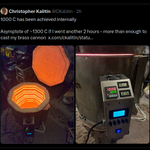
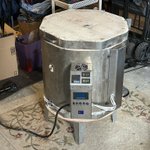
1000 C has been achieved internally
Asymptote of ~1300 C if I went another 2 hours - more than enough to cast my brass cannon


It’s important to remember that all architecture is fundamentally economic.
Change the economics and you get different architecture.
If you’re on the right side of capitalism, it’s very easy to win.

Still thinking about this post. Human creative innovation is not spontaneous but is actually a byproduct of solving problems. Art deco (for example) was not some randomly-inspired force of will to create beauty; it happened because metallurgy became just advanced enough to create everything out of metal, and because zoning laws required skyscrapers to have a stepped shape at the top.
This is why top-down efforts at changing our civilizational aesthetic (like those guys building the giant Greek statues) don’t work. They don’t change the “problem” we’re solving as a civilization, which is the actual source of the bleak & dreary surroundings we find ourselves in
“These things don't get cheaper over time. They only get more expensive.”
It seems like government has completely internalised this chart.
Inability to build things - particularly civil engineering projects - on time or budget is taken as an axiom.
It doesn’t have to be this way.
Because of the surface area of the economy that politicians interface with, they become focused on the unproductive sectors.
This seems to lead to mass application of the axioms true in those sectors to everything else - and everything stagnates.
Contrast this with places in which politicians are constantly dealing with problems of growing sectors, and their perspectives on the future.
If the capstone of your career is getting a behind schedule extremely over budget civil engineering projects over the line, you’ll be incapable of reasoning about the dynamic sectors of the economy.


Obv DOGE regulatory capture
10x'ing their salaries overnight!

BREAKING: President Trump reveals his new anti-fraud program set up to reward people who expose fraud with a 1% commission on the money uncovered.
"If you turn somebody in and you, let's say report and you find $1 billion, we are giving a commission to that person of 1%."
Readers added context they thought people might want to know
DOJ's published guidance caps individual whistleblower rewards at up to $30,000 per tip, not an uncapped 1% of fraud uncovered, with a total program fund of $25 million. A $1 billion fraud tip would not yield a $10 million payout under the official program rules. newsweek.com/trump-vance-of… foxnews.com/politics/trump…
If I had a billion dollars I’d build solar arrays not dams.
Civil engineers/ managers (who speak English) completely forgot how build large scale projects on time or budget.
EPC firms structurally can’t deal with a massive Hydro buildout.
They are the reason BC dams are 3x more expensive than China’s (environmental regs are only ~10-20% cost increase) and why every large scale refinery in Alberta was build years behind schedule.
It’s unfortunately not actually worth extracting all the latent potential energy of water in the Pacific North West because of our inability to do it cheaply.
There is no modern Henry Kaiser, the Henry Kaiser’s of the world went to other fields.
Luckily we can tile the Pacific North West with solar and extract a different form of latent energy.
I’ve just been nerdsnipped by trying to figure out how to get Hydro utilization in the PNW above 20%. My guess is it all flows through a relatively small number of rivers, and the analysis of which are geographically reasonable to dam isn’t too difficult.
Would’ve vibe coded that last night if I didn’t have a midterm in an hour.

It’s been 30 months since I predicted peak global launch rate in 2025-26.
We’re now likely to see peak global launch rate in 2025.
Well calibrated prognostication!
Now more predictions:
It likely won’t be until 2029-2030 that we once again beat the record, mainly depending on the ramp of Starship and Chinese reusable vehicles.
Launch rate growth will flatline as F9 ramps down.
Next year may also see a decrease in total mass to orbit, due to low Starship payload mass (~40-50t). Starlink V3 satellites are dense enough (kg/Gbps) that Starlink will keep growing.


I had Claude (so glad I don’t have to do this myself anymore) fit a curve to historic launches and account for no more Starlink launches from the cape to predict total launches in 2026.
Currently on track to be the first year without launch rate growth since 2019. The cause of the lack of growth in 2019 was also SpaceX slowing down Falcon 9 launches.
Furthermore, for the rest of the year China is expected to launch more than the Falcon 9.
10 months ago I wrote a blog post on Falcon 9 cadence asymptotically approaching a limit and predicted peak launches in 2028 and barely any growth from 2026 to 2028.
Turns out I was too optimistic wrt Falcon cadence. No need to delay burning the boats if you’re never setting foot on them again!
ckalitin.github.io/posts/fal…


The 2012 Tesla Model S shunt resistor has 3 ICs on it:
A 2903AVG differential amplifier
An IHM-A-1500 (which has a datasheet available on the internet!!!) that is an ADC with some horrible proprietary 3-wire SPI-like communication protocol
And an STM8AF, presumably to translate that horrible proprietary 3-wire SPI into something more readable.
Strange design, certainly seems like something they changed at the first opportunity to delete the redundant STM8 IC.
It also has a fun molex minifit like connector that is keyed. Maybe idiot proof the design while having many of the same type of connector on one board.


Much of the reason for expanding the capacity of the Grand Coulee dam 3.5x (!) - making it once again the biggest in the world, reclaiming the title - was load growth due to Aluminum refining
This went almost entirely unused (see second image's chart) as aluminum refining went away from America and general load growth slowed. SAD!
I've of course got a blog that covers some of this:
ckalitin.github.io/posts/bat…


Aluminum is so interesting
Making aluminum at scale takes so much power that smelters of virgin aluminum are typically sited near large power sources. Usually hydroelectric dams.
In Russia, the Angara flows out of Lake Baikal, by far the largest lake by water volume in the world, as well as the deepest by over 500 feet. The Angara flows into the Yenisei. The combined basin supports 9 hydroelectric dams, six of which have an aluminum smelter just a few kilometers away. 90% of Russia's aluminum comes from these sites.
In the United States there *is* equivalent dam infrastructure and we *did* have hydroelectric aluminum smelters at such a scale. That's where the Russians got the whole fucking idea.
Dams along the Columbia produced almost the same amount of aluminum. Except Oregon/Washington are not Siberia and a lot of people live there. The electricity was more valuable to just sell than use to make aluminum. Every single smelter along the Columbia was shut down between 2001 and 2020.
So where can you make aluminum for American business where humans aren't competing for the power? The closest place to Siberia in North America is Canada.
Every single large aluminum smelter in Canada is mated to a hydroelectric dam. The majority of virgin aluminum in the United States comes from Canada. The rest is taken up by a massive amount of recycled aluminum, which is made domestically. There's about a 50/50 split between American-made aluminum (almost entirely recycled) and imported aluminum (mostly virgin).
I had Claude (so glad I don’t have to do this myself anymore) fit a curve to historic launches and account for no more Starlink launches from the cape to predict total launches in 2026.
Currently on track to be the first year without launch rate growth since 2019. The cause of the lack of growth in 2019 was also SpaceX slowing down Falcon 9 launches.
Furthermore, for the rest of the year China is expected to launch more than the Falcon 9.
10 months ago I wrote a blog post on Falcon 9 cadence asymptotically approaching a limit and predicted peak launches in 2028 and barely any growth from 2026 to 2028.
Turns out I was too optimistic wrt Falcon cadence. No need to delay burning the boats if you’re never setting foot on them again!
ckalitin.github.io/posts/fal…


I’ve decided that I am making no PCBs until the AIs can (competently) do the routing and component placement for me.
Looks like we’re getting very close
The latest board(s) I made:


Judging by the absurd number of likes on this post, everyone thought the PCBs in the images were designed by an LLM
Nope, look closely and you see far too many little mistakes for them to be made by an AI
These were made in the old way, handcrafted, many subtle imperfections
Wabi Sabi

