

We're actively working to call an Article V convention and restore self-governance in America.
Houston, TX
Joined August 2013
- Tweets34.2K
- Following2
- Followers69.6K
- Likes21.6K






Convention of States retweeted

Are you ready for Election Day? conventionofstatesfoundation…
Convention of States retweeted
A Different Kind of Internship: ELP is not simply a professional development program. It is a holistic formation experience.
Interns do not merely study leadership from a distance—they practice it daily through meaningful work, disciplined study, guided discussion, and service within a national civic movement. cosinternship.com/

$40,000,000,000,000. That's our national debt. What does that number actually mean?
Forty trillion dollars is almost impossible to comprehend. Here's one way to put it into perspective.
💵 Stacked: Forty trillion $1 bills would create a stack approximately 2.7 million miles high, about 11 times the distance between Earth and the Moon.
Read more: conventionofstates.com/news/…

Before the Storm | COS Now 2026 Ep. 23 xitter.cf/i/broadcasts/1vJpPNyEy…

Convention of States retweeted
There are six core values that define Convention of States Foundation's mission: conventionofstatesfoundation…
Convention of States retweeted
We still have a lot to learn from history. conventionofstates.org
Convention of States retweeted
Are you ready for Election Day? conventionofstatesfoundation…
Convention of States retweeted
Voting is more than just a right. It’s a responsibility.
No, AI did not write that line. We included it because it highlights an important, forgotten truth about voting. Far too many Americans celebrate their right to vote, but fail to treat it like a responsibility. As a responsibility, voting is about more than just “showing up” on election day. Serious, responsible voters will not try to circumvent the research and planning that go into casting a responsible ballot. They will not roll lazily out of their cars at the polling place and vote blindly for their favorite party. Instead, they will embrace their civic duty with prudence, diligence, and careful preparation.
If there is one thing all Americans can probably agree on this year, it is that the campaign mail and political texts have become excessive. And yet, the millions of ads tend to obscure the complex realities behind the issues at stake on Election Day. Driving past a few dozen signs with the words “VOTE YES” or reading about a candidate on the flyer he left hanging on your door does not make you an informed voter. It takes more than that to keep a Republic.
“Democracy,” historian Will Durant observed, “is the most difficult of all forms of government, since it requires the widest spread of intelligence, and we forgot to make ourselves intelligent when we made ourselves sovereign.” As a self-governing people who love this country dearly and seek to perpetuate its institutions, we should educate ourselves about candidates, local and federal races, and ballot initiatives as if the fate of the whole election depended on us alone. The seriousness and rigor of our political education should reflect our love and gratitude for living in a free country.
Voters can and should prepare for Election Day first by reviewing a sample ballot. Don’t assume “you’ve seen it all” just because you’ve received 10,000 pieces of campaign mail. If you don’t check what’s on the ballot in advance, you’re bound to freeze up — and vote ignorantly — when you encounter an obscure proposition.
The next step is to educate yourself about the candidates and issues. Official campaign communications are notoriously one-sided and dramatic, designed to manipulate your emotions. Informed voters know better than to let partisan hacks and party enthusiasts control them with cheap sloganeering, melodramatic ads, and hyperpartisan messaging.
Your political education should run deeper — much deeper — than just what candidates tell you about themselves and their opponents. You should vote your values, vote based on facts, and vote based on a firm understanding of the efficacy and ramifications of whatever it is a candidate is trying to sell to you. Ask yourself: Has this policy ever been tried before? Did it work? If not, why should I believe it will work here?
Remember, candidates only want you to see the shiny pros — not the cons, not the side effects, not the price tag for taxpayers. It’s up to you to look into the bigger picture.
Lastly, if voting is important to you, you will make a plan to vote. Check your registration status. Verify voting locations and requirements through official election resources. There are steps involved in voting — just like there are steps involved in going to the airport or planning a vacation. If you show up without preparing, you may be turned away.
If that all sounds like too much work to you, it is probably time to reset how you think about Election Day. Voting is more than just a right to be enjoyed. It is a responsibility to be exercised, and an obligation both to our ancestors and to future generations. As such, it demands that we do our due diligence. Educated, self-governing, responsible voters form the very best firewall against government of, by, and for the ignorant. If we are uninformed when we cast our ballots on November 3, we are condemning our country to repeat the all-too-common mistakes of the past.
The Framers entrusted this country to the care of a knowledgeable citizenry at a time when information only traveled at the speed of the printing press. Today, we have more ways than ever to learn about the choices before us — and fewer excuses to vote without understanding them.
Convention of States retweeted
Are you ready for Election Day?
The health of our Republic depends on more than our willingness to vote. It depends on our willingness to think critically, seek the truth, and understand the choices before us.
In a sea of campaign ads, political slogans, and partisan noise, are we taking the time to become informed citizens?
Voting is more than a right. It’s a responsibility—and one we cannot afford to take lightly.
Read the full blog: conventionofstatesfoundation…

Convention of States retweeted
Too often, internships offer little more than busywork, résumé building, or shallow professional experience.
Young people are rarely challenged intellectually, mentored personally, or entrusted with meaningful responsibility. Many graduate professionally credentialed but morally unformed—prepared for careers, yet unprepared for leadership.
The Emerging Leaders Program exists in direct response to that need. cosinternship.com/

Convention of States retweeted
“The heavenly city isn’t static,” writes Peter J. Leithart in On Earth as in Heaven: Theopolis Fundamentals. “It’s not merely placed in the world among the cities and nations of men. God established His city among the cities of men to redeem those human cities. Jesus commissioned the church to disciple nations. He established His city to engage in an urban renewal project.”
That “urban renewal project” is at the heart of Patriot Academy’s Biblical Citizenship course, which launched earlier this month and offers to help joint citizens of heaven and America “operationalize” their faith in the arid religious landscape of modernity. Convention of States Foundation is proud to partner with Patriot Academy to promote this eight-week series of classes on the Constitution, America’s biblical heritage, and urgent opportunities for Christians to get involved in the fight for liberty.
The course features timely insights from the late Turning Point USA Founder Charlie Kirk, actor Kirk Cameron, David and Tim Barton of WallBuilders, and more. Grassroots activist Mark Meckler will join the program live on November 30. conventionofstatesfoundation…

Convention of States retweeted
History has largely condemned Herbert Hoover’s presidency as an abject failure.
The dingy atmosphere of the images dog his legacy: shantytowns pejoratively called “Hoovervilles,” bread lines, unemployment lines, and desperate families searching for work after the catastrophic stock-market crash of 1929 and the onset of the Great Depression.
In 1932, American voters ejected Hoover from office in a landslide, choosing Franklin D. Roosevelt by more than seven million votes as the country searched for a new direction. Yet the calamity that overtook Hoover’s presidency should not obscure the remarkable life and noble ideas of the man who occupied the White House
Hoover was a brilliant engineer, businessman, humanitarian, and public servant. One of the first graduates of Stanford University, he built a successful career as a mining engineer and became wealthy via successful international business ventures. During World War I, he organized private relief efforts for civilians in Europe, leading President Woodrow Wilson to appoint him to head the U.S. Food Administration.
Hoover later served as secretary of commerce under Presidents Warren Harding and Calvin Coolidge. He helped promote the development of commercial aviation and radio in the United States, and he directed the federal response to the Great Mississippi Flood of 1927.
That background is significant when thinking about his legacy and revisiting his October 22, 1928, presidential campaign address, “Principles and Ideals of the United States Government.” Hoover was not an impractical theorist hostile to public service. He had seen government operate during war and had personally managed immense relief and administrative efforts. His argument was more precise: Government had legitimate responsibilities, but it should not assume the role of the citizen, the community, or private enterprise.
The American system
Hoover’s speech was plainly partisan. As the Republican Party’s standard bearer, he was campaigning for the entire slate and defending the party’s record after seven and a half years of Harding and Coolidge in the White House. He praised tax reductions, protective tariffs, agricultural assistance, infrastructure, veterans’ services, public health, scientific research, and other Republican accomplishments. He also criticized Democratic proposals concerning prohibition, farm relief, and hydroelectric power.
Beneath that campaign rhetoric, however, was a broader argument about the proper structure of American government. Hoover described the nation’s political tradition as “the American system,” founded on “decentralized local responsibility” and “ordered liberty, freedom and equal opportunity to the individual.” He argued that individual initiative and enterprise were not merely economic preferences. They were essential elements of self-government.
This vision was consistent with the constitutional principles established by the Founders. The American system was designed to distribute power, preserve local responsibility, limit centralized authority, and protect the freedom of citizens to govern their own affairs. Hoover believed that these safeguards were connected. When authority became concentrated in Washington, D.C., he warned, citizens would lose not only economic independence but also the habits and responsibilities that make self-government possible.
Government as umpire
The central theme of Hoover’s address was his opposition to government ownership and operation of commercial businesses. He contended that the federal government should serve as “an umpire instead of a player in the economic game.”
That distinction remains one of the speech’s most useful ideas. Hoover did not claim that government should ignore business or abandon the public interest. He explicitly defended government regulation of monopolies, public utilities, rates, services, and finances. He also supported laws to preserve competition and prevent large corporations from destroying smaller competitors.
His concern was that government would go beyond setting fair rules and become a direct participant in commerce:
“Every time the Federal Government goes into a commercial business, 531 Senators and Congressmen become the actual board of directors of that business.” No legislative body, he said, could effectively manage commercial activity because business requires “initiative, instant decision and action.”
Hoover’s case was not simply that government businesses might be inefficient. He believed that their deeper danger was political. Commercial operations require concentrated responsibility, while self-government depends on decentralization, accountability, and checks and balances. When government takes over business, he argued, political authority and economic power become intertwined. Bureaucracy expands, responsibility becomes difficult to locate, and citizens become increasingly dependent on administrators.
“Commercial business requires a concentration of responsibility,” Hoover said. “Self-government requires decentralization and many checks and balances to safeguard liberty.”
Individual freedom and bureaucracy
Hoover extended his argument beyond business performance. Much like Alexis de Tocqueville argued in Democracy in America nearly a century prior, he feared that a growing bureaucracy would change the character of citizenship itself. A government that controlled more workplaces, industries, and services would inevitably gain greater influence over the people who depended on it.
“Bureaucracy does not tolerate the spirit of independence,” he warned. Instead, it could spread “the spirit of submission into our daily life” and encourage “timid acceptance of irresistible might.”
This was not an argument against every public employee or every government program. It was a warning about dependency and concentrated authority. Hoover believed that citizens who rely upon any government for their livelihoods could become vulnerable to political pressure. Government employees might become a political machine, he suggested, or face restrictions on their political rights to prevent that outcome. In either case, the expansion of government could weaken the independence that free citizens require.
He also connected economic freedom to freedom of speech and political liberty. “Free speech does not live many hours after free industry and free commerce die,” he declared. In Hoover’s view, this was because control over economic life would eventually create pressure to control the press, public debate, and political opposition.
Not laissez-faire
Hoover took care to distinguish his position from an “every man for himself” philosophy. “It is no system of laissez faire,” he said. Individualism required more than the absence of government interference. It required equal opportunity, economic justice, and protection against domination by “any group or combination,” whether business or political.
He supported government action for flood control, navigation, irrigation, scientific research, national defense, and the development of new technologies. In those cases, government might produce power or commodities as a by-product of a legitimate public purpose. But, he insisted, such commercial activity should not become the government’s primary purpose.
Such a distinction resonates today. The question Hoover raised was not whether government should ever act. It was whether government action would preserve the capacity of citizens and communities to act for themselves. His preferred model was a government strong enough to protect the public interest, but restrained enough to leave room for initiative, competition, local responsibility, and private association.
A relevant warning
Events soon overtook Hoover’s presidency. The calamitous stock-market crash of October 1929, the Great Depression, and the suffering of millions of Americans accelerated disdain for his administration. Roosevelt’s victory in 1932 ushered in a dramatic expansion of the federal government and permanently changed the relationship between Washington, D.C., and the American people.
Still, Hoover’s lackluster term in office do not erase the questions he posed before the crisis. How much authority should government exercise over commerce? When does assistance become dependence? Can a nation preserve political freedom while placing more of daily economic life under centralized control?
Hoover concluded with a deeply personal vision of national purpose. He imagined an America where people could live “in ordered freedom,” build secure homes, raise their children, and enjoy opportunity not concentrated in the hands of a few but “spread through the lives of all.”
While that vision was partisan in its original setting, its foundation was not. It rested on self-government, limited and accountable authority, equal opportunity, and the belief that free citizens must remain the primary agents of their own prosperity.
In an era when federal power reaches into nearly every facet of life, Hoover’s warning remains worth remembering: Government should protect the conditions of liberty without becoming the master of the people it was created to serve. conventionofstatesfoundation…

Convention of States retweeted
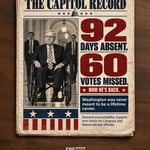
Washington, D.C., won't voluntarily give up its power.
The Constitution provides another path. An Article V convention offers the states a way to propose amendments that address federal spending, federal power, and term limits.
Your tax-deductible 501(c)(3) donation helps Convention of States Foundation educate Americans about this constitutional solution.
Donate today. Help put the Constitution to work.
secure.anedot.com/convention…

Convention of States retweeted
People who refuse to support an Article V convention because they fear a “runaway convention” — a mythological event with zero basis in history and zero basis in logic — might as well refuse to leave their homes in the morning because they fear a giant sinkhole could swallow them. This is not how patriots or people of faith make decisions.
The Convention of States Resolution has 3 subject matters:
- Impose fiscal restraints on the federal government
- Limit the power and jurisdiction of the federal government, and
- Limit the terms of office for its officials and Congress.
Our petition is different—it’s delivered directly to your state legislator. Sign here: conventionofstates.com/x-pet…

Harass Your Friends | The BattleCry xitter.cf/i/broadcasts/1RKZzBYAA…

83% of America's state legislative seats are on the ballot this year.
That's 6,139 state legislators who could help shape policies affecting your taxes, schools, public safety, property rights, and more. Before you head to the polls, take time to learn who's running for your state House and Senate and where they stand on the issues that matter most to you.
Read our latest blog: conventionofstates.com/news/…
Source: National Conference of State Legislatures (NCSL).

The people you elect locally can impact your taxes, schools, property rights, and freedoms. Learn why every line on your ballot deserves your attention. conventionofstates.com/news/…

Congress will never vote to end its own careers. That’s why the Convention of States Resolution includes term limits for ALL federal officials—including unelected bureaucrats. Along with fiscal restraints and limits on federal power, this is real reform. Sign the petition: conventionofstates.com/x-pet…
