

Join us March 3rd 2023 in the Great Hall of King’s College London to discuss the Future of Conflict. Get your tickets here: https://xitter.cf/t.co/kK7qhRTpnh
Strand Campus WC2R 2LS
Joined November 2013
- Tweets1.2K
- Following504
- Followers372
- Likes200


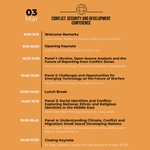







With that, our closing keynote has ended. Massive thanks to Dr. Rahman for his time and thoughts, and that's it for the 2023 edition of the conference!
"There are also other responses, e.g. regional and sub-regional level operations, as in Somalia, Mozambique, the Chad Basin, etc. There's been an expansion of the spectrum of UN responses and a recognition of where peacekeeping works and doesn't work."
"One of the things that we have learnt about peacekeeping is that it doesn't work where there is no peace to keep, e.g. DRC, CAR, and Mali, which are experiencing the most difficulty. Peacekeeping is not designed for that."
"The difference between peacekeeping and non-peacekeeping is the spectrum of operations. The Council continues to mandate new operations, insofar as it's not hamstrung by the veto."
"Many of the operations we see today have mandates for protection of civilians, capacity-building and election support. Rather than having military components, they do things that feel and look a bit peacekeeping-y."
"Whilst the UNSC hasn't mandated new operations since 2014, it has mandated other operations. There has been a gradual evolution in what we mean when we talk about peacekeeping."
On UN peacekeeping operations and the potential for new missions being mandated by the UNSC (the last one being in 2014): "There are three things I want to bring out here..."
Moving on to impunity: "At one level, there has been some difficulty in implementing mechanisms to prevent impunity, but that hasn't stopped IOs' efforts to create more mechanisms."
"I don't think China wants to tear the architecture down, it's just seeking a larger, more influential, and more powerful role within that structure. It's not fundamentally reforming the structure, just trying to change it to fit its ambitions."
"I think China has an approach to security and development cooperation that has different short-term characteristics, e.g. conditionality, but there's also the concern about how it's instrumentalising this debt."
"In so doing, there are a couple of areas of concern. What does this mean for the normative framework? I don't think we and China share the same view on how it's meant to operate."
On China's rise, briefly: "It's becoming more significant globally, in social, economic, and security affairs; it feels that it is more entitled to a greater voice on those issues than it currently has, and so is seeking to expand that."
"Visions for the UK's role in the Commonwealth need to centre more on what the Commonwealth wants out of it. The remarkable thing about it is that it continues to endure."
"Benefits lie outside of the political arena, e.g. the Commonwealth Lawyers' Association, which is important in helping to spread legal norms. Outside the realm of high politics, Commonwealth relationships remain vibrant."
"States still want to join the Commonwealth, which suggests there's still some value or attraction for states. The question is what that is today, and it's very different from what the value was at the time of its foundation."
On the Commonwealth: "There's a British tendency to think of it as an instrument for us, but it's potentially more profitable to think about what the Commonwealth can offer its states."
"[The declaration] also emerged at the end of the Cold War, where the politics around multilateral institutions were very different. I'm not sure we would have the same kind of success today."
We're thrilled to welcome our last speaker of the day, Dr. Babu Rahman to deliver the closing keynote! Moderating is Maggie Costello, co-chair of the conference.
Kelman: "Conflict, migration, and security aren't just buzzwords. People want to live safe and healthy lives, and we have the money to help them, but right now that money is going to fossil fuel companies."