
Version 2 of the Grasshopper Algorithmic Modelling plugin for Rhinoceros 3D.
Joined December 2021
- Tweets67
- Following0
- Followers1.3K
- Likes39






Just remembered after six years I'm supposed to have a blog... ieatbugsforbreakfast.com/202…

UI design can be difficult. I get it wrong all the time. But then a 120 billion dollar company like UPS puts this on my screen and you have to wonder what sort of world we live in.

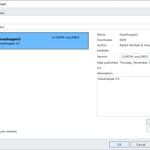
Welp, it took nearly half an age of Middle Earth but there's a new GH2 alpha out today. Some minor new features and fixes, but mostly I changed a lot of deep down code and have been dealing with a load of new bugs because of it.
Apologies for the prolonged silence everyone.
Automatic upgraders in action; panels, parameters, and interop components seem to work well together now (ignore the additional zeroes).
Panels can upgrade to different types depending on GH1 usage.


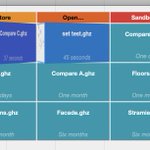
#grasshopper2 new release out later today. New features include file diffing, sandbox mode, automatic backups, autosave, and canvas tiles.
Be sure to set your user name in the App menu so that your hard work cannot be claimed by your lazier team members.


In what direction does a list go? Where is item 4 in relation to item 5 according to your intuition? All three options make sense to me on some level.
46%4 is to the left of 5.
7%4 is underneath 5.
44%4 is above 5.
4%.tfel-ot-thgir kniht I
57 votes • Final resultsMajor new feature in today's alpha release of #grasshopper2; Display Rules. Never mind the UI yet, that's not finished. But you can affect the preview display of shapes based on their meta-data using commands like 'show', 'hide', and 'tint'.


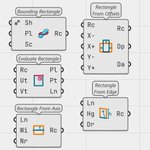
Coming up later today in #grasshopper2; more curve and surface tools, as well as more data and list manipulation components.


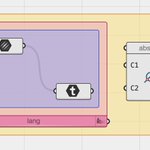
New #grasshopper2 out today. Biggest new features; pins and groups. Pins are used to override some basic contextual setting like tolerance or language rules and can be assigned to compatible components, or entire groups.


Mouse picks can be difficult. Especially if it involves area-like shapes and curve-like shapes, multiple drawing layers, and the possibility of objects being entirely occluded by other, (semi)transparent ones. Testing my picking code on a per-pixel basis today. So many bugs left.


Working on Groups and Pins for the past two weeks. Groups are both simpler and more complex than in #grasshopper1. No more exotic outline shape types, but they do support pins; which allow you to assign contextual values (such as tolerances or language rules).

Finally a new alpha of #grasshopper2 out today. Main focus for this release was on expressions, although I'm nowhere near done. Expressions attached to parameters should now work for all data types, and two dedicated components added to the Maths category.


New #grasshopper2 alpha out today. It contains the first iteration of a *.gh and *.ghx file converter. *very* early days, use with caution. This will not yet work on mac OS.

Working on expressions and giving them access to global values via Shouting objects. You can also listen in on global data using a Listener object, just like the Telepathy plugin.
This won't go out until the next alpha release of #grasshopper2.

Some improvements to the function editor. Cyclical function references no longer crash as they are no longer allowed. Scalar inputs for functions are now stacked left to right and limited to always be within the boundary of the editor.

Warnings and errors for the entire file are now easily accessible from the status-bar. Click on the counter to show a menu which allows you to navigate to each message.

Today's #grasshopper2 alpha adds another bi-arc component. This one creates a bi-arc with a tangent line segment between two arcs of fixed radius.

Some more geeky number theory stuff. Load the start of sequences by their OEIS identifier, and perform a bijection between the entire number line and a finite interval (or the best approximation thereof given the 64-bit floating point discrete number field).


Perpendicular and Tangential lines from curves to points are available in today's #grasshopper2 alpha.


Three nerdy ways to define line segments in today's #grasshopper2 alpha release. Implicit and explicit equations, as well as the Hesse Normal form.


