

Own your mindset, own your life. Coached 2000+ improve self-talk, communication & interpersonal intelligence. MD, Oxford & SingularityU
Enough = new rich
Joined April 2010
- Tweets1.8K
- Following2K
- Followers1.1K
- Likes331






Pinned Tweet
In 2016, I had a near-death experience that taught me the most powerful lesson of my life.
I fell asleep while driving on a New Zealand mountain. (hot tip - don't do it)
I rolled the car three times with my best friend in the passenger seat.
Everything that needed to go right for us to survive uninjured did.
Facing death, I realised I spent the past years in a high-status job I didn't want to be in.
I procrastinated and dreamt of leaving but did nothing except further climb the wrong career ladder.
I nailed the science of achievement but failed in the art of fulfilment.
Maybe you’re feeling this.
You're in a role or career that ticks the boxes, but inside you, something is missing.
Or perhaps you want to stay in your role but can't figure out how to adapt your emotional response to be less anxious and stressed and to thrive.
It's a pattern I see in many clients, particularly those from high-expectation families (often ethnic and first-generation immigrants). You were taught risk & failure were wrong, and you never developed a productive relationship with
experimentation and backing yourself off the traditional path.
Even worse, through all this, the bureaucracy of your job saps your life.
I didn't fully see it then. I was just a cog in a massive, uncaring machine.
Money. Credibility. A defined path.
What will I do next?
But my crash made something crystal clear:
When you die, you either did something or didn't do it.
There is no maybe.
No, I should have.
No, I could have.
You did it.
Or you didn't.
The end.
So, I chose to stop being an unhappy cog and build my own wheel.
Just after the accident, I resigned.
Since then - I've built the career I love.
I work on my schedule.
Remote first, wherever in the world I want.
With great clients, doing exciting work.
It's freeing, and I love it.
Many people come to me knowing they are climbing the wrong ladder and feel trapped.
One client, after a few sessions withdrew from her medical training program to forge a business career. She needed support processing her decision, managing her anxiety, and defining her next steps. She's now thriving.
For others, leaving isn't the answer.
I work with many clients on trigger management and changing emotional responses to their dysfunctional work environments.
Many people, especially doctors, value their work, though they dislike the system they work in.
But you can only control yourself and your response.
There is no point in waiting for the system to change.
Change you.
My programs help people in these situations.
I built them because it's what my younger self wanted but didn't have. And now I help those around me who know there is more but feel stuck.
If that's you, comment or DM me.
Own your mindset, own your life.
The only person holding you back is you.
My take on Jensen’s honeypot: China plays an impressive game. Two experiences that blew my mind
2018, I was working in AI in Silicon Valley, teaching software engineers how to use AI.
My co-founder (now employee 250 at Anthropic) and I got invited to meet Beijing Government officials.
And not officials representing the whole city. They governed one district in Beijing.
They had a single government mandate: train 10,000 AI engineers per year.
That was 2018.
They had come to the US to learn from the best, take the playbook back, and scale it.
Consider that foresight.
China now has the most AI researchers globally.
What was the Australian government doing with AI in 2018?
2016, My first trip to China.
My cousin lived there, speaks translator-level Chinese, and every time he opened his mouth, people treated him like a movie star.
The most impressive place was the Shanghai Urban Planning Museum.
I learnt that there has been a continuous master plan for Shanghai for almost 100 years.
The goal: build the world’s best city.
The city has KPIs. One of them: you should be able to get from any point in Shanghai to any other point within 60 minutes.
What infrastructure does that need? Build for that
Should the best city in the world have a designated amount of green space? Absolutely. Let's track and enforce that.
Shanghai was the most impressive city I've ever visited.
Whatever you think of the CCP, consistent leadership, absolute focus, and Chinese work ethic make them an execution machine.
They’re not debating what to do. They’re doing it.
Australia runs on three-year election cycles, flip-flopping, with political theatre that stalls nearly every major project.
When the US Congress can’t pass a budget, federal services shut down for a month.
Meanwhile, China just executes. Every. Single. Day.
The West overlooks the upsides of the Chinese system. Phenomenal. Ruthless. Highly impressive.
Earlier this year, news broke that the Mayor of Arcadia, California, a city of 50,000 people, was an alleged Chinese intelligence asset.
Yes, a town of 50,000 in the US.
If bum f**k nowhere in the US has been targeted, what do you think is happening at the top?
And now we have our answer.
The Honeypots infiltrated it.
Credit where credit is due.
China plays the long game, while the West reacts week to week.

10 years ago I fell asleep driving a car in the mountains, drove off the road and rolled the car
I woke up just as we were driving off the road entering the roll. Everything slowed down in time. It felt peaceful.
I remember clearly thinking “ let’s see what happens now” and there was an enormous disconnect between the reality of what was happening and my internal experience of it with time feeling elongated and everything almost in slow motion
My best friend and I survived uninjured
I’ve never had that experience of time any other occasion in my life

What do studies of near death experiences tell us about time perception? @RobertGreene explains on the Huberman Lab podcast out now.
Robert has a new out 11/10 (I’ve read it and it’s incredible); The Law of the Sublime.
100
Duolingo isn’t a language learning app
It’s an entertainment app
I’ve never met somewhere learn much useful from Duolingo
But its users love it
A very senior friend paid a lot to keep her 252 day streak after losing it
See it as entertainment - and it’s not gonna die

There's a game being played around you. Nobody disclosed the rules.
You operate on a straightforward assumption: do the work well enough, long enough, and recognition follows.
Outcomes matter. Results speak. Capability determines position.
That model holds early in your career. Then somewhere around mid-level the evidence stops supporting it.
People who are less capable end up in rooms you're not in.
Decisions get made by people who didn't earn the standing to make them.
The thing that was supposed to matter turns out to matter less than relationships, visibility, and knowing how to position yourself inside a system that was never actually neutral.
The frustration isn't that the game exists. It's that nobody disclosed it.
You trained for one kind of excellence and are being evaluated by a different standard entirely.
One you were never given the chance to opt into or reject.
What I do isn't teach people to play that game.
It's teach how to read it clearly enough to decide what you actually want to do with that information.

There's a version of burning out that doesn't look like burnout.
It doesn't look like collapse. It looks like someone going through the motions at a high level. Hitting every output, showing up to every meeting, technically performing.
But somewhere along the road something switched off. The standards that made them exceptional. The drive. The refusal to accept mediocrity. You don’t feel any of that anymore.
This is what sustained contact with a system that doesn't reward caring produces.
Not breakdown. Adaptation.
The adaptation is rational. You stop caring as much because caring kept costing you things and the system didn't notice.
You can feel yourself making accommodations you wouldn't have made three years ago. Accepting work that isn't your standard. Letting conversations end at "good enough" when you know it isn't. The gap between what you could do and what you're willing to do gets wider.
The people I work with are usually in the early stages of this. Still performing. Still capable. But aware something has shifted.
That feeling is important. It means the thing isn't gone yet.
The question is what you do with that awareness before the adaptation becomes permanent.

At some point your expertise stops being your edge and starts being your constraint.
Being the most knowledgeable person in the room is an advantage until it isn't. In technical domains, depth wins. In organisational ones, depth can make you the bottleneck. The person who has to be consulted, whose approval everything waits on, whose standards nothing can meet.
The shift from expert to leader requires something most high-performers find genuinely uncomfortable: putting the expertise down. Not abandoning it. Knowing when it's useful and when leading with it is costing you the room.
You stop being the person who knows everything and become the person who knows what needs to be known. You stop being the person who can do it best and become the person who gets it done through others.
The people who make this transition well aren't the ones who stopped caring about being right. They're the ones who learned that being right is one tool, not the whole kit.
Nobody teaches this explicitly. The assumption is that if you were good enough to get here, you'll figure it out. Some do. A lot don't.
When you recognise that your knowledge is becoming your limitation, you've identified the next level of your development.

One of turning points in a higher performer’s life is when you finally realise the people above you aren't smarter.
They just got there first.
There's a specific moment you experience often in your thirties.
You sit across from someone senior, someone you spent years trying to reach the level of, and realise the gap isn't what you thought it was. The person isn't more capable. They just arrived first.
That realisation lands differently depending on the person. For some it's fuel. If the ceiling is that low, I can move through it. For others it's destabilising. If it's not a meritocracy, what have I been optimising for.
The ones who get stuck are the ones who can't get past the unfairness of it. The ones who move treat it as information. The game has different rules than the ones they were taught. Adjust.
I had this moment. My clients have it too.
The conversation after that moment is usually the most useful one I have with them.
When you stop optimising for fairness and start operating within the actual system, your trajectory changes overnight.

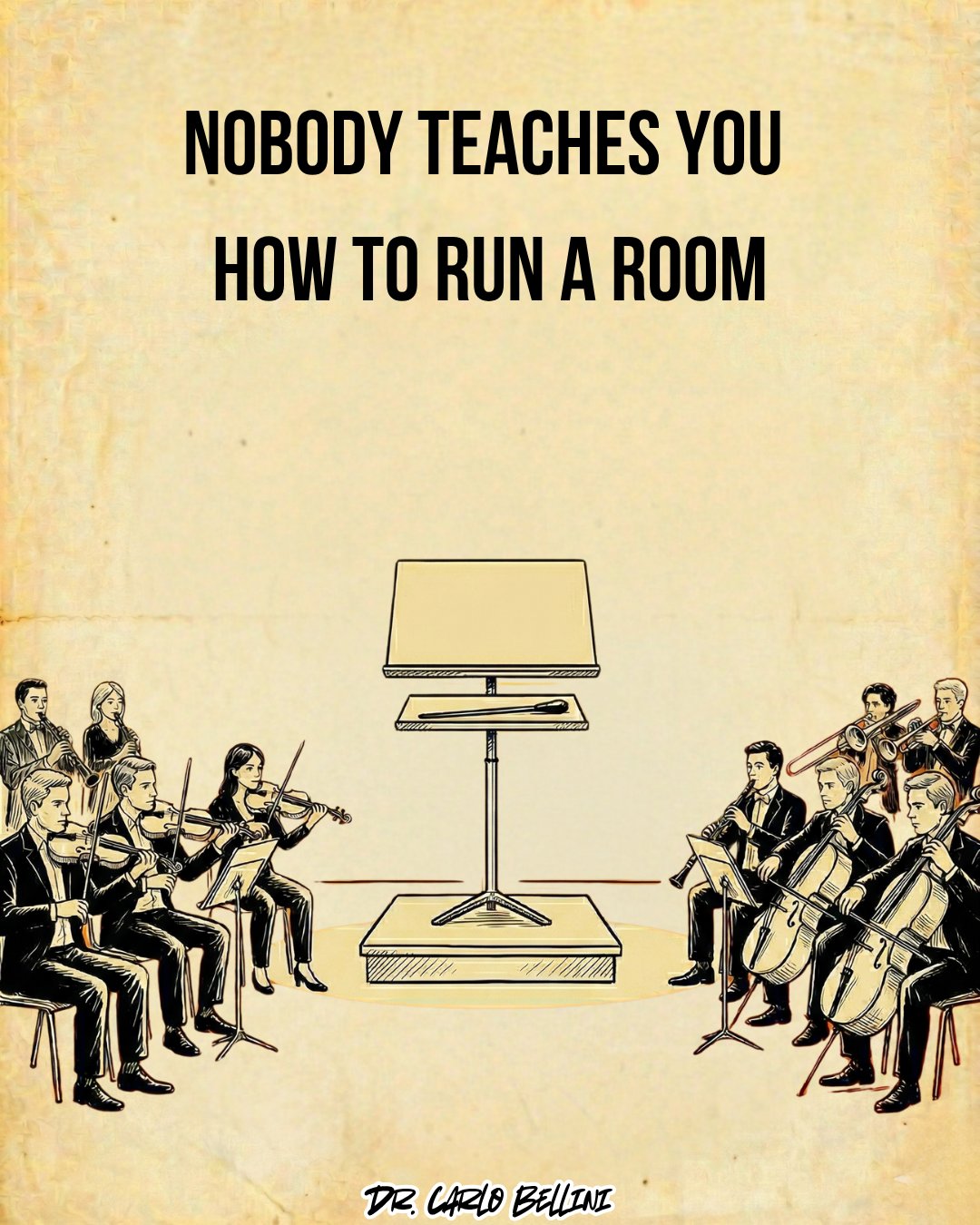
Nobody teaches you how to run a room once you become the most senior person in it.
You spent years perfecting the work. Mastering the technical skills. Building credibility through competence. Then promotion arrives and the game changes completely. You're no longer judged on what you produce. You're judged on what the room produces when you're in it.
The transition is invisible until it isn't. One morning you walk into a meeting and realise everyone is waiting for you to set the tone. Manage the undercurrents. Decide what gets said and what stays buried. The political weight of the room now rests on your shoulders.
You were trained to solve clinical problems. Nobody trained you to read the micro-expressions around a boardroom table. To know when silence means agreement versus when it means mutiny. To recognise the difference between productive tension and destructive friction.
The ones who figure this out quickly usually had someone who showed them. Not through formal training. Through observation. A mentor who'd navigated these waters and was willing to share what it actually required.
Most don't get that guidance. They learn by failing in rooms full of people who were watching them fail.
You are not burning out. You have an avoidance problem.
The word "burnout" has become a catch-all that obscures what is actually happening to you.
It places the problem inside your body. Your resilience. Your capacity.
As if the solution is more sleep, a meditation app, and a long weekend.
Look closer at what is actually draining you.
You have accountability without authority.
You are responsible for outcomes you cannot control.
You sit in meetings where decisions are made by people who have never done the work you do.
You are surrounded by colleagues who propagate broken systems and call it stability.
The exhaustion is not from working hard. It is from working hard inside a system that punishes the people trying to fix it.
You push. The system absorbs it. Nothing changes. You push again. Same result.
And slowly, your energy is not spent on the work. It is spent on the friction.
Reframing burnout as an avoidance problem changes what you do about it.
You stop trying to recover.
You start trying to reposition.
You stop asking "how do I get my energy back?" and start asking "how do I get my authority back?"
That is a different question entirely. And it leads somewhere.

You already know what needs to change. The question is whether you will do it this year or waste another one.
You have spent years accumulating knowledge, credentials, and experience.
You know more than most people in your field.
You can diagnose problems others cannot see.
You understand the politics, the dysfunction, the invisible trade-offs that your colleagues accept as normal.
And still, something is not moving.
You have the intelligence. You have the track record. You have the talent.
Everything around you says you should be further ahead than you are. And you know it.
You feel it every time you watch someone with half your ability operate with twice your confidence.
The thing that is missing is permission.
Permission to want more than the career path that was laid out for you.
Permission to challenge the system you were trained to serve.
Permission to build a life that matches your capability rather than your conditioning.
That permission will never come from the outside.
Not from your organisation. Not from your mentor. Not from your family.
It comes from a single decision.
This year will be different.

Nobody told you that growth at this level requires grief.
You built your identity on being the smartest person in the room. The most reliable. The one with the answers.
Every promotion you earned reinforced it. Every problem you solved confirmed it. That identity kept you safe for years.
Now your role requires something completely different. Let other people have the answers.
Sit with ambiguity. Make decisions with incomplete information. Trust someone else to deliver the thing you know you could do better yourself.
That transition is an identity crisis.
You are not struggling because you lack leadership training. You are struggling because the person you built over 15 or 20 years is being asked to step aside.
And that person does not go quietly. They show up every time you redo a colleague's work.
Every time you answer a question that was not directed at you.
Every time you stay late doing the thing your team was hired to do.
Nobody prepares you for this.
Nobody tells you that growth at this level requires grief. That becoming the leader you are capable of being means releasing the identity that got you here.
The best leaders walked through that grief. Stop avoiding it.

A patient fell outside my hospital. It changed the trajectory of my career.
She came in for a cardiac procedure. When it was time to leave, there were no wheelchairs available.
So she walked. She fell. Brain bleed.
I questioned everything.
Had I examined her thoroughly enough?
Had I missed something?
Could I have intervened earlier?
The answers did not matter. The doubt had already taken root.
And it did not stay in the hospital.
It followed me home.
It sat at the dinner table.
It drained my energy.
It dulled my ambition.
It quietly rewired how I showed up in every relationship, every conversation, every decision.
That is the thing most clinicians never articulate.
The emotional weight of clinical responsibility does not clock out when you do.
You carry it into your evenings, your weekends, your sleep.
You absorb it so gradually that you do not notice the accumulation until something fundamental has shifted inside you.
If you do not learn to process that weight, it does not disappear. It transforms. It becomes numbness. Detachment. A slow, invisible slide into apathy disguised as professionalism.
I know because I felt it happening. And I almost let it.

You were not trained to perform under pressure. You were trained to avoid it.
Every system you grew up in taught you the same thing.
Minimise risk.
Follow the path.
Do not deviate.
Your family taught you that safety was the priority.
Your education taught you that the right answer was more important than the right question.
Your profession taught you that following protocol was more valuable than challenging it.
And now you are in a role where the single most important skill is performing when the stakes are highest.
Making decisions with incomplete information.
Holding your ground when the room is pushing back.
Staying clear when your nervous system is telling you to retreat.
You were never given that training. Not in medical school. Not in your MBA. Not in any leadership programme you have attended.
Every institution you passed through optimised you for compliance. For safety. For staying inside the lines.
The result is a career full of moments where you knew exactly what to do and could not bring yourself to do it.
Moments where you played it safe and spent the next week wishing you had not.
It’s time to break the programming.

The thing that made you successful is now the thing holding you back.
You were promoted because you were the best.
The best clinician. The best lawyer. The best analyst.
You outperformed everyone around you.
Your technical excellence was undeniable.
So they gave you the title, the team, and the responsibility.
Now you are leading people who do the thing you used to do. And you cannot stop doing it for them.
You review their work and redo it. You sit in meetings thinking you would have done it faster. You carry the weight of every deliverable because letting go feels like lowering the standard.
Your technical excellence became your identity. It is the thing you are most proud of. The thing that earned you respect. The thing that made you feel valuable. Letting go of it feels like losing who you are.
It is not. It is becoming who you need to be.
The transition from individual contributor to leader requires you to grieve the old version of yourself.
The version that had all the answers. The version that was the best in the room. Nobody tells you that. Nobody prepares you for how disorienting it feels.
But the grief is the process.

Someone told me recently: "When I die, I want to come back as you."
I understand why they said it.
The adventures. The freedom to wake up on a Tuesday and know that the day belongs to me. The Porsches. The travel. The people I get to work with. A career that looks like it was designed on purpose.
It was. Every piece of it.
And that is the part most successful professionals miss. You have the money. You have the credentials. You have the network. Everything you need to build an extraordinary life is already available to you.
What you do not have is your own permission.
You are still running the programme your parents installed. The one that says comfort is earned through sacrifice. That wanting more is ungrateful. That stability is the highest form of success.
So you build a life that looks impressive on paper and feels quietly incomplete on the inside. You tell yourself you will get to the adventures later.
After the next milestone. After the kids are older. After you feel ready.
The life you want is available to you right now. The only cost is the discomfort of choosing it.

Used chatgpt yesterday after using Claude for recent months
It was like going back to your ex that was amazing at the start and infinitely disappointing at the end
1
85
I spend more time preparing for a workshop than delivering it. Most facilitators do the opposite.
Before I walk into any room, I have already spoken one-on-one with every executive who will be in it.
A detailed questionnaire. A personal conversation.
I know their frustrations. Their political tensions. Their unspoken objections. The narrative they will try to control before it even begins.
By the time I stand in front of the group, there are no surprises. I already know who will resist and why. I already know which topic will trigger defensiveness.
I already know who needs to feel heard before they will listen to anyone else.
That is the difference between facilitating and orchestrating.
A facilitator walks into a room and reacts.
An orchestrator walks into a room and conducts.
Every question is placed deliberately.
Every exercise is sequenced to surface what needs to surface, in the right order, with the right people in the right emotional state.
Most people skip the pre-work. They trust their ability to read the room in real time. And then they wonder why their workshops produce polite nodding and zero follow-through.
The room was decided before you entered it. Prepare accordingly.

Within 60 seconds of hearing you speak, I know exactly what you are doing wrong.
That sounds arrogant. It is not.
It is pattern recognition built from thousands of hours of coaching high performers through interviews, presentations, and negotiations.
The first thing you hear is energy.
Doubtful energy leaks through every sentence.
You can hear it in the pacing. In the qualifiers. In the way someone softens their achievements before they have finished stating them.
You can hear when someone does not fully believe they deserve what they are going for.
No amount of scripted answers fixes that.
You can rehearse the perfect response to every question and still walk into the room radiating uncertainty. The interviewer feels it before they process a single word.
One client came to me preparing for a senior role. Talented. Qualified.
Completely undermining herself every time she opened her mouth. We worked on the operating system underneath the words. The relationship with her own worth. The permission to take up space.
Same person. Same skills. Same CV. She landed the role with a $180K raise.
The words changed because the energy changed first.

I ran an AI session for a group of doctors recently.
Their reaction told me everything about the opportunity ahead.
These are smart, successful professionals. Top of their field. Years of postgraduate training.
And most of them had barely scratched the surface of what AI tools can do for their workflow.
The gap is exposure. These are people with the intelligence to master anything you put in front of them. They simply have not been shown what is available.
One session. A few tools. A structured walkthrough of how AI applies to their specific work. The word I kept hearing was "mind-blowing."
AI is a performance multiplier. If you are already operating at a high level, it makes you exceptional. It compresses hours into minutes. It gives you a research partner that never sleeps.
It turns a good presentation into something that commands a room.
The question worth asking is not whether AI will change your field. That is already happening.
The question is whether you will be the one using it or the one watching someone else pull ahead because they started earlier.
The window is open. It will not stay open forever.
More here: aifordoctors.com.au/
You already know what to do.
You have known for a while. And yet, when the moment arrives, you freeze.
The board meeting where you needed to speak up.
The negotiation where you needed to hold your ground.
The conversation you rehearsed a hundred times that disappeared the second the pressure was real.
This is not a character flaw. It is biology.
Your nervous system does not distinguish between a boardroom confrontation and a physical threat.
When the stakes rise, your prefrontal cortex goes quiet and your survival brain takes over. You default to whatever response kept you safe as a child. Compliance. Avoidance. Over-preparation as a form of control.
The professionals who perform under pressure have not eliminated that response. They have trained a different one. They have spent time in environments where the consequences are immediate, the feedback is real, and the gap between thinking and doing collapses to zero.
That training does not happen in a classroom. It does not happen in a textbook. It happens in moments that demand something of your body, your emotions, and your decision-making at the same time.
You already have the knowledge. The operating system needs the upgrade.
