

Oil & Natural Gas Trader
Joined September 2017
- Tweets8.7K
- Following15
- Followers23K
- Likes1.9K
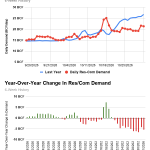


Failure to launch: After a brief spike in mid-October, #natgas res/com heating demand has stalled out as temperatures remain unseasonably mild across much of the Lower 48. Demand is consistently trailing year-ago levels by at least -5 BCF/d. Don’t look for this to meaningfully improve for another week or so and, even then, will remain marginal.

European #natgas inventories registered a new season-high drawdown yesterday at -5 BCF/d (5-yr avg: +3 BCF/d) as chilly temperatures dominate the continent. As a result, storage dropped below 2021 levels and is back at 5-yr lows.


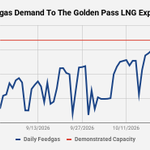
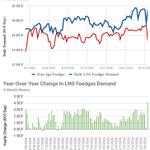
LNG feedgas demand rose to a new high of 0.84 BCF/d yesterday as the plant is finally beginning to ramp up again. It wasn’t quite enough to send nationwide export demand to a new all-time high but volumes continue to hover just shy of new records in the 19.0-19.5 BCF/d. #Natgas

European #natgas inventories registered their largest daily storage withdrawal of the Fall yesterday at -3 BCF/d. With colder-than-normal temperatures expected across much of the continent for the next 1-2 weeks, it is increasingly likely that inventories have peaked for the season. European storage would enter the withdrawal season at an impressive -576 BCF deficit vs the 5-yr avg & right at 5-year lows.

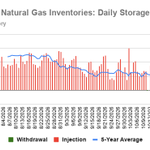
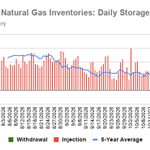
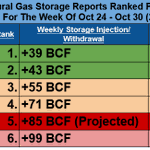
For the EIA #Natgas Storage Week of October 24-30 that ends today, I am projecting a preliminary +85 BCF injection, 24 BCF bearish vs the 5-yr avg & 46 BCF larger than last year. It would be the 2ndlargest build for the week in the last 5 yrs, below only 2022’s +99 BCF. The EIA will release official numbers next Thursday, November 5.

Earlier this morning, I project that realtime #natgas inventories topped 3800 BCF. This was 12 days later than last year (October 18) but 15 days earlier than the 5-yr avg (November 14, the seasonal maximum). Based on current projections, it is increasingly likely that inventories top 3900 BCF over the next 10 days before the heating season begins.

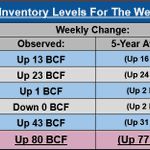
Today’s +80 BCF EIA #natgas injection is undoubtedly a disappointment, especially since it featured the season’s first meaningful cold snap as well as a ramp up in LNG exports to record highs. The biggest underperformance came from the South Central Region at +43 BCF, highlighting the impact of dwindling cooling demand across the Region.

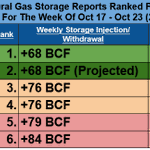
For today’s EIA #Natgas Storage Report for October 17-23, I’m projecting a +68 BCF injection, a slight 9 BCF bullish vs the 5-yr avg & tied with 2022 for the single smallest injection for the week in the last 5 yrs.

With yesterday’s +4.1 BCF daily #natgas storage injection, European inventories climbed to 2909 BCF and, for the first time in about 2 months, are no longer at a 5-year low (2021 at 2908 BCF). This is rather academic however, since storage remains at a massive -567 BCF deficit vs the 5-yr avg heading into the withdrawal season.

LNG feedgas demand was revised lower in yesterday’s late-cycle pipeline data by nearly 2 BCF/d due to—you guessed it—a nearly complete zeroing out of volumes at Freeport. This dropped total flows to just 17.7 BCF/d. Per today’s early-cycle data, Freeport will normalize, driving total volumes back to 19.5 BCF/d, within 0.2 BCF/day of record highs & up a steep +4.2 BCF/d vs 2025 due to a decline this time last year. This all said, don’t be surprised to see another downward revision tonight if Freeport can’t get its act together. #Natgas


The 14-day temperature outlook is still not a friend of #natgas bulls with markedly below-average Gas-Weighted Degree Days (GWDDs) into the first week of November. Much of the 10-day outlook is likely priced in by this point with gas prices at multi-month lows. By November 7 or 8, there is some early indications that temperature-driven demand could improve and the evolution of this outlook will likely dictate price movement this week.

While domestic #natgas inventories probably have another 2-3 weeks of injections to go, European daily injections have dwindled and storage levels appear to be peaking for the season, right on schedule. At 2898 BCF, inventories are at a -574 BCF deficit vs the 5-yr avg & essentially tied with 2021 for the 5-yr minimum.

I calculate that #natgas production reached a one-month high of 109.7 BCF/d yesterday, now nearly 3 BCF/d above early October lows. However, due to an even sharper recovery this time last year, the year-over-year gain in production has actually narrowed.

Within the past hour, projected realtime #natgas inventories have topped 3700 BCF. This is two days earlier than the 5-yr avg (October 25) but a full 14 days later than last year (October 9). Storage has another 140 BCF or so to inject before the heating season kicks off in about 3 weeks.

For today’s EIA #Natgas Storage Report covering October 10-16, I’m projecting a +80 BCF injection, a slight 7 BCF bullish vs the 5-yr avg & the second smallest injection for the week in the last 5 yrs, just above 2024’s +78 BCF 5-year minimum.

#Natgas prices are now at their second lowest for the date in the last 5 years and down over -20% from this time last year—despite a -150 BCF year-over-year storage deficit. Investors remain all-in on a record warm El Nino-fueled winter to justify this divergence.

This is not what you want to see as a #natgas bull. As 14-day accumulated Gas-Weighted Degree Days (GWDDs) are expected to start ramping up as we approach the start of the withdrawal season in less than 3 weeks, the current GFS and ECWF forecasts have both trended lower over the past two days. It’s not surprising to see some selling pressure here.

Per today’s early-cycle pipeline data, LNG feedgas volumes to the new Golden Pass facility will top 0.8 BCF/day for the first time. This hasn’t been enough to bolster #natgas prices, however, due to a weak near-term temperature outlook & rebounding production.

While record weekend LNG exports are a bullish catalyst, the near-term temperature outlook—which becomes increasingly important as we approach the end of the Shoulder Season—is underwhelming. For October 19-November 1, I’m forecasting 125 accumulated GWDDs, -33.6 GWDDs fewer than the 5-yr avg & the 2nd fewest for the period in the last 5 yrs. Based on this data, I wouldn’t be surprised to see a small gap down for #natgas prices this evening.


The new Golden Pass LNG export facility has hit consecutive new highs this weekend: 0.69 BCF/d yesterday and then 0.714 BCF/d today per early-cycle data. This has helped to drive nationwide LNG feedgas demand to a new record high of 20.1 BCF/d today. #Natgas
