
Assistant Professor in Child and Youth Studies at Brock University, focused on Critical Disability Studies.
- Tweets1K
- Following508
- Followers330
- Likes617




ALT "We Move Together: Enacting Social Justice through Storytelling" Sepakers: Dr. Anne McGuire and Dr. Kelly Fritsch, When: March 17, 2023 3:30-5:00 pm EST, Where: Zoom. Reading and discussion with creators of "We Move Together" Register on Eventbrite: wemovetogetherbrock.eventbrite.ca ASL interpretation provided


ALT A person is smiling while sitting outside. A graphic of a microphone is accompanied by the text 'Podagogies A Learning & Teaching Podcast' with the title that reads 'Imagining Better Learning Spaces with Dr. Terri Peters'.


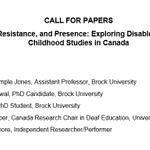
ALT Call for papers: Deadline Extended - Activism, Resistance, and Presence: Exploring Disabled Children's Childhood Studies in Canada

ALT This call invites: writing by and for children, sign language submissions, original artwork, images, animations, short films, and other multimedia welcome! This special issue of Studies in Social Justice aims to highlight crucial developments in disabled and Deaf children's justice-seeking experiences in the northern part of Turtle Island known as Canada by asking: How does disabled children's activism, resistance, and presence contribute to social justice movements? Deadline for abstract/submissions: Feb. 2, 2022 [Brock University Logo, QR code]

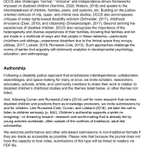
ALT Authorship Following a disability justice approach that emphasizes interdependence, collaboration, assemblages, and space-making for many at once, we invite scholars, researchers, advocates, activists, artists, and community members to share their work in relation to disabled children’s childhood studies and the themes listed below, or other themes not listed. And, following Curran and Runswick-Cole's (2014) call for more research that centres disabled children and positions them as knowledge producers, we invite submissions by and for children. Like Runswick-Cole, Curran, and Liddiard (2018), we take the call to listen to children seriously (p. 644). Children’s authorship supports a wider re-imagining—or dreaming toward—research and world-making that is already led by young activists worldwide, often outside of the confines of traditional, adult-led scholarship. We welcome performance and other arts-based submissions in non-traditional formats if they are made as accessible as possi

ALT Themes Broadly, this special issue seeks submissions including but not limited to the following themes: • intersections of disability and critiques of disability/childhood innocence • BIPOC experiences of disability and childhood, including from the interdisciplinary field of Black girlhood studies (and others) • indigenous perspectives and experiences at the intersection of disability and childhood • madness and/or psychiatrization in childhood • deaf experiences of childhood/growing up • childhood in the context of “crip times” (or in relation to crip theory) (McRuer, 2006; 2018) • cripping education (including cripping sex education, special education, early years education, etc.) • gender, sexuality, compulsory ablebodiness and childhood • disabled children’s climate activism • critical responses to government and education policy related to disabled children • children’s experiences of disability, rurality, or remote living • parenting and making family/kin (including queer pa

ALT Formats • articles (5,000 words max, inclusive of references) • dispatches and/or creative interventions (2,500 words max): o commentaries or creative writing o multimedia submissions (animations, short films, etc.) o Sign Language submissions (including ASL, LSQ and Indigenous sign languages) o performance submissions (i.e., music, dance, and other forms in accessible format) o interviews and other dialogues o images (photographs, illustrations, drawings, etc.) o digital stories and multi-media content (made accessible) Submission guidelines All submissions must be anonymous. Please do not include any identifying markers on your submission. All submissions should engage concretely with the field of social justice. Please submit article submissions to: [email protected] Prospective timeline Submissions due: December 3, 2021 Notification of decision to send the manuscript for peer review: January 10, 2022 Response from reviewers: April 22, 2022 Revisions due: June 24

ALT CALL FOR PAPERS Activism, Resistance, and Presence: Exploring Disabled Children’s Childhood Studies in Canada Editors Dr. Chelsea Temple Jones, Assistant Professor, Brock University Abneet Kaur Atwal, PhD Candidate, Brock University Monte Hardy, PhD Student, Brock University Dr. Joanne Weber, Canada Research Chair in Deaf Education, University of Alberta Dr. Helen Pridmore, Independent Researcher/Performer

ALT Aim of Special Issue This special issue of Studies in Social Justice aims to highlight crucial developments on disabled and Deaf children’s justice-seeking experiences in the northern part of Turtle Island known as Canada by asking: How does disabled children’s activism, resistance, and presence contribute to social justice movements? We use the phrase “disabled children” to encompass a myriad of bodymind differences that are not restricted to age or developmental status, including mad, Deaf, neurodiverse, sick, and spoonie people of many stages/ages whose fluid experiences of childhood are complex, intersectional, and evolving. Following Tillie Curran and Katherine Runswick-Cole's (2014) inaugural work on disabled children’s childhood studies, this special issue spotlights transdisciplinary works that: • highlight new understandings of disabled children’s childhoods including their activism, resistance and presence in social justice movements that resist ableist, colonial ontologies

ALT Authorship Following a disability justice approach that emphasizes interdependence, collaboration, assemblages, and space-making for many at once, we invite scholars, researchers, advocates, activists, artists, and community members to share their work in relation to disabled children’s childhood studies and the themes listed below, or other themes not listed. And, following Curran and Runswick-Cole's (2014) call for more research that centres disabled children and positions them as knowledge producers, we invite submissions by and for children. Like Runswick-Cole, Curran, and Liddiard (2018), we take the call to listen to children seriously (p. 644). Children’s authorship supports a wider re-imagining—or dreaming toward—research and world-making that is already led by young activists worldwide, often outside of the confines of traditional, adult-led scholarship. We welcome performance and other arts-based submissions in non-traditional formats if they are made as accessible as possi


ALT A black and white illustration of a person’s head, heavily shadowed, is in the bottom right corner, composed of many horizontal lines. The image is credited as “The Illustrated Dune by John Schoenherr 1964”. Text reads, “Dreaming Accessibility Futures. A Card Game. bit.ly/DreamingFutures. October 25th. 5-6:30 pm EDT. With funding support from Social Justice Week.” There is a live caption symbol and an ASL symbol on the bottom left. In the top left corner, there is the logo for the School of Disability Studies, Faculty of Community Services. The Ryerson University logo is upside down with a red X across it.





ALT Image 1 has the logo for the School of Disability Studies. Ryerson University is upside down with a red X overtop. Text underneath says: Black Deaf History in Canada. August 31st. 6-8pm EDT. https://bit.ly/BlackDeafHistory There is an illustration of a black hand signing ‘B’, and a yellow B extends from this hand. Cyan, red, and green lines are underneath. There are ASL and CC icons in the bottom right corner.

ALT Image 2 has a photo of a black woman looking at the camera smiling. Her black hair is in tight curls and pulled back into a ponytail. She is wearing a light pink top and brown glasses. The text underneath says Dr. Jenelle Rouse with Nur Abdulle, Abigail Danquah, Amelia Palmer, and Amy Parsons.


