

Timely updates info on advanced technology and scientific progress in China. Run by @PDChina, the largest newspaper group in China
Beijing, China
Joined August 2019
- Tweets16.5K
- Following10
- Followers2M
- Likes3




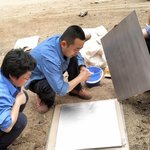

Established in 2003, the cultural relics protection center in Jingzhou, central China's Hubei Province, undertakes the conservation of about 80 percent of China's waterlogged bamboo and wooden slips. The center has developed comprehensive conservation techniques for such slips, covering sectors from archaeological excavation and laboratory conservation to display and storage.
To date, the center has provided technical support in cultural relic conservation to more than 130 cultural and museum institutions across the country, and has restored more than 10,000 lacquered wooden artifacts, over 180,000 bamboo and wooden slips, and more than 1,100 textile artifacts.


Chinese researchers have discovered a new flower species, Primula panzhouensis, in southwest China's Guizhou. Assessed as Critically Endangered, this new species is currently known only from the type locality on Jichangping in Panzhou County and is mostly found on damp cliffs of karst formations at altitudes of 1,700–1,800 meters.


CIIE: A vital window into China's continued opening up
The ninth China International Import Expo (CIIE) will be held at the National Exhibition and Convention Center (Shanghai) from Nov. 5 to 10.
As the world's first national-level trade fair focused exclusively on imports, the CIIE has attracted exhibitors and delegates from more than 180 countries and regions across its inaugural eight editions. Overseas exhibitors have made about 27,000 appearances at its business exhibitions, generating cumulative transaction intentions exceeding $580 billion.
Beyond showcasing innovations, the expo has successfully catalyzed the commercialization of exhibited technologies and facilitated the transition of exhibitors into long-term investors. It has thus emerged as a critical gateway for multinational enterprises seeking to establish enduring operations in China.
Held consistently each year and steadily expanding in scale and influence, the CIIE has evolved into a vital platform through which China deepens its engagement with global markets, fosters industrial upgrading, and delivers tangible economic benefits to consumers.
This year, veteran CIIE participants will unveil a series of new products, technologies, and solutions, showcasing their latest innovations.
Read Full: en.people.cn/n3/2026/1012/c9…


Since 2014, the China-Fiji Juncao Technology Demonstration Center has carried out three phases of technical assistance projects. To date, it has organized 67 training sessions, trained more than 2,900 local technicians, promoted Juncao cultivation on over 2,500 hectares of land, and helped more than 3,500 households achieve sustained income growth.
The Juncao technology was developed in China and introduced to Fiji more than a decade ago. Originally designed as a substrate for cultivating edible mushrooms, Juncao has since become a tool for restoring degraded land, supporting livestock farming and creating new sources of income for rural communities.


BeiDou Navigation Satellite System drives economic growth and social development
From satellite constellations in space to ground-based terminals, and from transport and emergency response to smart cities, agricultural production, and maritime navigation, China's BeiDou Navigation Satellite System (BDS) has steadily expanded its global footprint in recent years. By strengthening industrial support capabilities and deepening its international reach, the system is providing new momentum for economic and social progress worldwide.
Looking ahead to the 15th Five-Year Plan period (2026-2030), China will coordinate the deployment of space-based and ground-based navigation augmentation resources, and promote the integration of the BDS with low-Earth-orbit navigation augmentation systems, 5G and 6G, inertial navigation, LiDAR, vision-based technologies, and other sources of positioning and timing information.
The goal is to build a multi-level, three-dimensional integrated positioning and navigation system, extending seamless positioning and timing services from outdoors to indoors and from the deep sea to deep space.
Read full: en.people.cn/n3/2026/1020/c9…


Women helped build China's 2,200-year-old Terracotta Warriors, according to a new study of fingerprints preserved in the clay warriors - the first quantitative biological evidence challenging the long-standing assumption that the standardized, large-scale production of the life-size clay figures was exclusively men's work.
Researchers from the Emperor Qinshihuang's Mausoleum Site Museum and Shandong University examined 79 distinct fingerprints on 23 terracotta figures. Using a Bayesian mixture model - a statistical method that estimates the overall makeup of a group from imperfect individual clues rather than identifying any single person - they concluded that about 45% of the prints likely came from adult men, 32.7% from adult women, while 22.3% from people under age 15.


China launched a Long March-8A carrier rocket from the southern island province of Hainan on Sunday, sending a batch of internet satellites into space.

China launched a Long March-8A carrier rocket from the southern island province of Hainan on Sunday, sending a batch of internet satellites into space.
The rocket lifted off at 10:03 a.m. (Beijing Time) from the Hainan commercial spacecraft launch site. The payloads, the 28th group of low-orbit internet satellites, entered the designated orbit.
Grassland city in N China's Inner Mongolia transforms into an AI computing hub
How long does it take to travel from Ulanqab in north China's Inner Mongolia Autonomous Region to Beijing? By high-speed rail, roughly 100 minutes. Yet data traverses the same distance -- more than 240 kilometers -- in just 2.1 milliseconds via high-capacity fiber-optic cables.
Harnessing its abundant wind resources and cool climate, Ulanqab is rapidly emerging as a major computing hub. As of the end of August, the city had secured agreements for 109 computing projects, covering more than 7 million standard server racks, with 190,000 petaflops of computing capacity already in operation.
Read full: en.people.cn/n3/2026/1022/c9…


China on Friday successfully sent the Yaogan-50 03 satellite into its planned orbit via a modified Long March-6 carrier rocket from the Taiyuan Satellite Launch Center in north China's Shanxi Province.

Shaanxi universities put their research to work for local industry
In northwest China's Shaanxi Province, university researchers are being placed inside companies as part-time tech deputies as a way to move lab work onto the factory floor. Their projects range from improving strawberry yields to breaking bottlenecks in advanced materials manufacturing.
The arrangement rests on a policy introduced in July 2025 that lets companies recruit university and research institute experts part-time. Companies gain expertise they couldn't otherwise access while the researchers keep their academic positions.
The arrangement addresses a longstanding gap: researchers often struggle to turn laboratory findings into commercial products, while companies lack the expertise to overcome technical obstacles.
It is already delivering practical results across the province.
Read Full: en.people.cn/n3/2026/1010/c9…


China advances coordinated development of intelligent computing, advanced storage capacity
Driven by rapid advancements in artificial intelligence (AI), computing power has evolved into indispensable new digital infrastructure. It enables a wide range of real-world applications: AI systems can now estimate caloric content from a simple photograph; massive traffic datasets are processed in real time to optimize urban mobility; production workflows are dynamically scheduled to enhance factory efficiency; and highly realistic visuals are generated for creative media production.
According to China's Ministry of Industry and Information Technology, national intelligent computing capacity reached 2,185 exaflops (EFLOPS) by the end of June 2026. To support this expansion, over 70 major computing corridors have been established, linking key national data hubs across the country.
In August 2026, China unveiled its development blueprint for the information and communications sector covering the 15th Five-Year Plan period (2026-2030). The plan sets ambitious targets: by 2030, intelligent computing capacity is expected to reach 9,800 EFLOPS, and advanced storage capacity to hit 1,700 exabytes (EB) -- representing increases of more than fivefold and twofold, respectively, compared to 2025 baselines.
But what exactly is the relationship between computing power and storage? And what do these rapid expansion goals signify? To answer these questions, People's Daily consulted leading experts in the field.
Read Full: en.people.cn/n3/2026/1010/c9…


Look inside a Chinese automaker's workshop in Fuzhou, east China's Jiangxi Province, where industrial robots and automated guided vehicles work seamlessly together.
Stamping, welding, painting and final assembly processes run efficiently under full-process digital control here.


The future is here | Check out how AI is rewriting the classroom in China
In classrooms across China, AI is no longer a concept. It's is part of everyday teaching.
Blackboards that understand handwriting, experiments that unfold in 3D, and real-time language feedback are becoming part of daily teaching.
iFLYTEK's AI education solutions are helping teachers teach better and students learn more deeply. One step at a time, AI is making quality education more accessible and more engaging for the next generation.
China's robots move from stage to shop floor
At a plant run by China Construction Steel Structure Corp. Ltd., a subsidiary of construction giant CSCEC, robots now handle high-altitude welding, rust removal and heavy material transport. Thanks to this, workers have shifted to overseeing equipment, monitoring automated systems and checking quality.
In the Tengger Desert, a wheel-legged robot made by Deep Robotics, a maker of quadruped and humanoid robots and core components, helps with sand control — its rugged casing keeping wind-blown grit out of its joints.
Scenes like these are becoming common across China's industries, as robots with more flexible limbs and stronger interactive abilities move out of controlled environments and into the field.
China became a net exporter of industrial robots in 2025, customs data shows, with exports surpassing imports for the first time — a milestone for a sector that has expanded rapidly in recent years.
Read Full: en.people.cn/n3/2026/1009/c9…


China rolls out "token factories" to drive AI economy
As AI applications gain momentum, China is accelerating the rollout of "token factories" in a bid to build an economic order suited to the AI era.
Every time a user prompts an AI model to generate code, images or video, tokens are consumed behind the scenes. In March, China adopted "ciyuan" as the official Chinese term for "token," giving its AI services a standard unit for measuring, settling and tracking usage -- similar to how electricity is measured in kilowatt-hours.
In late September, Beijing unveiled an action plan to accelerate the development of the token economy for 2026-2028. "This is the first provincial-level policy in China specifically dedicated to the token economy," said Zhang Jinrui, an official with the Beijing Municipal Bureau of Economy and Information Technology.
"With the rollout of Beijing's new policy, tokens are no longer just a technical term associated with large models. The token economy has officially entered a stage of industrial application and institutional development," said Liu Yong, president of the Beijing-based Zhongguancun Internet Finance Institute.
The Beijing action plan calls for building world-class token factories and establishing tiered evaluation standards, with throughput capacity, time to first token, PUE (power usage effectiveness) and cache hit rate as core metrics, to ensure the large-scale supply of high-quality tokens.
Read Full: en.people.cn/n3/2026/1013/c9…

Smart traffic police robot directs traffic in Jingzhou, C China's Hubei
A smart traffic police robot has joined officers on duty at a busy intersection in the Jingzhou Ancient City, a national 4A-rated tourist attraction in central China's Hubei Province, helping direct traffic and keep pedestrians safe.
The robot — named Xiao'an, standing 1.73 meters tall and designated JZ001 — began working at the intersection outside the east gate of Jingzhou Ancient City on the morning of Oct. 3.
The robot coordinates with traffic lights and uses standard hand signals to direct vehicles, while audio prompts remind drivers and pedestrians to follow traffic rules.
It also supplements the officers during busy periods, when holiday crowds and heavier vehicle traffic put added pressure on the intersection.
Read full: en.people.cn/n3/2026/1019/c9…


China's Long March legacy endures from trek to tech
One of the most visible legacies of the Red Army's Long March, a roughly 12,500-km military odyssey that ended 90 years ago, may well be an active rocket family that bears the same name.
Among the world's busiest launch vehicles, China's Long March rockets have for more than half a century carried satellites, crewed spacecraft and scientific probes into orbit and beyond, helping open the country's path to space.
The journey behind these Chinese rockets echoes that of the Red Army: both were marked by immense hardships, determined perseverance, and the resolve to press ahead against the odds.
Read full: en.people.cn/n3/2026/1022/c9…


Why the world is looking east: The growing global appeal of China's innovation ecosystem
One way to gauge a region's appeal to investors and entrepreneurs is to listen to those already embedded in its ecosystem. Take a European founder based in Shenzhen, south China's Guangdong province, who has called the city home for over a decade. He reports receiving daily inquiries from overseas startup leaders eager to visit, explore partnerships, or establish operations in China.
The steady stream of visitors eager to explore Shenzhen and its tech companies offers a glimpse into the growing global interest in China's innovation ecosystem.
This is no fleeting trend. It underscores investors' confidence in China and their optimism about the country's prospects. The steady flow of overseas technology delegations, increasingly regular cross-border business discussions, and growing interest in "looking east" go beyond conventional economic and trade ties. They offer a vivid illustration of how the world is gaining a new understanding of China and seeking opportunities for cooperation and shared development.
Increasingly, entrepreneurs, researchers, and investment institutions from around the world are traveling to China to learn firsthand about its innovation mechanisms, industrial dynamics, and development pathways. Looking back at China's evolving economic and trade ties with the world, this surging eastward focus marks a profound shift and more comprehensive, objective recognition of China's development.
Read full: en.people.cn/n3/2026/1019/c9…


The first "Land Aircraft Carrier" flying car intended for use in the UAE's advanced low-altitude aviation regulatory demonstration zone rolled off the mass-production line in Guangzhou, south China’s Guangdong Province on Tuesday, marking a step forward in China-UAE cooperation on next-generation transportation.


With around 85% of its terrain consisting of hills, Zizhong County in southwest China's Sichuan Province is turning to drones to speed up last-mile deliveries, where winding roads often slow down courier services. The county currently operates 131 drone routes serving 131 villages and plans to expand coverage to all 301 villages by the end of the year.

