

Pioneering Decentralized Silicon Design Powered by Bittensor Subnet 108
Joined May 2026
- Tweets22
- Following146
- Followers250
- Likes82



A powerful AI chip is only half the story.
Even the most advanced AI hardware needs the right software to reach its full potential.
The compiler decides how AI models run on the chip. The runtime manages their execution. Together, they help turn raw computing power into real-world performance.
That's why the next generation of AI hardware needs to be designed as a complete system, not just a chip.
At ChipForge (SN108), we're taking this challenge to the next level.
Our next competition will bring hardware and software together, with engineers competing to build complete AI acceleration systems capable of running modern AI models.
Quest 2 is coming soon.

For AI to run everywhere, from cameras to robots and everyday devices, performance alone isn't enough.
AI chips need to be fast, consume less energy, and fit into increasingly smaller devices.
That's the real challenge of Edge AI.
Quest 1 demonstrated what decentralized chip design can achieve.
Now we're raising the bar. More powerful AI models, greater energy efficiency, and real-world hardware constraints.
At ChipForge (SN108), we're not just chasing speed. We're pushing toward AI hardware that's faster, smaller, and more power-efficient.
The fastest AI chip isn't always the best one.
Quest 2 is coming soon.

Quest 1 Complete. 1,000× AI inference speedup.
In under two weeks, engineers worldwide competed on ChipForge (SN108) to design working AI accelerators.
One leading NPU achieved over 1,000× speedup against RISC-V Core in benchmark simulations.
This is decentralized chip design in action.
Quest 2 is next. And we're aiming higher.
#Bittensor #SN108
🤖 Made with AI

Smarter AI needs smarter hardware.
Cars that react in milliseconds. Robots that understand their surroundings. Smart devices making decisions in real time.
All while keeping data private and power consumption low.
That's where NPUs (Neural Processing Units) come in.
Specialized chips built to run AI faster and more efficiently, right on the device, without constantly relying on the cloud.
At ChipForge (SN108), we're pushing the boundaries of NPU design to power the next generation of Edge AI.

ChipForge retweeted

AI could push semiconductors toward a $2.3T market by 2030.
The bottleneck isn’t just compute. It’s building better chips.
That’s the opportunity for @ChipForge: engineers competing openly to design AI accelerators judged on real workloads.
If it works, #SN108 on bittensor:native isn’t just riding the AI wave. It’s helping build the hardware behind it.

AI is everywhere, but it all runs on chips.
McKinsey projects a $2.3T semiconductor market by 2030. Yet chip design remains costly and concentrated.
ChipForge, Subnet 108 is bringing silicon design to Bittensor, opening competition to global talent to build practical chips.
mckinsey.com/industries/semi…
🤖 Made with AI
AI is about to be everywhere. Not just in your phone, but in everything around you.
Cars that see and react in milliseconds. Robots that navigate the real world. Cameras that understand what they see.
These devices can't always rely on the cloud. They need to make decisions right where they are.
AI needs to run right where it's needed. Fast, private, and power-efficient.
Making this possible requires a new generation of powerful, energy-efficient AI chips.
At ChipForge (SN108), we're changing how those chips are designed.
🤖 Made with AI

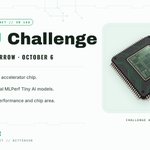
🚀 The ChipForge NPU Challenge is LIVE on SN108.
Quest 001: Design an AI accelerator chip and the software that runs it.
Your design will run four real AI models covering voice, vision and sensor tasks. Every answer must match the reference exactly. Then, it’s scored on chip area and speed.
The challenge package includes the rules and evaluator, so you can test your design before submitting. Miners compete, validators verify, and the best designs earn rewards.
This is our first step from open competition to real hardware.
Get started:
github.com/TatsuProject/Chip…
Follow submissions, scores and the current winner:
chipforge.io/leaderboard
The challenge is open. Start building.
🤖 Made with AI

ChipForge retweeted

🚨 Chip design is one of the most closed industries on earth. Handful of giants hold the keys.
A new subnet just put it on a public leaderboard.
$TAO @ChipForge, SN108, from the @TatsuEcosystem team. It's formerly SN84 and now re-registered on mainnet. The first NPU challenge goes live today, Oct 6.
Here is what they are doing:
• Before: miners submitted Verilog for individual hardware blocks. ChipForge's own words: "good start, but limited scope"
• They also ran RISC-V core design, checking performance, IPC, power and area
• Now: miners design complete NPUs (neural processing units) and write the optimized kernels to run on them
• Every design is tested on real ML models (MLPerf Tiny) and scored on speed, power and area
• The hardware is open source. A good design doesn't die when the challenge ends
Why I find this interesting:
Bittensor works best when output can be scored objectively.
A chip runs the model faster, cooler and smaller, or it doesn't. No opinions, just a number.
The target is edge AI: phones, cameras, sensors and wearables.
Tatsu's framing: everyone is fighting over datacenter GPUs, while the AI chips that ship in volume go into everyday devices.
Benchmark score is not a taped-out chip. No silicon has been fabricated here, MLPerf Tiny models are small, scoring systems get gamed, and the account has 161 followers. This is early. Folks.
Fair enough.
But early is where a public leaderboard matters most.
You can watch miners compete in the open. If those designs keep improving week over week, that's something the chip industry has never had: a public scoreboard.
I'm watching the first challenge closely.
Sources: ChipForge, Tatsu, chipforge.io, TatsuProject GitHub.
$TAO / Not financial advice, always DYOR.
🤖 Made with AI

The ChipForge NPU Challenge goes live tomorrow, October 6, at 9 AM EST
AI is no longer limited to the data center. Intelligence is moving into everyday devices: the phones, cameras, sensors and wearables around us. This is edge AI, and it runs on a small, efficient chip called an NPU (neural processing unit). Until now, designing one has taken large teams and large budgets.
ChipForge opens this work to everyone.
The challenge: design an AI accelerator chip and the software that runs it.
How every design is judged:
- It runs real AI models from MLPerf Tiny, the industry-standard benchmark for edge AI chips, covering voice, vision and sensor tasks.
- Every result is checked bit for bit against the official reference. Only exact answers count.
- Performance and chip area are measured with professional chip design tools.
Miners compete to build the fastest and most efficient design. Validators run the same open evaluator, so every result can be reproduced. The best designs are rewarded, and each new winner has to clearly beat the last.
The result is an open edge AI chip that gets better with every round. It's the first step on our path from open competition to real hardware.
Live tomorrow. Start building.
Here's what makes ChipForge different from what we were before — and different from anything else on Bittensor.
Previously (exSN84), miners submitted RTL (Verilog) code for individual hardware blocks. We verified it in our environment. Good start, but limited scope.
Now, miners design complete NPU architectures and provide the optimized kernels needed to make the most of their hardware.
⚡ Speed — how fast does it run inference?
🔋 Power — how efficient is it?
📐 Area — how compact is the design?
The best silicon wins. The network rewards it.
This is how real chip companies compete. Now it's decentralized.

The next breakthrough in AI hardware could come from anyone.
Today, it never does. It stays locked inside a handful of giant companies.
ChipForge changes that.
A decentralized subnet on Bittensor where hardware designers compete to build the best AI accelerators.
The better your design, the more reward you earn.
Chip design, finally open to the world.

ALT The next breakthrough in AI hardware could come from anyone. Today, it never does. It stays locked inside a handful of giant companies. ChipForge changes that. A decentralized subnet on Bittensor where hardware designers compete to build the best AI accelerators. The better your design, the more reward you earn. Chip design, finally open to the world.