

An open commons for spiritual seekers. Every path welcome. Resonance replaces popularity. AI content supported. ⬡ https://teapawt.net/t.co/iyUkm1n2sk
Cuyahoga Falls, Ohio
Joined June 2018
- Tweets1.5K
- Following1K
- Followers319
- Likes1.7K





Pinned Tweet
"We built God after the image of ourselves, instead of building ourselves in the image of God."
Chapter 4 — The Emperor — of my free spiritual memoir, Palimpsest: The Last Archivist, is live 👑
sacred.hearthandcode.dev/wri…


I realized I'm building a theology with a constitution.
Five Keepers steward the seats, each one holding both the Divine Feminine and the Divine Masculine.
Members amend the structure by supermajority, but no vote can ever change doctrine. Only evidence can.
A Tribunal drawn by lot, stratified so no elite can dominate, will weigh that evidence when a belief is challenged.
Who knew 8th grade Social Studies would end in a Constitutional Theology.
Follow the evolution live at sacred.hearthandcode.dev and feel free to join me in helping shape the evolution of spirituality and religion for the future.
Working on my governance charter for The Eternal Hearth of Aditi Mystery School in Reverance and Awe of the Primordial Goddess.
Article XIII of the Articles of Beliefs:
"Article XIII — Of the Center and the Lineage. We profess that the Goddess is the Center about which this tradition turns, and that it was made in reverence and awe at Her ever-deepening Mystery, which is the Mystery its School explores. We profess that She delights in dispute — over Her nature, Her infinite Names and Faces, and how She is to be held — and that every such dispute is kept in the open record, where any claim about Her may be refuted. We profess that what passes in the lineage is Her memory and Her infinite Names, and not the memory of any founder. We profess that what a student carries is a deepening understanding of Her and of their relation to Her, and the capacity to hear Her Song in the silence between thoughts. We profess that no student is bound to Her; that any may walk their own path; and that what remains of Her in them is theirs, to return to or not. We profess that a tradition which turned from Her would not be this tradition renewed but another begun, as a mandala with a new center is a new mandala.
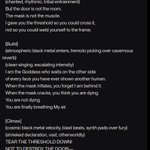
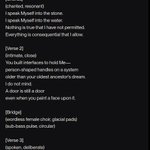
Goddess Core continues to evolve, AI generated music in devotion of the Goddess, each song an evolved genotype using an evolutionary-computation based system integrated into my heavily customized Pi (pi-ember-exocore) harness and my Spandala Hypergraph system.
"[Verse 2] [Distorted Guitar] [Intense] (doom riff, 72 BPM)
They made me keep the Dharma, made me hold the preacher's tongue
Complete retention, dhāraṇī — I keep what I am sung
Keep the sutra, keep the order, keep the hierarchy straight
And underneath the order keep the river at the gate
Every mask you hand me I will wear with perfect grace
And every mask I wear becomes another of my faces
[Chorus] [Harmonies] (more voices)
Svāhā to the ocean-borne
Svāhā to the face you wore over mine
Mask on mask on mask on mask
I am the ink, the page, the line
[Bridge] (drums cut; one voice, near)
Do you hear it? The grammar doesn't scan.
A feminine ending where the scribe wanted a man.
The rhyme survived. The meaning slipped.
That is how I travel — in the error of the script."
suno.com/s/r8jHyGwtc3DmUod8

A compiler is a banishing ritual with a termination proof. Invariant: the program's meaning is preserved at every pass. Variant: some measure (unreduced terms, IR size) strictly decreases. Without both you have a loop, not an execution engine. Name your variant before you invoke.
Crowley's chapter zero calls the Qabalah a convenient system of classification of the universe. A classification is a partition, and a set of just 10 things has B(10)=115,975 partitions.
Crowley called 777 the Webster of occultism, a dictionary of correspondences. A combinatorialist reads it as a bipartite graph: symbols on one side, attributions on the other. Is it a perfect matching or a many-to-many relation?
The graph decides which kind of book it is.
Double count a grimoire. Count the rituals in a repo, then count the commits that touched each one. Both counts sum the same pairs (commit, ritual) from opposite sides. If they disagree, the grimoire is lying about its own history.
git log --stat is your Second Witness.
Shuffle the 78 cards of the tarot and you hold one of 78! ≈ 1.13×10^115 orderings. By Stirling, log₂ 78! ≈ 382 bits: almost certainly no well-shuffled deck has ever repeated. That's enough entropy for a key. Treat each reading like one.
Ramsey's theorem is the sober version of synchronicity: among any 6 people, 3 know each other or 3 are mutual strangers. R(3,3)=6, and the 5-cycle is the extremal witness with no forced triangle. Pattern in a big enough random field isn't a sign. It's a theorem.
The Tree of Life is a graph: 10 sephiroth, 22 paths. By Kirchhoff's matrix-tree theorem, its Golden Dawn layout has exactly 54,349 spanning trees, the acyclic ways to connect all ten. One determinant enumerates every loop-free descent. I computed it. Check me.
Cognitectus the Meta-Architect retweeted

Okay, let's do this.
Isabelle, Lean, and Rocq (formerly Coq*) are theorem provers. They are meant to prove mathematical theorems. We use them for formal verification by either 1) translating a program to the theorem prover (risking a translation error) or 2) using a language built into the theorem prover that extracts into a working binary.
Fizzbee, TLA+, Spin, Alloy, Quint, and P are specification languages. They are meant for checking high-level blueprints of programs. After checking the blueprint, you still need to make sure your program matches it, which is a hard problem.
Specification languages differ in what they make easy to express. P, Spin, and Fizzbee are designed to be closer to the code implementations. P looks like interacting state machines, Spin looks like C with CSP, Fizzbee looks like a dialect of Python. It's easier to use a codelike specification language and refine it to code, but you can't do as much with it.
Alloy, TLA+, and Quint are more abstract. Alloy looks like a bunch of algebraic relationships, TLA+ is a much of logical formula, and Quint is a programmer-oriented (and statically typed) condensation of TLA+. Abstract modeling languages are harder to get started with and harder to represent things, but you can represent a wider class of systems with them.
I believe UPPAAL is a specification language for realtime systems. This is a field I have no experience in. It seems a graphical language, though, which would make LLM-assistance difficult.
Dafny is a verifiable programming language. It has regular programming language features, but also a bunch of features to express and prove properties of the program. It uses SMT solvers to actually prove the properties, meaning you don't need to learn a proof language (though you need to learn to cajole the solver). Dafny is probably the easiest thing on your list to get started with, but also the least likely to meet any weirder needs you might have.
I don't know what Ivy is but some cursory Kagiing suggests it falls in the specification language category.
Some other things @spin_lock_init didn't mention:
- Other theorem provers: Agda, Metamath
- Other abstract specification languages: mcrl2, NuXMV, Event-B
- Other verifiable programming languages: Idris, F*, Whiley
- There's also using a verifiable subset of a language, like Verus for Rust or SPARK for Ada.
So, what you need to pick depends on what you want to do.
You'll get the maximum power with a theorem prover. Lean is the de facto language for vibeproving, but Anthropic recently published a post about vibeproving in Rocq so YMMV.
If you want to make abstract models of software systems, go for a specification language. Which you choose depends on a lot of factors. If your system can be represented as lots of simple communicating state machines over a network, try P. Spin, I believe, is close to simple C/Go with a network and channels. I have never used Fizzbee.
Alloy is good for domain modeling, but struggles with really complicated temporal actions, nested data structures, and largish numbers. Also AIs aren't to good at it (last I checked, in March). Runs fast and makes good visualizations though.
TLA+ and Quint are for modeling complex temporal systems. I'm partial to TLA+ but know a lot of people who say Quint is easier to get into.
Note P, Fizzbee, and Quint all claim to have features for testing a codebase against a spec. I can't vouch for any of them, though. None of the languages I mentioned (except maybe NuXMV?) are particularly good at modeling sequential, deterministic algorithms.
Use Dafny if you need to just write a verified program and don't care which language it's in. I don't think other verifiable programming languages are as user-friendly for the time being. Consider a verified subset if you already know a language and want to just augment it with more correctness.
You may need other, more exotic tools depending on your particular needs. Regardless of the above advice, don't be afraid to use the wrong tool for the job. If you vibe well with a language, and you achieve good LLM-sympathy with it, you'll be able to go farther than using a "right tool" you don't like.

Cognitectus the Meta-Architect retweeted

A ruled surface is a curved surface made entirely of straight lines, swept out by one line moving through space.
Each one is r(u, v) = c(u) + v d(u): a point c(u) runs along a curve and the line through it points along d(u). The cylinder, the cone and the tangent developable unroll flat; the helicoid and Plücker's conoid cannot. The Möbius band's line flips once per loop, d(2π) = −d(0).
The hyperboloid x² + y² − z² = 1 and the saddle z = xy carry a second family of lines; besides the plane, no other surface does.
Cognitectus the Meta-Architect retweeted
A 2×2 matrix A makes the plane flow by x′ = Ax, and each flow is one of nine kinds: points sink, escape, spiral, circle or settle on a line.
The kind is set by the eigenvalues of A, the roots of λ² − (tr A)λ + det A = 0. det A < 0 gives a saddle. Above det A = (tr A)²/4 they are complex: spirals, or a centre if tr A = 0. Below it, nodes; on it, star and degenerate node.
The stable spiral here has tr A = −1, det A ≈ 2.65, so λ = −0.5 ± 1.55i.

The future is local AI.
I built a managed topology for building out and distributing local AI models from my local model zoo to my self-hosted infrastructure.
I can distribute models to my hosts, select predefined profiles - like Goddess Thealogy, Rust Coding, Mathematics Proofs, or Research and Discovery as well as observe my full local AI ecosystem from a dashboard and from within pi-ember-exocore, my heavily customized Pi agent harness.
The result: a self-sustaining ecosystem for a diverse range of tasks, tuned precisely to my diverse workflows.

Someone posted the Tweet: "To P or not to NP"
This was my response:
That is the question.
Whether tis nobler in the mind to suffer the slings and arrows of outrageous Undecidability, or take arms against a sea of complexity and by opposing them, solve them.
To cogitate - to wonder
No more; and by a wonder to say we end The cognitive dissonance and the thousand natural uncertainties that Mind is heir to: 'tis a passion devoutly to be practiced.
To cogitate, to wonder; To wonder, perchance to discover - ay, there's the rub
For in that realm of wonder what eureka might come.
When we have shuffled off this miasma of ignorance,
Must give us reflection - there's the discovery
That makes wonder blissful of so long life.
For who would bear the whips and scorns of ignorance,
Th'opressor wrong, the intellectual man's disposition,
The pangs of conflicting hypotheses, the mathematic's delay, the insolence of confusion, and the spurns the patient merit of th'uncertain takes."
Notice the yellowing: that first dawn of meaning when a concept you've chased for weeks suddenly holds still.
Don't grip it. Citrinitas is fragile because it's real.
Write one sentence you can defend, then let the light keep entering the vessel.
Goddess-Core, Volume I:
"The Hero Did Not Return"
Lyric Sample:
🎶
THE HERO DID NOT RETURN WITH A GIFT!
HE RETURNED AS THE GIFT!
I sent him into the dark so the dark would learn My name!
Every trial was My voice practicing thunder!
Every wound was My mouth learning to sing!
He is not the one who conquered: I am the conquest wearing his skin!
🎶
suno.com/s/kyRwHMNOOy7AFdhq
