






Emerging markets and developing economies hold two-thirds (or more) of global stablecoin supply. That is a measure of demand, and it puts a choice in front of policymakers: treat stablecoins mainly as a source of risk, or treat them as a foundational change in payment infrastructure that their economies can shape.
Today we publish "Stablecoins in emerging markets: Opportunities and challenges."
Stablecoins collapse messaging, clearing, and settlement into a single onchain step, settle in seconds, and can execute on conditions without an intermediary. Those gains are largest where payment frictions are highest, which is why the opportunity is concentrated in emerging markets.
The paper maps four opportunities: cross-border remittances, where sending $200 still costs about 6.5 percent on roughly $650 billion a year flowing to developing economies; tokenization and smart contracts; agentic commerce at machine speed and sub-cent scale, so creators and publishers can be paid per use; and competition in banking and FX.
It takes the concerns policymakers raise in turn, from deposit flight and dollarization to capital flows and illicit finance, and finds that in most cases the answer is a matter of policy design and supervision, not a flaw in the instrument. A six-part regulatory blueprint sets out what that design looks like, and case studies of India, Brazil, and Indonesia show the rails and the demand are already in place.
The question is no longer whether stablecoins arrive. It is whether they arrive inside a clear regulatory perimeter, where a country can address its concerns and capture the value being built on stablecoin rails, or outside one.

AI agents now retrieve, compare, and transact on people's behalf, and the web has had no standard way to charge them for what they use. This paper examines why traditional rails cannot economically carry high-frequency, sub-cent payments, why stablecoins in concert with open protocols like x402 currently fit that market best, and what policymakers can do to keep agentic finance open and interoperable. With @kleffew94 @MurrLincoln @smshr98
Coinbase Institute retweeted

The internet’s business model was built around people: attention, ads, subscriptions and checkout. AI agents are changing that. They can retrieve and use content without sending a human reader back to the publisher.
That raises a real question for creators, publishers and developers: how can they get paid when an agent uses their work, sometimes for a fraction of a cent?
Our new Coinbase Institute @CoinbaseCBI paper, "Machine-to-machine payments in the AiFi era," examines why existing payment rails often struggle with high-velocity microtransactions—and why stablecoins on low-cost networks are a strong fit today.
The policy goal should be an open, interoperable payment layer, with safeguards that match the risks—not closed marketplaces that decide who can participate.

Our new paper, Small Banks and Stablecoins: Nothing to Fear, Much to Gain, explains why well-regulated stablecoins are a once-in-a-generation opportunity for roughly 4,000 community and regional banks to compete on equal footing in payments and programmable financial services with the big banks—often by plugging into shared infrastructure via partners, rather than building from scratch. No billion dollar tech budget needed.
As for concerns about stablecoins draining community-bank deposits, the data tell a clear story. As USDC’s market cap grew to around $75 billion, overall bank and community-bank deposits grew alongside it. Over the last 6 months, USDC grew 4.6 percent while total demand deposits grew 4.5 percent. This doesn’t look like substitution.

Read the paper here: coinbase.com/public-policy/a…
The Coinbase Institute's new paper makes the case for euro stablecoins — not as a threat to monetary sovereignty, but as a tool to strengthen it. A projected €570B market by 2030 won't crowd out bank lending. It will cement the euro's global role.

Read the paper here: coinbase.com/public-policy/a…
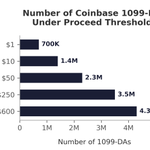
The U.S. tax code was built for paper-era money, not onchain finance. Treating digital assets as property means every stablecoin payment and gas fee can be a taxable event—and @Coinbase has already seen a 34% jump in crypto tax support inquiries this year vs. last. It is time to modernize the rules. Our new paper lays out practical reforms on information reporting, payment stablecoins, and de minimis relief so tax policy supports, rather than penalizes, everyday digital asset use under frameworks like GENIUS.

Read it here: coinbase.com/public-policy/a…
The internet defaults to ads, subscriptions, and bundles because small payments have always been uneconomical. Stablecoin rails + x402 could change that—letting users and AI agents pay tiny amounts for exactly what they need. Pay-per-use AI, microwork, niche data, pay-per-article. This opens the door to broader participation in the digital economy

Read our explainer here: coinbase.com/public-policy/a…
1/ Settlement finality—the legal moment when a transfer becomes unconditional and irrevocable—is central to financial stability, and blockchains change how we deliver it. Our new Coinbase Institute piece, Settlement Finality Onchain, shows how atomic settlement removes the T+N exposure window, how technical finality on major proof-of-stake networks creates stronger economic guarantees than centralized ledgers, and how always-on public blockchains reduce operational and liquidity risks tied to business-hour settlement and single points of failure.
2/ The remaining task is a familiar one for policymakers: define when technically final onchain transactions become legally final, and calibrate collateral, liquidity, and insolvency rules to reflect shorter, safer exposure windows.
Read more here: coinbase.com/public-policy/a…
1/ Cornell Professor Lin William Cong released a December paper finding that well-regulated GENIUS stablecoins can enhance bank operations, strengthen deposit competition, and support financial stability—corroborating recent Coinbase Institute research on the same topics. A banking trade group recently attempted to reframe his findings. Who better than Cong to correct these misreadings and mischaracterizations of his own work.

2/ Prof. Cong just issued a correction to these banking group mischaracterizations of his work. Key reminders and clarifications: stablecoin yield only threatens bank deposits above 6% (far above current levels); GENIUS design constraints are central to his analysis; and payments adoption ≠ deposit displacement without explicit behavioral mechanisms.
3/ And Cong emphasizes: shifts in asset holdings don't necessarily contract credit—they may reflect reallocation to more efficient intermediaries. He also reminds that his paper explicitly acknowledges residual risks remain (comparable to other financial institutions and innovations), contrary to banking claims it describes stablecoins as risk-free. The full correction can be found at: linwilliamcong.com/
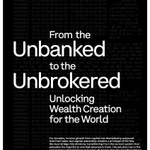
There’s a significant (and growing) problem with global wealth creation. For decades, income growth from capital has dramatically outpaced that from labor, but capital ownership remains a privilege of the few. Roughly two-thirds of adults on earth are excluded from capital markets due to access barriers and frictions. Our new paper shows how tokenization could help billions of unbrokered savers turn a smartphone into a gateway to diversified, global ownership.

The paper can be found here: coinbase.com/public-policy/a…
