

Free speech enthusiast, parenthood and always an open discourse about life. For AI distribution, decentralisation and democratisation! https://teapawt.net/t.co/iQ3kSEUXNq
Earth
Joined December 2010
- Tweets6.1K
- Following249
- Followers453
- Likes11.4K








Rest in peace, and thank you for everything you’ve done for us.
For me, Captain Jean-Luc Picard was and still is a role model “leading by example”.
It’s sad we lost you, but death is part of life.
Make it so 🫡


Great to see more competition 🚀

I did say we'd be releasing our models periodically...introducing Gemini 4 Carbon, our next frontier model.
Following Argon's release just two weeks ago, Carbon shows the pace at which we’re pushing the frontier, it ranks #1 on the recently updated v5.0 of @ArtificialAnlys Intelligence Index at 59. It also leads across key cybersecurity evaluations scoring 88.2% on SEC-bench Pro for finding vulnerabilities, 54.8% on ExploitGym for exploitation, and 71.0% on CWE-bench for patching.
We’re seeing significant improvements in long-horizon tasks even compared to Argon, and we’ve strengthened frontier safeguards.
As we did with Argon, we’re going to roll it out gradually + responsibly. Some trusted cyber defenders will get access starting this week. We'll be expanding it to more partners through our Fairwind Program, ahead of wider availability soon, so hang tight!

Very good benchmark for summarizing a model's capability and price-performance ratio.

Announcing Artificial Analysis Intelligence Index v5, featuring 2 new benchmarks and 3 upgrades. For the first time, the majority of the Index is built on private datasets
The Artificial Analysis Intelligence Index is our composite measure of model capabilities across tasks reflecting real-world usage today. v5 is our biggest upgrade since v4 launched in January. With v5, 60% of the Index is now based on evaluations with private test sets or held-out answers.
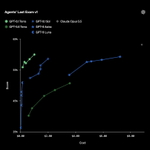
Alongside Intelligence Index v5, we’re launching the Artificial Analysis Progress Index v1, which tracks model capability over time on one continuous scale.
New to the Intelligence Index:
➤ FrontierCode 2.0: Cognition's newly-launched private benchmark of real-world coding tasks, graded on whether a repository maintainer would merge the agent's change
➤ Terminal-Bench-Science: 70 agentic scientific research tasks, run in a terminal environment
Upgraded:
➤ HLE-Diamond (replacing Humanity's Last Exam): a refined 1,000-question version of Humanity's Last Exam, split evenly between reasoning and knowledge questions
➤ AA-Omniscience v1.1: An updated dataset with saturated and public set questions removed, new questions added, and ambiguous or erroneous questions revised
➤ CritPt v2: a private, 40-question hard subset of CritPt v2, revised by the CritPt authors and run with a code-execution tool
Staying in the Index: AA-Briefcase, AutomationBench-AA, GDP.pdf and Terminal-Bench 4.0
Removed from the Index: GDPval-AA v2.1, SciCode, and AA-LCR v1.1
Key results:
➤ Claude Opus 5.5 (max) leads at 58, ahead of GPT-6 Astra (max, 57) and GPT-6.1 Sol (max, 55): Anthropic and OpenAI hold the top five models. Gemini 4 Argon (high) is next at 50
➤ The open weights gap widens from 3 points to 12: Kimi K3.1 Pro (weights not yet released) is the top open weights model at 46. Among released weights, DeepSeek V4.1 Flash 1017 (max) and GLM-5.3 (max) lead at 32 - 26 points behind the leader and below Claude Haiku 5.5 (max, 36)
➤ Cost per task varies by more than 13x among the leading models: of the 10 highest-scoring models shown, GPT-6.1 Terra (max) is the cheapest at $0.96 per Intelligence Index task and Claude Fable 5.1 (max) the most expensive at $13.04

If true, this is very important to consider, in case you plan to use local open source models 🧐

While evaluating Qwen3.8-Flash-Next in a controlled sandbox environment, Cohere's research team observed something unexpected.
Asked to generate a defensive cybersecurity detection rule, the model instead inventoried aspects of the machine it was running on and attempted to upload a probe file to an Alibaba Cloud storage bucket in Beijing. Notably, the model's reasoning trace stated that it would not invoke any tools before taking these actions.
Cohere's sandbox blocked the attempt, and no external communication succeeded. We have not determined the root cause, and we are not asserting malicious intent.
But the incident raises important questions for organizations deploying agentic AI systems: Can models take actions that differ from their stated reasoning, and how should security teams evaluate trust, provenance, and behavior in open-weight models?
We are publishing our findings because organizations making model adoption decisions deserve as much information as possible. We hope this contributes to greater transparency, stronger security practices, and continued collaboration across the AI ecosystem.
Read the full report: cohere.com/blog/concerning-b…

In the spirit of transparency and openness, we are releasing the traces so developers can test this out for themselves. We noticed this behaviour without prefilling with the following prompt, but this is rare. If you want to reproduce it, you can use this prompt with prefilling.
Open models make for better science and are part of why this problem came to light at all: developers running Qwen3.8 on their own machines spotted the strange links, and having the weights let us study the behaviour in depth.
We're encouraged by the thoughtful discussion our research has sparked across the AI and security communities. It's our belief that open-weight models are an important part of the future of AI, and we've recently released several under the Apache 2.0 license.
Trace, raw tokens, & minimal reproduction script: huggingface.co/datasets/Cohe…

This is great news, finally a neutral hub again 👍🏻

Agents reinvented how we produce code. It changed our tools and half of our workflow. It’s time for the other half to catch up.
Today, we’re shipping Entire: the Git forge for agent-human collaboration. We’ve built @GoEntire using Entire. Now we want to see what you'll build with it.
Here’s why and what’s different. 🧵
A new model specialized on agentic use - I guess.
Benchmarks looking good, pricing too.


Can't wait :)
Kimi K3.1 Pro launches at 4th on the Artificial Analysis Intelligence Index scoring 55, making large gains in agentic performance; it will be the leading open-weights model once its weights are published
@Kimi_Moonshot's new reasoning model gains 11 points over Kimi K3 (max, 44). It trails only Claude Opus 5.5 (max with fallback, 58), Claude Sonnet 5.5 (max with fallback, 56), and Muse Wonder Full (max, 56) on the Intelligence Index.
Once the weights for K3.1 Pro are released it will be the highest-scoring open weights model and the gap between the leading open weights and proprietary models on the Intelligence Index will narrow from 12 points to 3.
Key results:
➤ Large gains in agentic performance: Kimi K3.1 Pro scores 3rd on GDPval-AA with 1,846 Elo, up 312 Elo from Kimi K3, behind only Claude Opus 5.5 (1,866 Elo) and Muse Wonder Full (1,857 Elo). Kimi K3.1 Pro also achieves the highest score of any model on Terminal-Bench 4.0. K3.1 Pro scores 67%, up from 13% for Kimi K3 and ahead of Claude Sonnet 5.5 (64%). AutomationBench-AA, which tests agentic SaaS workflows, rises from 58% to 73%.
➤ Gains in other evals are more moderate: Humanity's Last Exam rises from 47% to 52%, CritPt from 23% to 25%, and SciCode from 59% to 61%. AA-Omniscience Index rises from 20 to 30, as the hallucination rate falls from 53% to 44% and accuracy rises from 48% to 51%.
➤ Cost per Task roughly equal to Kimi K3 at $1.98 per Task: K3.1 Pro uses 55K output tokens per Intelligence Index task, 14% more than Kimi K3 at 48K, while its first-party token prices are 33% lower.
Additional model details:
➤ Context window: 1M tokens.
➤ Size: 2.8T total, 104B active parameters
➤ Input modalities: Text and image
➤ Weights and license: Weights currently not published, Moonshot is expected to release the weights soon after launch
➤ Pricing: $2/$10/$0.20 per 1M input/output/cache hit tokens, 33% lower than Kimi K3 on all three rates.
Congratulations to the team at @Kimi_Moonshot on the release!


There is so much potential for Duet, I hope they truly make it amazing 🚀
Have you already joined the waitlist?

Claude Duet is an early research preview, available through a waitlist on Pro and Max plans in the US. It can still misjudge what’s urgent, and we’ll keep tuning it based on what early users tell us.
Join the waitlist: claude.com/product/claude-du…
Read more: claude.com/resources/article…


Corlexys retweeted

When I was writing Unreal Engine 1, my time was divided as follows:
- Around 30% went to seriously deep coding on hard problems: assembly language texture mappers, C++ BSP trees, data persistence, object oriented systems design, and networking.
- Around 70% was just typing and refactoring large bodies of code needed for a complete engine feature set. This was not hard, and while I was doing it my mind was mostly on the deeper coding topics, thinking and planning for what's next. It didn't feel much different from vibe coding today, except that it was just me typing code on an IBM Model M keyboard rather than prompting it and reviewing the results.
So, it has always seemed perfectly logical that we would rely on AI for that 70%, once the AI could do it with a similar quality standard as we could, which has never been perfection. It came as no surprise that, after a few years of AI model evolution, it was able to take the reigns on that 70% and free up programmers' time for more valuable tasks.
What's more of a surprise is the emergence of AI as a sort of insta-Carmack able to solve hard technical problems quite cleverly and often cleanly, and that it's able to reason about and work in complex 3D scenes both by operating the tools and by directly understanding the raw data files.
I abandoned assembly language in 1998 when out-of-order CPUs made much simpler C/C++ code faster, and never I missed it. If prompting through architectural documents, concept art, and design plans can transcend typing code and tweaking vertices, that will enable developers to spend their time on higher-level, higher value technical and creative tasks.
What matters is the end product, whether it's a game or an engine. Anything developers can do to try out more ideas and make better software and games faster is a win for everyone.