

Daily dose of Universe
Joined August 2026
- Tweets340
- Following558
- Followers351
- Likes455



What if the explosions that helped shape the Universe were also blocking its light?
For years, scientists thought supernova-driven winds helped ultraviolet radiation escape early galaxies.
New Hubble observations suggest the opposite: stronger winds may trap more of that radiation.
A 13-billion-year-old mystery, with a surprising twist.
The Universe was darker than we thought.

25
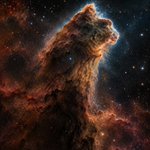
This looks like something hiding in the darkness.
It's a stellar nursery, 7,500 light-years away. 🌌
Hubble reveals the dark pillars of dust. Webb peers into infrared light to uncover details hidden within them.
Behind this eerie silhouette, the process of star formation is unfolding.
The Universe doesn't need to invent monsters.

41
A planet covered in molten rock shouldn't be able to hold onto its atmosphere for billions of years.
Yet TOI-561 b may be doing exactly that.
Webb observations suggest it reflects around 75% of its incoming starlight. Scientists think reflective mineral clouds could be the reason.
A world of lava. Clouds made of minerals. A cosmic mystery. 🌋
"Read the discovery" (sciencedaily.com/releases/20…)

37
A flash lasting milliseconds. A galaxy nearly invisible to our telescopes.
Webb traced the most distant fast radio burst yet to a tiny galaxy that existed when the Universe was just 3 billion years old.
The mystery? We still don't know exactly what creates these powerful flashes.
What would you investigate first? 🌌

33
A telescope built to map the distant Universe spotted something closer to home. ☄️
Meet Comet C/2026 S1 (Euclid), discovered in images taken by ESA’s Euclid mission.
Sometimes, the Universe hides surprises in the data we thought we understood.
What else are we missing?

28
This might be the loneliest selfie ever taken.
In 2014, the Rosetta spacecraft captured itself just 16 km from comet 67P, with dust and gas streaming into space.
Earth was 472 million km away.
Somewhere out there, a robot was taking pictures of another world.
Source: ESA / NASA APOD

34
This planet’s atmosphere isn’t symmetrical.
1,300 light-years away, WASP-17 b has an atmosphere that stretches almost twice as far on its hot evening side as on its cooler morning side.
Webb measured the difference. Powerful winds help explain it.
Even alien skies have weather.

Astronomers found a white dwarf that appears greenish.
WD J1330+6435 is about 280 light-years away. Its unusual atmospheric chemistry may be linked to planetary debris swallowed by the dead star.
Even stellar remains can surprise us.
Source: SDSS research

4
154
It flew through the Sun’s atmosphere.
NASA’s Parker Solar Probe became the first spacecraft to fly through the Sun’s corona, the superheated outer atmosphere.
It braved extreme heat and radiation to study the star that makes life on Earth possible.
We went to touch the Sun.
Spacecraft Files #7 - Parker Solar Probe.

37
Jupiter’s poles hide a bizarre sight.
NASA’s Juno spacecraft revealed enormous cyclones arranged in geometric patterns around the planet’s poles.
It also probes beneath Jupiter’s clouds to investigate the giant planet’s interior, magnetic field, and origin.
We’re still uncovering what lies beneath.
Spacecraft Files #6- Juno.

36
Cosmic Pill retweeted
It spent 13 years exploring Saturn.
Cassini revealed the planet’s complex rings, discovered lakes of liquid methane on Titan, and found evidence of a hidden ocean beneath Enceladus’ icy surface.
In 2017, it made one final dive into Saturn, ending its mission after 20 years in space.
Spacecraft Files #4 Cassini.

It slept for 321 days and woke up 9.5 billion kilometres from Earth.
NASA’s New Horizons is back from its longest hibernation, ready to send science data from the distant Kuiper Belt.
It gave us our first close-up of Pluto. Its journey isn’t over.
Spacecraft Files #5 - New Horizons

It spent 13 years exploring Saturn.
Cassini revealed the planet’s complex rings, discovered lakes of liquid methane on Titan, and found evidence of a hidden ocean beneath Enceladus’ icy surface.
In 2017, it made one final dive into Saturn, ending its mission after 20 years in space.
Spacecraft Files #4 Cassini.
It found a hidden ocean on a world covered in ice.
For 13 years, Cassini explored Saturn and discovered water-rich plumes erupting from its moon Enceladus, evidence of a global ocean beneath the ice.
In 2017, it plunged into Saturn, protecting the moons it had helped us understand.
Spacecraft Files #4 - Cassini

This telescope sees a universe our eyes cannot.
The James Webb Space Telescope observes infrared light, revealing galaxies from the early universe, stars forming inside clouds of dust, and the atmospheres of distant planets.
It doesn't just look farther into space.
It looks further back in time.
Spacecraft Files #3, James Webb Space Telescope

1
44
In 41 days, Voyager 1 will be one light-day from Earth.
Launched in 1977, it became the first human-made object to enter interstellar space.
And it carries a golden record containing sounds, images and greetings from Earth.
Humanity’s message is still traveling.

34
This telescope changed how humanity sees the universe.
Hubble has been orbiting Earth since 1990, turning distant galaxies, dying stars and exploding nebulae into some of the most iconic images ever captured.
And it’s still looking up.

35
Stars are being born and immediately throwing things into space.
Webb has revealed powerful jets erupting from newborn stars inside NGC 7129, about 3,300 light-years away.
Some stars begin their lives violently.

29
Messi has a place in astronomy. Not a star. Not a planet. Something stranger
In 2016, astronomers named a machine-learning algorithm MeSsI after Lionel
Messi.
It was built to find galaxy clusters that are colliding and merging.
The algorithm identified 61 such clusters.
And the researchers dedicated it to Messi because, in their words, "Lio couldn't be less.

29
