

Economist, paid for doing what I love by Moody's Analytics as senior euro zone economist. Views my own. @crisisstudent.bsky.social
Prague
Joined March 2013
- Tweets6.4K
- Following370
- Followers2.8K
- Likes4.1K






Pinned Tweet
So what does this mean for the recent past and the future tariffs?
Broadly, my thesis is that individual tariffs have a different mix of motivations belonging to different categories, which implies different durability, but overall, tariffs are not going away anytime soon.
1/


I agree the end of scarcity of German bonds plays some role.
But I struggle to see in the data any evidence this is a major factor.
Sure, superficially both bund-swap spreads and French spreads increased between 2022 and now.
But the timing is off: You had 2 years of...


Adam Tooze makes a useful point about bond markets that often gets inverted.
When Germany barely issued new debt (debt brake + surpluses), Bunds became scarce. Bond traders and portfolio managers still need high-quality paper to buy, sell, and hold. So French OATs stepped in as the closest substitute. Demand for French bonds rose, prices went up, yields fell — and France temporarily joined the “high-quality” club alongside Germany.
Scarcity of the safest asset doesn’t mean managers love thin markets. It means capital gets pushed into the next-best alternative until that scarcity eases. Once German issuance picked up and perceptions shifted, France’s spreads widened again.
Kamil Kovar retweeted

This kamilkovar.substack.com/p/th… by @CrisisStudent is really excellent: "whatever it takes" (OMT) worked and was possible only "because Italian politics and fiscal policy were already on a sensible path" due to major reforms implemented by Mario Monti." @lugaricano @Isabel_Schnabel

@CrisisStudent: "The future French fiscal crisis seems almost inevitable ... because the French govt is unlikely ... to change course without one. ... only the crisis creates the political capital" for reforms. So, ECB TPI or QE could undermine reforms that unburden the young
Kamil Kovar retweeted
@CrisisStudent: "The future French fiscal crisis seems almost inevitable ... because the French govt is unlikely ... to change course without one. ... only the crisis creates the political capital" for reforms. So, ECB TPI or QE could undermine reforms that unburden the young
The three-part series on French fiscal crisis concludes with a pessimistic part (that follows a realistic one and optimistic one?).
I argue it almost seems inevitable that we will get fiscal crisis in France...eventually.
1/
kamilkovar.substack.com/p/th…
Kamil Kovar retweeted

*FRANCE 10Y BOND FUTURES CLIMB AFTER MOODY'S KEEPS CREDIT RATING
More than 10bp from peak now

This might be a 10 days of liberals' relief.
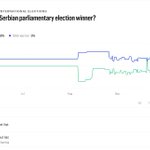
We got Bolsonaro losing in Brazil and Vucic in Serbia.
Next: Netanyahu possibly losing in Israel and Republicans (i.e. Trump) in US.
It will feel good. But it might also send a wrong message and cause more pain down the road.
1/

Big losses for right leaning populists in Brazil and Serbia. Along with Orban in Hungary, that's now three big names on the right that are down for the count. Colombia's Espriella did manage to squeak through in Colombia in June, so not all is lost for the right. Bottom line: no signs that we are living in the 1930s.
Why?
One word: Complacency.
The case is clearest in US, of course, something I wrote about recently.
But it would also apply more globally: liberals might conclude that the illiberal tide will ebb and reverse, lowering the urgency to fight.
2/2
czechtheworld.substack.com/p…


Great thread, from Ben.
I would just maybe add that an important factor behind more "leisure" is government policy: taxation, labour laws, social and health policy, not just preferences.


Kamil Kovar retweeted

Right on the money
Unfortunately, the French (and ppl in general tbh) will only act after the fact once it becomes politically viable to do so
Altho I wld argue that esp the French yearn for a strong leader to guide them to glory
Kamil Kovar retweeted
The three-part series on French fiscal crisis concludes with a pessimistic part (that follows a realistic one and optimistic one?).
I argue it almost seems inevitable that we will get fiscal crisis in France...eventually.
1/
kamilkovar.substack.com/p/th…
The three-part series on French fiscal crisis concludes with a pessimistic part (that follows a realistic one and optimistic one?).
I argue it almost seems inevitable that we will get fiscal crisis in France...eventually.
1/
kamilkovar.substack.com/p/th…
The reason? The fiscal crisis Catch 22, something @TheStalwart @tracyalloway were getting at in their podcast:
The solution to fiscal crisis is simple: credible change in fiscal trajectory. But as luck would have it, that seems to be politically impossible without a crisis.
2/2
This is exactly how I am increasingly thinking about our juniors. We still need them; our jobs are messy. But I now see a future where we might not need them for majority of tasks.
But we will need people for the messy remainder of tasks, so we still need to train juniors...

I mostly agree with you @Claudia_Sahm.
I expect colleagues to continue to have research assistants even if only for mentorship than because they need the help.
Companies to have junior staff not because they need their current work but to train them for future roles.
Ikigai.
A new word for my personal dictionary.

This is it.
Everyone is excited about AI.
I'm not.
AI is the biggest commoditizer of human capability we have ever built. Doctors earn more than cleaners because expertise takes a decade to acquire and judgment to apply. AI is going to make most of that expertise available to anyone, at marginal cost.
The gap doesn't go to zero. But it shrinks. And the same thing happens in almost every knowledge profession. Programmers. Lawyers. Analysts. Traders. Designers. The taxi driver replaced by a robotaxi is the easy case. The harder ones are people who spent twenty years training to do something a model can now do in a second.
The one corner of human life I don't see this hitting is sport. Nobody pays to watch a robot beat a human. The whole appeal is humans competing against each other. That's why nobody watches Deep Blue play chess anymore.
From an investing perspective, the next decade plays out in three phases.
Phase 1 is the buildout. Hundreds of billions in capex on chips, data centers, and energy. This is what's driving today's market.
Phase 2 is the deployment. Productivity rises sharply, then deflation sets in as the cost of knowledge work collapses. Jobs disappear faster than the economy can replace them.
Phase 3 is the social adjustment. Capital becomes more powerful than labor. The biggest winners are likely to sit where AI cannot reach. Real assets. Energy. Commodities. Precious metals. Scarce land.
And there's something deeper than the economics. The Japanese have a word for it: ikigai. The reason you get up in the morning. Your vocation. Your purpose. The work that makes you feel needed. AI is coming for that too. Nobody has yet figured out what a healthy society does when most of its members no longer feel needed by anything.
I might be wrong. I hope I am.
If I'm not, the world is about to change faster than most people are ready for.
Kamil Kovar retweeted

I'm thrilled to be launching Econvitals today. It's been the main way in which I have been tracking and understanding the economy over the last several months. And I decided I might as well share it with all of you--for free.
Has a combo of website, email lists & social media.

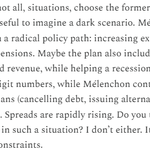
@RobinWigg had a good piece on the FT Alphaville, arguing that the inflationary shock from Iran war does not have to (or even should not) show up inflation expectations.
Instead, the central bank should partly offset by higher *real% rates.
1/5
ft.com/content/e5585991-c884…

But I can imagine this actually being possible:
Especially in late summer and early fall I think we have shifted towards "this energy price level, and especially volatility, might not be going away any time soon". Simply, there will be more supply shocks down the road.
4/