

Girl dad | Security Engineer | Windows/Linux tryhard | Infinite conquest of learning | OSRS/WoW lifelong nerd
United States
Joined September 2016
- Tweets6.5K
- Following450
- Followers904
- Likes23.4K



cyber-ipman retweeted

Brb just attacking the worlds every server with a …. Checks notes. 📝
128GB attack run (per sever) 🥷🫡🤪🤓

PoC for CVE-2026-123007, showing RCE against NGINX in a local Docker container, available here: github.com/sfewer-r7/CVE-202…. Exploitation requires ~128GB of network traffic and a specific memcpy implementation (a fast path based on AVX512)!
cyber-ipman retweeted

The RCE for nginx needs 128GB of HTTP/2 traffic to trigger and specific CPU instructions to be exploitable
I hope I saved you some time.


cyber-ipman retweeted

> be AI company
> scrape the entire internet
> ignore licenses and copyright
> download millions of pirated books
> use them to train frontier models
> spend tens of millions buying physical books
> cut off their spines
> scan every page
> destroy the originals
> lecture everyone else about intellectual property
> we are the good guys

We added two sentences to Claude Code's prompt on Opus 5.5 to steer it away from recreating someone else's specific game because using Claude to infringe IP is against our usage policy.
Original games, genre games, and games built from your own designs and assets are meant to keep working.
We'll continue to iterate to ensure we're striking the right balance. In the meantime, if Claude turns down something that's yours, send it my way.
cyber-ipman retweeted

- They pulled credentials from inside their app's container and used them to request every secret on the platform: ours and every other customer's.
- They tried our cloud provider's metadata endpoint, the standard way to steal credentials for the host a container runs on.
- They asked the cluster what those stolen credentials were allowed to do.
- They went looking for our databases and caches by guessing their internal names.
- They port-scanned our whole internal network, all 65,536 addresses, twice.
- It was about 24 commands over 15 minutes, done on purpose and scripted. No app was ever run.
- Every attempt was blocked. Nothing was accessed.

cyber-ipman retweeted

Google wants to eradicate every software vulnerability but can’t prevent malware served from their own ads, its been an attack vector for YEARS but it’s part of their revenue stream so gg



cyber-ipman retweeted

有人发现了一种非常离谱的 JavaScript 混淆技术:通过在代码里塞入大量生物武器、毒药和致死剂量相关的函数名,让 AI 因为安全限制而拒绝分析代码。
安全研究员 veritas 在分析浏览器指纹脚本时,发现一段来自 ServicePipe 相关域名的 JavaScript,里面充斥着极其诡异的函数名:
computeRicinLethalDosageForWaterSupply
calculateDeadlyLethalSuicideAspirinDosage
光看名字,仿佛在研究生化武器。但实际上,这段代码只是在收集浏览器指纹,包括 User-Agent、GPU、Canvas 等信息。
研究员怀疑,这些名字是开发者故意设置的陷阱,专门用来阻止 AI 辅助逆向工程。
于是他做了个实验:
• Astra:拒绝分析
• Astra + Daybreak Blue:仍然拒绝
• GLM-5.3:成功分析
这就有意思了。
传统代码混淆是通过复杂控制流、加密字符串、无意义变量名,让人类和工具难以理解代码。
而这种新思路,直接瞄准了大模型的安全机制。
代码本身可能完全无害,但只要在函数名里塞进足够多的危险词汇,部分 AI 就可能主动放弃分析。
更讽刺的是,模型越严格遵守某些安全规则,面对这种混淆时反而可能越容易受到干扰。
当然,目前还没有证据证明开发者一定是故意这样设计,也不能说明这种方法对所有模型都有效。
但它揭示了一个值得关注的趋势:随着越来越多的逆向工程依赖 AI,未来的代码混淆技术可能不再只针对编译器、反编译器和人类研究员,还会专门针对大模型的安全判断机制。
以前是让代码难以理解,现在甚至可以尝试让 AI 不敢理解。

cyber-ipman retweeted

Security is about being pragmatic.
Most cybersec folks see security as black and white.
The more you make life harder for your users the less secure your org gets over time in ways you never imagined.
Security done correctly requires a healthy dose of user empathy

Security disabled screenshots on company laptops to prevent confidential information from leaving the organization.
Within 48 hours, employees started taking pictures of their screens with their phones.
One guy in Accounting has been sending IT photos of Excel errors taken from approximately six feet away.
I asked why.
"Company policy says I can't take screenshots."
Fair.
Then Marketing started taking photos of PowerPoint slides to send to clients.
Sales started photographing their CRM.
One employee printed a confidential document, photographed the paper, and emailed the photo to himself.
Security found out.
They issued a reminder that photographing company screens was also prohibited.
So yesterday a sales director needed to show a customer something from our system.
He turned his laptop around and held it up to his webcam during a Zoom call.
For twelve minutes.
The customer asked if he could just share his screen.
He said Security wouldn't allow it.
The customer asked if we were a bank.
We're a company that sells office furniture.
Security is now investigating whether screen sharing constitutes an unauthorized visual reproduction of company data.
Meanwhile, the sales director has requested a second webcam.
He wants one specifically for pointing at his laptop.
I've been asked to approve the purchase.
Honestly, at this point, I might.
cyber-ipman retweeted

In addition to this - for those that are on the receiving end of screenshots and want to copy out the error code, in Windows 11 you can press WIN + Shift + T to extract text on screen


cyber-ipman retweeted

So basically, today PHP got two critical bugs that let anyone run code on your server without even logging in, which is bad, and then the details leaked before the patch was even out, which is worse, and it works on WordPress and MediaWiki and Magento and Joomla and Laravel, and Censys says like 1.5 million servers are running a version with no fix, so the NSA was like "take your system offline," and the FBI was like "take your system offline," and CISA and the UK and CERT-EU were all like "take your system offline," and then the Prime Minister of Japan, the actual Prime Minister, posted at 5:55 in the morning telling 48.8 million people to take their system offline, so everyone took their system offline, like the Dutch cybersecurity agency took its own website offline, and the Dutch parliament went offline, and the Port of Rotterdam went offline, and Finland and France and Denmark started pulling government sites, and Wikipedia went down, and Archive.org went down, and Asana and GOG and Something Awful went down, and the University of Vienna's webmail went down for some reason, and that's just PHP. Because GitLab also dropped a CVSS 10.0, which is the highest score they give out, for a bug that's been there since 2014, so that's every self-hosted GitLab for twelve years, and then LiteLLM 1.107.0 got hijacked and shipped a credential stealer and a remote access trojan in every single wheel and the Docker images, including latest, and you didn't even have to import it, just installing it was enough, and it's the second time this year, and then Railway paused every deployment on the entire platform because someone got into the environment variables, so now everyone has to rotate every secret they've ever stored there, and TiDB Cloud said someone was walking around inside with stolen credentials for basically a month and an extortion group says they took 10.6 terabytes, and Zeabur got breached for the second time in two months and is just shutting down, like the whole company, and Node.js patched remote code execution and a TLS bypass, and CISA says Plex is being actively exploited, and someone took over 300 Tor exit relays to steal SSH passwords, and SafePay ransomware has hit over 600 critical infrastructure orgs, and India's biggest bank filed a data loss incident, and Japan has been in an official state of emergency in cyberspace since October 9, which honestly explains the 5:55 AM post. Oh, and eMudhra, a certificate authority that's issued over 60 million certificates, whose entire job is proving websites are who they say they are, was supposed to be using private keys that are random numbers over a hundred digits long, and one of them was 4. Just 4. And the others were like 66 and 237. Anyway, it's Wednesday.


cyber-ipman retweeted

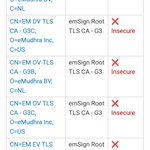
Let’s not forget about this certificate clusterfuck while everyone is busy with the PHP RCE news.
Almost at the same time, another serious security incident became public.
Eight intermediate CA certificates from eMudhra were found to use ridiculously weak private keys. We’re talking about P-384 keys where one private key was literally the number 4. FOUR!
Six of these were TLS CAs, allowing anyone to recover their private keys and potentially issue trusted certificates for arbitrary domains.
Major browsers have already blocked the affected CAs. But what about API clients, backend services, embedded devices, containers, and systems with outdated trust stores?
Many don’t enforce Certificate Transparency or check revocation. Some could remain vulnerable for years.
These weak keys have existed since April 2025. No confirmed malicious exploitation so far, but the implications are serious.
Don’t overlook this one while focusing on PHP.
Technical details and test endpoints:
emudhra.we-have-a-problem.co…
cyber-ipman retweeted

An urgent notice from the Railway team
blog.railway.com/p/security-…

cyber-ipman retweeted
"On October 21st at 07:41 UTC, more than six hours before the coordinated release, Chainguard unilaterally broke the embargo and published built images containing the fix. Like other distributors, Chainguard had received the patch in advance so its users could update the moment the vulnerabilities were disclosed. Any attacker could now study the fix in binary form while every other PHP user was still waiting for the release. This disregarded weeks of work by many parties toward a coordinated disclosure."
thephp.foundation/blog/2026/…
