

Stake Ada at https://teapawt.net/t.co/GZGwQWAOMX. Family owned and operated bare metal Cardano stake pool by Rick, Christian, and Kyle McCracken. Blocks made in the USA.
United States
Joined June 2021
- Tweets361
- Following2.1K
- Followers2.4K
- Likes16.5K




Pinned Tweet
We have decided to vote "No" on the governance action "Should stakePoolTargetNum (k) be raised from 500 to 1000? (SPO poll)"
Rationale:
Raising k works by cutting rewards on pools above the proposed saturation point (about 39M ada, half of today's 78M), pushing their delegators to move, so that some of that stake might go to smaller pool entities. We will not vote in favor of disrupting delegation on sustainable independent pools that have successfully attracted stake, for the chance of a small increase in decentralization.
Increasing k will negatively affect these independent pools that have grown above the proposed saturation point, and could disrupt their operations. Institutional and exchange pools, some of the largest pool entities on Cardano, have full control of the ada delegated to them, so they are effectively immune to losing stake if k increases. That leaves independent pools to take the loss. The trade-off is not worth it.
We do not think k is an effective tool to increase decentralization. Decentralization should come from more users delegating from their own wallets to the pool they want, and from pools competing for that stake.
The Nakamoto coefficient (NC) is the smallest number of pool entities that together control more than half of the stake. Figures published in support of raising k put the NC at about 12 before k was increased from 150 to 500 at epoch 234 (December 6, 2020), rising to a high of 54 at epoch 322 (February 19, 2022), then falling back to about 15 by epoch 630 (May 9, 2026). By these figures, the NC is only about 3 higher than it was before k more than tripled. If there was any effect, almost none of it lasted.
The k parameter stayed at 500 while the NC dropped 72%, from a peak of 54 to about 15, so the answer is something other than k. The rise began near the start of a bull run, when new users were entering the network, and the peak came over a year after k changed. This suggests that the NC moved with other factors much more than with k. Those other factors, including more users, more ada staked from their own wallets, and a growing ecosystem, are where the effort to improve decentralization should go.
Oversaturation Attacks Become Easier and More Damaging:
Halving the saturation point would also make oversaturation attacks on independent pools far easier and more severe. A single attacker can oversaturate any pool near the saturation point just by delegating their ada to it, provoking real delegators to leave to avoid lost rewards. The attacker then moves on to the next pool and can repeat this indefinitely with the same ada. Raising k would put more pools near the saturation point.
These attacks are relatively cheap and easy for a bad actor to carry out. The attacker only has to delegate, so they keep their ada and give up just part of their own rewards. The same amount of ada over the saturation point can also cut delegators' rewards almost twice as much at k=1000 as at k=500.
On December 6, 2020, shortly after k was raised from 150 to 500, one wallet pushed the CFLOW pool about 20M ada over the saturation point, and within five days over 150 delegators with more than 26M ada had left before the wallet moved on to oversaturate other pools.
Digital Fortress 🇺🇲 retweeted

There are 16 Billion Ada currently not staked to a pool. That's 16 Billion Ada not earning rewards.
38.5 B Ada supply
22.7 B Ada staked
Stake your Ada with Digital Fortress to start earning today! If you do, you're probably gonna make it! 🤠
Stake here: digi.pro/

We have decided to vote "No" on the governance action "Reduce minPoolCost to 75 ada and increase Plutus Memory Limits (Part 2)"
minPoolCost to 75 ada: Disagree
Increase Plutus Memory Limits: Agree
We do not support another cut to minPoolCost as a stopgap. Reserve funded block rewards were meant to help bootstrap the chain. These rewards are designed to shrink over time, with transaction fee revenue meant to replace them as the chain matures. That handoff is not happening at the scale it needs to because transaction fee revenue from chain activity has not grown enough to replace the shrinking reserve. Lowering the fixed fee floor as that reserve portion shrinks is just a temporary patch. The same kind of cut will have to be made again until minPoolCost is 0, unless on-chain activity increases enough that transaction fee revenue replaces the shrinking reserve. The purpose of the minPoolCost parameter is to set the minimum fixed fee high enough to cover the economic cost of running a pool. We don't believe a 75 ada fixed fee would reasonably cover those costs. We would rather leave minPoolCost at 170 ada until a parameter such as minPoolMargin is in place. Once in place, we can determine the viability of reducing minPoolCost or retiring the parameter completely.
We voted Yes for the Cardano van Rossem hard fork!

The van Rossem hard fork initiation governance action has been submitted on the Cardano mainnet.
An intra-era hard fork that introduces some new features and lays the foundation for the next major era, Dijkstra, which will ultimately bring Leios to Cardano mainnet.
Looking to the future, while honoring the journey here.
This hard fork is named after Cardano community member, Max van Rossem. A dedicated builder; developer, SPO, DRep, Constitutional Convention delegate, and so much more. Following Max’s untimely passing in October 2025, the Cardano community voted to dedicate this hard fork in Max’s honor in early 2026. The info action, “Name Protocol Version 11 hard fork - van Rossem”, received 83.62% DRep (and 4.44B ada) support.
A lasting dedication in memory of Max has been written within the proposal metadata. Read it below:
gov.tools/governance_actions…

All Digital Fortress [DIGI] Cardano nodes are updated to node version 11.0.1 on mainnet in order to proceed past the PV11 boundary - van Rossem hard fork preparations are under way!

Digital Fortress is on the latest Cardano Node version and correct canonical chain, mitigating the mainnet fork situation on the nodes we control. Systems are looking good.
All Digital Fortress Cardano nodes across the mainnet, preview, pre-production, and Sanchonet networks have been updated to Cardano-node version 10.1.4.
Digital Fortress Cardano stake pools are ready for the Plomin Hard Fork decision deadline for January 24, 2025.
All nodes were updated to version 10.1.3, and "Yes" votes for delegated Ada stake weight was cast in December 2024.
Digital Fortress voted Yes to activate the Plomin Hard Fork.
The Plomin Hard Fork enables full CIP-1694 governance functionality, including DRep voting on all actions, treasury withdrawals, constitutional updates, and votes of no confidence, while also introducing new Plutus primitives for advanced cryptographic and logical operations.

All Digital Fortress Cardano main net servers are upgraded to Cardano-node 10.1.3
Ready for the #PlominHardFork
All Digital Fortress nodes are migrated to Cardano node 10.1.2.
Ready for Chang 2 #Cardano 😎

Check out our new website 👉 digi.pro/
Works great on desktop and mobile wallet dapp browsers.


Digital Fortress voted "Yes" on the Chang 2 Hard Fork initiation on the Preview testnet. SPOs must be on version 10.1.1+ for the hard fork to execute.
Govtool proposal data and action ID at this link: preview.gov.tools/governance…

We're thrilled to announce that Digital Fortress has never needed a "Tech Janitor" to run our pools! Our infrastructure is built in-house for our pools and other Cardano services, with love and lots of coffee ☕️. We promise we’re not just hitting "run" on someone else's scripts.

There is a very good reason for this...
The SPOs aren't supposed to have a say in these parameters. In fact, after seeing this post from @_KtorZ_, I now believe it was a mistake to give SPOs a say in the Security Parameters.
For a bit of history: The "Security Parameter" category was added to CIP-1694 late. It's not even an independent category, it's a bunch of different parameters from the Network, Economic, Technical, and Governance groups that are cross-listed as "Security" because or their vital importance to the system.
To make the "Security Parameters" more robust, the SPOs were given a vote in their governance. The reasoning was that it's because SPOs are "technical experts"... but is that really the case?
Many SPOs are Script Kiddies, utilizing the #Cardano SPO script set to do the great majority of their work. Other SPOs are influencers or great marketers, who employ a tech janitor to keep their pools and nodes running for them.
I'm not saying these people aren't valuable! And there are certainly SPOs who are deep technical experts. But we also have technical experts who build software and work on projects who do not run pools.
Why should an influencer who hires a tech janitor to run their pool have more say over parameters in the system than @adamKDean who retired his (successfully running) pool to focus on building software?
Ultimately, the SPOs do have a way to have a say on Parameters. They can advise their DReps on what they think are the proper thresholds or they can become a DRep themselves!
Keep in mind, both now and after the Chang Hardfork the SPOs still have the power to choose what version of the Cardano node software they will run. They can choose to break the Constitution and change the way Cardano operates if they wish. This is something that the DReps are constrained from doing by the Constitutional Committee.
But the entire reason we have DReps is to provide Ada Holders with a group of representatives who are separate from the SPOs, so that if SPOs do not wish to engage in making choices on how the system is governed - and instead just run the software according to whatever rules are decided upon by the community - they are welcome to do so.
[Closing note: No shade is being cast on @_KtorZ_ here. He has a great mind for governance and any differences of opinion I might have from him are held in good faith.]
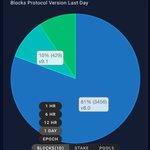
Here is the best way to measure Chang Hard Fork readiness:
1. Go to pooltool
pooltool.io/networkhealth
2. Set Blocks to 1D (not epoch, yet)
3. Check for v9.1
* Don't use "Nodes Reporting Version" as it is a small subset of actual stake. Plus, we have to consider CEX readiness.

We have upgraded to Cardano node version 9.1.0.
Once enough SPOs and exchanges upgrade to this version, the Chang Hard Fork will be initiated.
#Cardano

