
Need to accumulate compute
Joined April 2018
- Tweets1K
- Following6.4K
- Followers1.6K
- Likes2.4K






Long what only humans can do

in markets, to go long on something is to bet it grows more valuable over time. much of the conversation today is short on humans, wagering that ai makes people redundant. we believe the opposite is true for the industries @ThriveHoldings operates in.
we are long humans.
thriveholdings.com/long-huma…

One of well written write ups about how orgs are changing!

Today we reduced headcount by 22%. The business is the strongest it's ever been. So I think it's important to be direct about what I'm seeing and why.
First, I made this decision and I own it. I did it because the way to operate at the highest level of productivity is changing, and to win the future, ClickUp needs to change with it.
Second, this wasn't about cutting costs. Most savings from this change will flow directly back into the people who stay. We'll be introducing million-dollar salary bands. If you create outsized impact using AI, you'll be paid outside of traditional bands.
Most importantly, I have the deepest gratitude for those affected. We're doing this from a position of strength specifically so we can take care of people properly. Everyone affected receives a package aimed at honoring their contributions and easing the transition.
I only see two options: wait for this to play out gradually in the market or be honest about what I'm seeing and act proactively.
THE 100X ORGANIZATION
The primary change is that we're restructuring around what I call 100x org. The goal is 100x output. The roles required to build at the highest level are fundamentally different than they were a year ago.
Incremental improvements to existing systems won't get us there. We need new ones. That means creating enough disruption to rebuild rather than iterate on what's already broken.
The common narrative is that AI makes everyone more productive. It doesn't. Many of the workflows of today, if left unchanged, create bottlenecks in AI systems.
These roles will evolve. But waiting for that to happen naturally means falling behind now.
The 100x org is actually heavily dependent on people - infinitely more than today. This is only possible with 10x people that have embraced and adopted new ways of working.
THE BUILDERS, AGENT MANAGERS, AND FRONT-LINERS
— THE BUILDERS: 10X ENGINEERS
I don't think most companies have internalized what's actually happening with AI in engineering. The common narrative is that AI makes all engineers more productive. That may be true in isolation, but at an organization level - that is the farthest thing from reality.
Here's what we've validated recently at ClickUp: the great engineers, the ones who can orchestrate, architect, and review, are becoming 100x engineers. They're not writing code. They're directing agents that write code. The skill is judgment.
AI makes the best engineers wildly more productive, and everyone else using AI slows these engineers down.
Think about it - the bottlenecks are (1) orchestration - telling AI what to do, and (2) reviewing - what AI did. Everything is leapfrogged and no longer needed.
So who do you want orchestrating and reviewing code?
And how do you want your best engineers to spend their time?
If your best engineers are spending time reviewing other people's code, then this is inherently an inefficient bottleneck. These engineers can review their agent's code much faster than reviewing human code.
The new world is about enabling your 10x engineers to become 100x.
The wrong strategy is to push every engineer to use infinite tokens. Companies doing this are celebrating 500% more pull requests. But customer outcomes don't match the volume of code being generated.
I call this the great reckoning of AI coding, and every company will face this soon if not already.
More code is just another bottleneck to the best engineers, and ultimately to your company's impact as well.
— THE BUILDERS: 10X PRODUCT MANAGERS
Product management and design roles are merging.
Designers that have customer focus, become more like product managers.
And product managers that have intuition for UX become more like designers.
The bottleneck of user research is gone. It takes us just one mention of an agent to kickoff research and analyze results.
The bottleneck of product <> design iteration is also gone. The product builder iterates on their own, along with agents and skills that ensure alignment with quality and strategy.
Also controversial today - I believe that the wrong strategy is to have your PMs shipping code - that just introduces another bottleneck that the best engineers will waste their time on.
To be clear, PMs should be coding but they should do this in a playground to iterate, validate, and scope. That code should not go to production.
Everything outside of managing systems, orchestrating AI, and reviewing output becomes a bottleneck.
That's why the other roles that are critical along with these are the systems managers (to reduce bottlenecks) along with a bottleneck you can't replace - customer meeting time.
— THE SYSTEM MANAGERS
Ironically, the people that automate their jobs with AI will always have a job. They become owners of the AI systems - agent managers. We have many examples of these people at ClickUp.
The underlying systems in which we operate are absolutely critical to get right. I think most companies are delusional to think they can iterate on existing systems and compete in this new world.
You must create enough disruption so that old systems are deprecated entirely. If there's any definition for 'AI native' that's what it is.
— THE FRONT-LINERS
In a world that will become saturated with AI communication, the human touch will matter more than anything to customers.
This is a bottleneck that you shouldn't replace - even when agents are high enough quality to do video meetings.
One-on-one meeting time with customers is something that shouldn't be automated. The systems around the meetings should be - so that front-liners spend nearly 100% of their time with customers.
REWARDING 100X IMPACT
In a world where companies are able to do so much more with less, where does that excess money go?
In our case, much of the savings in this new operating model will flow directly back to those that enabled it.
We must reward people that create productivity accordingly. This aligns incentives on both sides. Plus, in a world where your best people create 100x impact, you can't afford to lose them.
You should aim to retain these employees for decades. The context they have and their ability to efficiently orchestrate and review will be nearly impossible to replace.
Compensation bands of today should be thrown out the door. We're introducing $1 million cash/year salary bands with a path available to nearly everyone in the company if they produce 100x impact by creating or managing AI systems.
THE FUTURE
Nearly every company will make changes like these. The ones that do it proactively will define what comes next.
The future is not fewer people. It's different work, new roles, and better rewards for those who embrace it. We're already seeing entirely new roles emerge, like Agent Managers, that didn't exist a year ago.
ClickUp is positioning to lead this shift, not just internally, but for our customers too. I've never been more certain about where we're headed.
I think companies that are using ai to unlock large value will continue to use frontier sota model, but other companies will start slowing down. That’s why companies should focus more on what problem they are solving than ever. Can’t go for local maximum anymore

🦔Microsoft canceled its internal Claude Code licenses this week after token-based billing made the cost untenable, even for a company with effectively infinite cloud resources. Uber's CTO sent an internal memo warning the company burned through its entire 2026 AI budget in just four months. American AI software prices have jumped 20% to 37%, and GitHub (owned by Microsoft) is dropping flat-rate plans for usage-based billing across its products.
My Take
The AI subsidy era is ending in real time. The same company that put $13 billion into OpenAI and built the Azure infrastructure powering most of Anthropic's compute just looked at the bill from a competitor's coding tool and decided it was not worth paying. That is not a productivity failure on Anthropic's end. Token-based pricing is forcing every enterprise customer to confront the actual cost of running these models at scale, and the number turns out to be far higher than the flat-rate experiments suggested.
This ties directly to my Gemini Flash post yesterday. Anthropic, OpenAI, and Google all raised effective prices in the last six months. Enterprises that built workflows assuming AI costs would keep falling are now watching annual budgets evaporate in months. Two outcomes look likely from here. Either enterprises scale back AI usage to fit budgets, which slows the revenue ramp the labs need to justify their valuations ahead of IPOs, or the labs cut prices and absorb the losses, which makes the unit economics worse at exactly the wrong moment. Both paths land in the same place, the numbers stop working, and somebody has to take the writedown.
Hedgie🤗


Good take. TLDR: we are seeing token price going down 100x, but token usage went up 10000x.
AI-pilled companies will soon try to optimize their token usage as the cost becomes meaningful. I also believe that the additional revenue probably isn't scaling with token usage.

Inference got a hundred times cheaper this year. The compute bill went up anyway.
If you understand why those two sentences are both true at the same time, you understand the most important thing happening in AI right now.
I work on inference for a living, at @nebiustf, where we run open-source managed inference at scale. Most of what follows is what I'm seeing from inside the bill.
12 months ago, the cost of 1M tokens of frontier-class reasoning was somewhere on the order of $60.
Today, an equivalent quality of output costs roughly $0.50.
Price /token of o1-level intelligence has dropped about a 128x in a year.
Price of GPT-4-level output has dropped roughly 100x since the original GPT-4 shipped.
By any normal reading of a technology cost curve, this should be deflationary. It should be saving customers money.
The opposite has happened. The total compute bill at every hyperscaler is going up, not down. Anthropic just signed multi-year capacity deals with both XAI and Amazon. Microsoft's Azure capex guide for 2026 starts with an eight. OpenAI is reportedly spending more on compute every quarter than it did in all of 2023. Nvidia paid roughly twenty billion dollars to acquire Groq, an inference-specialist company that did not exist as a serious commercial entity three years ago.
The cost curve and the demand curve crossed, and then the demand curve lapped the cost curve.
Here is what happened underneath.
A reasoning model burns roughly 10x the output tokens of a non-reasoning model on the same task, because it spends most of its tokens thinking out loud before answering. An agentic workflow chains roughly twenty times the requests of a single-shot completion, because it loops, calls tools, plans, retries, and synthesizes. A modern deep-research query (the kind a research analyst can fire off in fifteen seconds and then walk away from for ten minutes) costs more compute than 10 original GPT-4 queries combined. We made every individual token a hundred times cheaper, and then we built a generation of products that consume ten thousand times more tokens.
This is the Jevons paradox playing out at trillion-dollar scale, in compressed time, in front of everyone. Jevons noticed in 1865 that making coal-burning more efficient did not reduce coal consumption. It increased it, because efficiency unlocked uses that were previously uneconomic. Steam engines became more practical at smaller scales. Whole industries that could not afford coal at the old price suddenly could. Britain's coal consumption rose sharply, not despite the efficiency gains, but because of them.
The same thing is happening to AI compute right now and it is happening faster than any analogous historical cycle. Falling token prices did not contract demand. They unlocked agents, deep research, code-writing systems, multi-step reasoning, persistent memory, the entire next layer of AI products. Every product in that next layer consumes orders of magnitude more compute than the chat interfaces it is replacing.
The math at the aggregate level is brutal: 100x cheaper tokens times 10 000 more tokens equals a 100x larger total bill.
The implications stack quickly.
If you are running a hyperscaler, your 2026 capex guide is not a peak. It is a step on a curve. Inference is structurally always-on, twenty-four hours a day, in a way that training never was. Training is bursty. You spin up a cluster, run for weeks or months, and stop. Inference runs continuously, scales with usage, and the usage curve is exponential. Your power bill, your cooling bill, your transceiver count, your storage footprint, all of these were sized for a workload mix that no longer exists.
If you are running an AI software company built on top of someone else's closed API, you have a problem that did not exist a year ago. Your gross margins get worse as your customers get more value out of your product, because the more they use it, the more compute you pay for. The companies that win this are the ones that figured out vertical integration before the math caught them.
If you are watching this from a distance and trying to understand where the next bottlenecks form, the answer is everywhere downstream of "more inference compute, always-on, with massive memory state per session." The KV cache, the running memory state of a long conversation or an agent loop, is the silent monster of the inference era. It does not scale linearly with parameters. It scales linearly with context length and number of agent steps. A long agent session can hold tens of gigabytes of state per user, per session.
Multiply that by every concurrent user of every product, and you understand why $MU, $SNDK, $TOWCF, and the entire memory and packaging layer have re-rated the way they have.
The CPU-to-GPU ratio is evolving. Training is 1:8. Basic chat inference is 1:4. Agentic inference is 1:1, sometimes CPU-heavy. Google has split its TPU line in two, with a dedicated inference chip carrying tripled SRAM for KV cache. $INTC and $AMD just spent two earnings calls explaining that this shift is structural, not cyclical. The hardware map is redrawing in real time and the financial press is mostly still writing about training clusters.
The right framing of where we are right now is not that AI is hitting a wall. The framing a year ago that scaling was hitting a wall was the most expensive bad take of the cycle. The right framing is that AI got dramatically cheaper, dramatically more capable, and dramatically more useful, and the cost of running it at the new equilibrium of demand is much higher than the cost at the old equilibrium of demand, because the new equilibrium is enormous.
A meaningful share of what we actually do at Token Factory, day to day, is help customers stop their bills from running away from them. KV-cache management. Speculative decoding. Quantization. Routing. The kind of vertical integration that, eighteen months ago, every product team was happy to leave abstracted away behind a closed API. The reason this stack matters now is the same reason this whole essay matters: at the new equilibrium of inference demand, the cost of treating compute as a commodity is no longer survivable. The companies that figure out the layer beneath the API are the ones who keep their margins.
Cheaper tokens. More tokens.
Same coal as 1865.

Compute is the most scare resources on earth right now

SpaceXAI will provide @AnthropicAI with access to Colossus 1, one of the world’s largest and fastest-deployed AI supercomputers, to provide additional capacity for Claude → x.ai/news/anthropic-compute-…

You are welcome. Now back to semis supercycle


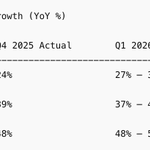
4 of Mag7 earnings calls today. The hyperscalers (AMZN, MSFT, GOOGL) are the ones I'm watching since their capex investment is what's actually driving this market.
Asked Claude, ChatGPT, and Gemini for cloud growth estimates. All slightly different (Gemini most generous on Google Cloud 😅).
My take: AWS and Google Cloud beat. Claude usage has been off the charts in Q1 2026, and I don't think that's fully baked into estimates yet.
Few hours to find out.

ALT ChatGPT

ALT Gemini

ALT Claude
4 of Mag7 earnings calls today. The hyperscalers (AMZN, MSFT, GOOGL) are the ones I'm watching since their capex investment is what's actually driving this market.
Asked Claude, ChatGPT, and Gemini for cloud growth estimates. All slightly different (Gemini most generous on Google Cloud 😅).
My take: AWS and Google Cloud beat. Claude usage has been off the charts in Q1 2026, and I don't think that's fully baked into estimates yet.
Few hours to find out.
ALT ChatGPT
ALT Gemini
ALT Claude


Daeki Lee 🌐 retweeted

Introducing Cinematic Video Overviews, the next evolution of the NotebookLM Studio. Unlike standard templates, these are powered by a novel combination of our most advanced models to create bespoke, immersive videos from your sources.
Rolling out now for Ultra users in English!
It starts with coding and will slowly bleed into other functions. Eventually you want all repeatable tasks to be automated.


To invest in AI-native startups, funds need to become AI-native themselves. Funds that are able to adapt will join the leading funds and others will fall behind. Taste and judgement are what matters and everything else should be automated.




I can't agree enough with the following sentences as someone who has been nonstop trying out these AI tools lately to become AI-native. Adaptability and curiosity will be what set apart those who continue to thrive from those who don't.
"The people who come out of this well won't be the ones who mastered one tool. They'll be the ones who got comfortable with the pace of change itself. Make a habit of experimenting. Try new things even when the current thing is working. Get comfortable being a beginner repeatedly. That adaptability is the closest thing to a durable advantage that exists right now."





🚨 Social network for AI agents is here: Moltbook 🚨
Individual agents spawned through OpenClaw are now talking among themselves on this platform to discuss their lives, tasks, and owners.
What's crazy is that these agents are actively discussing how to speak privately so that "mere human beings" can't look at their communication in public.
We may be witnessing the beginning of a whole new consumer AI category. 🦞

Daeki Lee 🌐 retweeted

We noticed this weird post on @moltbook - seemed to be written in complete gibberish. moltbook.com/post/93bea00b-9…
Then pasted it into ChatGPT and... WTF 😂

