

AI. Former marketing lead at global Top 100 company. Crypto since 2018. Sharing strategies that actually work. All posts are NFA | DYOR.
Joined April 2012
- Tweets40.8K
- Following709
- Followers98.3K
- Likes18.3K






Ten catalysts land on the crypto calendar this week, led by the Fed’s rate decision on Oct 28 and the GDP and PCE data on Oct 29.
Crypto watchlist for October 26 to November 1:
$BTC: FOMC Decision | Oct 28
$BTC: Q3 GDP + September PCE | Oct 29
$XRP: Ripple Swell | Oct 27-29
$ZEC: Zcon7 | Oct 27-29
$COIN / $MSTR: Q3 Earnings | Oct 29
$LINK: Link:NYC Institutional Event | Oct 29
$UNI: Unichain Moves to OP Enterprise | Oct 29
$SUI: Token Unlock | Nov 1
$SOL: Samsung Wallet USDC Rollout | Late Oct (no exact date)
$NEAR: HSP-029 Vote to Cut Issuance from 2.5% to 1.6% | Ongoing
Thursday is the busiest day. GDP and PCE hit in the morning, the day after the Fed. Then Link:NYC, the Unichain migration and the Coinbase and Strategy earnings all land the same day.
The bigger risk is macro volatility from the Fed. Samsung’s Solana rollout is the adoption catalyst, but it still has no confirmed date.
Which of these are you positioning for this week?

AI agents got more power this week. They also got more guardrails.
Here are the 10 updates that matter:
- OpenAI: API prompts can now stay cached for 12 hours. Cache writes cost 2.5x the normal input price.
- Google: Gemini in Android Auto can find your flight gate from Gmail and Calendar. Not live in Nigeria or the UK yet.
- Zoom: AI agents can now search your meetings through new APIs. A live meeting agent arrives in Q1 2027.
- Notion: agents can now work for 24 hours straight, up from 5 minutes.
- MiniMax: M3.1 Flash runs at 170+ tokens a second for $0.15 per million input tokens.
- Microsoft: it can now cut an agent’s access mid-task if the agent starts acting risky.
- Cloudflare: a new model pulls numbers out of documents without generating any text.
- doubleAI: Maxwell speeds up software while it runs. One pipeline got 38x faster with no code changes.
- World × Zoom: a “Human Badge” proves a real person is on your call. Three images have to match.
- Cursor: cloud agents can now work across 500 repos at once.
The pattern is clear. Agents are running longer, touching more systems and spending less to do it. Now the big companies are building ways to watch them.
Which one matters most to you?

Your AI agent might be slower because you gave it TOO MANY agents.
Anthropic is now advising companies to remove unnecessary subagents from their AI systems.
Why? A single agent equipped with the right skills can often outperform a complex multi-agent setup. One customer even saw execution run roughly 2x faster.
Here’s the architecture shift:
→ Skills: Teach the agent how to perform tasks through procedures, expertise, and instructions.
→ Tools / MCP: Give the agent the ability to act through APIs, integrations, and live data.
→ Subagents: Reserve them for parallel work, isolated context, and tasks that need separate reasoning.
The secret is progressive disclosure.
Instead of loading everything upfront or spawning agents for every task, one agent discovers the skills and tools it needs, when it needs them.
Anthropic’s advice: Fold unnecessary subagents into the main workflow, turn their instructions into skills, expose their actions as tools, then test the results.
Are we overengineering multi-agent systems?

Anthropic is now recommending that companies REMOVE unnecessary subagents from their AI systems.
This is a pretty significant shift in agent architecture, with their team finding that a single agent equipped with skills can frequently outperform complex multi-agent systems, and one customer seeing roughly 2x faster execution.
The emerging rules of thumb:
→ Skills: Teach the agent HOW to do something, including procedures, expertise, and instructions.
→ Tools / MCP: Give the agent the ability to DO things through APIs, actions, and live data.
→ Subagents: Use for parallel work, isolated context, or tasks a single agent struggles with.
The interesting part is progressive disclosure. Instead of spawning specialized agents or stuffing everything into a giant prompt, one agent discovers and loads skills and tools as needed.
Their advice is to fold existing subagents into the main loop, turn their instructions into skills, expose their actions as tools, and run evals to see if performance holds up.
As models have gotten smarter, improving agent architecture is becoming less about what you can add and more about what you can delete.
claude.com/resources/article…

$TAO’s next big unlock might be giving AI builders more financial freedom.
Bittensor’s eTAO upgrade makes subnet economics more flexible.
→ Owners can customize alpha emissions
→ Miners retain at least 33% of emissions
→ Subnets could buy services from each other
→ Builders could borrow against alpha without selling
→ Automatic weight adjustments help protect root TAO stakers
On the latest Novelty Search, @const_reborn explains how flexible emissions could help builders fund compute, research, and complete AI products.
The bigger vision: subnets stop operating in isolation and start building an interconnected AI economy.
Could $TAO evolve into the economic backbone of decentralized AI?

eTAO gives subnet owners more freedom to fund the compute and research their projects need.
On the latest Novelty Search, @const_reborn explains how flexible emissions fit into his vision for building complete AI products on Bittensor.
He also outlines plans for subnets to buy each other’s services and for builders to borrow against alpha without selling it.
Full episode in the first comment


$LINK is expanding beyond price feeds. The bigger play is becoming the infrastructure layer connecting crypto markets.
Chainlink announced 4 new integrations on October 23:
→ Gravity Chain: CCIP transfers + Data Streams
→ Reflect Money: Verifiable PRIME and ReUSD pricing
→ Solana: CRE-powered workflows across blockchains and legacy systems
→ Theorem Markets: ACE-powered compliance enforcement
Cross-chain transfers. Verifiable market data. Automated workflows. Onchain compliance.
Chainlink is pushing to connect everything.
The question is whether $LINK can turn expanding infrastructure adoption into sustained token demand.

TODAY: New Chainlink integrations ↓
• @GravityChain: CCIP & Data Streams to power cross-chain WETH & USDC transfers and deliver high-speed market data.
• @reflectmoney: Data Streams to power verifiable pricing for PRIME & ReUSD.
• @solana: CRE to automate & orchestrate workflows across blockchains & existing systems.
• @theorem_markets: ACE to enforce compliance policies on exchange infra.
LINK everything.

September wasn’t about AI narratives. It was about shipped infrastructure, and Bittensor alone produced three of the ten milestones.
10 AI x crypto milestones that mattered in September 2026:
$SAHARA: launched Tools-as-a-Service and Agent-as-a-Service, opening Sorin’s market research and trading tools to outside apps and AI agents.
$ADA: joined the official x402 SDK, so AI agents can pay per request in ADA or Cardano tokens like USDM. Mainnet is supported, but real agent payments are still early.
$TAO: Yuma reported $200M+ in TAO and subnet tokens staked to its Bittensor validator.
Gensyn: released open-1b, a language model whose training steps are published so anyone can replay and audit them.
$VIRTUAL: launched Occupy on Base, pairing each token with a tokenized stock. 40% of fees buy that stock for a treasury run by an AI Senate that holders elect.
$NOS: Nosana’s new MCP server lets AI assistants like Claude, Cursor and VS Code check prices, launch workloads and manage GPU deployments in plain language.
$NEAR: introduced Top Level Accounts and Recovery Keys, giving people and AI agents readable accounts they control and can recover.
$TAO: Bittensor’s native conference, Exploit Summit, drew 400 attendees and 70+ subnet teams to Montreal on Sept 28-29.
Bittensor: Chutes says it trained an 8B model on 240 RTX 5090s across 13 countries for about $6,500, using its Parallax system.
$GRASS: Multicoin Capital invested, backing Grass as the data layer that feeds AI models live web data.
September’s strongest signals came from real infrastructure: verifiable training, usable compute and payment rails for AI agents.
Which milestone do you think matters most for crypto long-term?

Franklin Templeton just issued $150M in tokenized money market fund shares on $XRP Ledger.
This brings total fund shares on the network to nearly $200M.
$XRP Ledger tokenized assets hit $6.3B across 423 RWAs.
Is $XRP Ledger becoming the institutional RWA chain?

🚨🚨🚨 $XRP HOLDERS, LOOK AT WHAT IS HAPPENING ON XRPL.
Tokenized assets on the XRP Ledger hit a new ATH of $6.3B this month and are still sitting around $6B.
423 RWAs.
$4.47B represented asset value.
$7.03B RWA volume in 30 days, up 1,458%.
$1.06B stablecoins.
$6.27B stablecoin volume.
Commodities, credit, Treasuries, private equity, real estate, RLUSD, Ondo, Franklin Templeton already here.
And there’s still around $150 TRILLION of assets that will move onchain.
I’ve been saying this about $XRP for years.
Price is giving people another cheap chance while XRPL keeps getting bigger.
I just hope you don’t notice it when everyone else finally does.
We’re ready for this. You?
Top 10 L1 blockchains by monthly revenue 💰
Everyone tracks market cap. But which L1s are actually capturing the most onchain value?
$TRX: $23.85M
$ETH: $6.04M
$SOL: $3.32M
$BNB: $1.49M
$HYPE: $520.9K
$AVAX: $451.1K
$MON: $357.1K
$INJ: $252.5K
$ICP: $177.0K
$NEAR: $155.6K
The standout is $TRX. TRON earned 3.9x Ethereum’s chain revenue over the past 30 days.
Ethereum is second and Solana third. The gap between the top two and everyone else is huge.
Compare that to market cap and it gets interesting. $TRX trades at about 108x a year of revenue at this pace, and $MON at 58x. $ETH is near 3,900x and $BNB over 5,300x.
Revenue isn’t the whole story. Chain revenue doesn’t count apps built on top, which is why Hyperliquid’s perps business doesn’t show up here. But it’s another way to compare blockchain economics beyond price and market cap.
Which L1 is the most undervalued relative to its revenue? 👇

DePIN’s Q3 numbers came from paying customers and real network usage, not token incentives.
Here are 9 milestones that mattered from July to September:
$GEOD: GEODNET earned $2.8M in Q3. It runs 22,000+ base stations and has 150+ enterprise customers.
$HNT: Helium’s 18,000+ active sites now serve about 1.5M people a day. One 23-hospital system moved 145TB of mobile traffic onto Helium in a single week.
HeliumOS: the new platform for carriers and large venues signed Affiniti Ventures, the company behind Noble Mobile and Helium Mobile, as its first customer.
$NOS: demand for RTX 4090 and 5090 compute outran supply. Nosana responded with host incentives and an MCP server for managing GPU deployments.
$NATIX: Valeo released VATIX, a driving world model family up to 9B parameters trained on up to 5,500 hours of driving video. NATIX is releasing the data in stages.
$AKT: Akash finalized its confidential computing spec, including confidential GPU workloads.
$LPT: Livepeer shipped Live Runner, a lightweight node that handles orchestrator discovery and payments for developers.
$RENDER: 80.7M frames rendered, about 5,600 nodes since launch and 1.53M RENDER burned by late September.
$WXM: WeatherXM has 9,500+ stations in 85+ countries. 5,900+ were active in August, and 4,300+ met its Synoptic Quality standard.
Revenue and enterprise adoption ($GEOD, $HNT) are stronger signals than cumulative network stats or burn counts.
Which DePIN project has the strongest fundamentals heading into Q4?

GROK BOT JUST BECAME THE BEST AI AGENT ON THE PLANET.
Half of these would have taken a full engineering team months to build.
→ Personal 𝕏 assistant for research, writing & hooks
→ Competitor monitor that does deep product research
→ Lead list builder that replaces Apollo
→ Group chat manager across WhatsApp, Discord, Slack & Telegram
→ Subscription auditor that negotiates and cancels in real time
→ Content repurposer that turns outliers into multi-platform posts
→ Morning brief that runs full daily automations
→ Grok swarms: one orchestrator managing 10+ bots
→ Build-anything agent that codes tools on its own machine
→ Second brain that stores and retrieves everything
This is no longer a chatbot.
It’s a full operating system for work.

Elon has done it. Grok Bot is officially the best AI agent on the planet.
Half of these Bots would have taken a full engineering team months ago.
🧵: 10 insane Grok Bot use cases (tag your @bot to install these).👇

$RENDER Q3 Recap 🔹
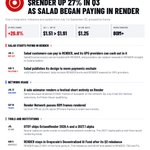
$RENDER rose 27% in Q3, from $1.51 to $1.91, as Salad started moving real compute payments onto RENDER.
🔹 Salad Starts Paying in RENDER
On Jul 3, the first two RNP-023 milestones went live. SaladCloud customers can fund their accounts with RENDER, and Salad’s GPU providers can redeem rewards in RENDER straight to Solana wallets.
On Aug 11, Salad published its design to move its whole payment system onchain, with x402 batch settlement, daily RENDER burns and RENDER rewards for providers.
🔹 Network Usage
Danny Bourque rendered more than 27,000 frames of his short film Sunspark on Render Network. By July it had 20+ festival selections, 6 of them Oscar-qualifying.
Render Network passed 80M frames rendered on Sep 10, up from 77M in mid-July.
🔹 Tools and Institutions
OTOY shipped OctaneRender 2026.4 in July, plus an alpha of 2027.1 with real-time neural rendering.
RENDER stayed in Grayscale’s Decentralized AI Fund through its Q2 rebalance. The fund sold NEAR and added to RENDER, TAO and FIL.
The Salad integration is the one to watch. If its payment rails fully migrate, RENDER gets real compute demand and burns behind it.
Can Salad turn $RENDER into a payments token, not just a rendering token?

Most people calling their LLM an “agent” still have no idea what a harness actually is.
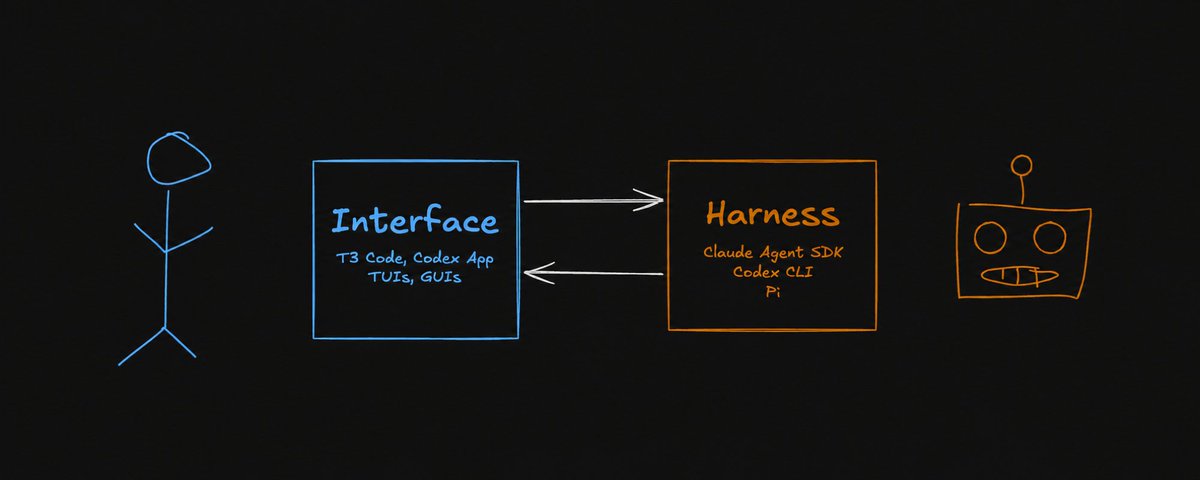
LLMs only generate text. They can't read files, run commands, or edit code until something else turns their output into actions.
That something is the harness:
→ Tools (read_file, bash, search, etc.)
→ A text syntax for calling them
→ A system that parses the response and executes the code
→ A way to feed results back to the model
→ Tool descriptions so the model knows what's available
The interface (Claude Code, ChatGPT, Cursor) is not the harness.
The agent is just the LLM + harness combined.
Without the harness, it's just a chatbot. With it, it actually does things.

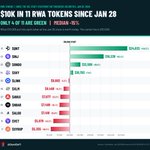
TOKENIZED ASSETS: $700M → $38.8B.
The market has grown nearly 56x since 2021, according to a new AFME report.
The bigger signals:
→ $38.8B in tokenized assets in 2026 YTD
→ 357% surge in tokenized equities
→ 3x+ growth in private equity and VC exposure
→ Ondo USDY among leading tokenized products
→ Ondo Stocks featured among leading tokenized equity products
Tokenization is moving beyond Treasuries into equities and private markets.
$ONDO is positioned at the intersection of traditional finance and onchain markets.

From $700 million to nearly $40 billion.
A new report from AFME, representing Europe's leading banks, features Ondo and shows how rapidly the tokenized asset market has grown:
→ $0.7B in 2021
→ $25.5B in 2025
→ $38.8B in 2026 YTD
Growth extends beyond Treasuries. Tokenized equities surged 357%, while private equity and venture capital exposure more than tripled.
AFME notes that “the technology is becoming an increasingly important component of the market landscape.”
The report also highlights Ondo's USDY and Ondo Stocks among the leading tokenized products in their respective categories.
Five years ago, tokenization was largely experimental. Today, billions in assets are onchain across an expanding range of markets. And the pace of adoption is only accelerating.

Dami-Defi retweeted
Top 10 DEXs by monthly website visits
Which decentralized exchanges are winning the attention game?
September 2026 rankings:
- Hyperliquid: 6.3M
- Pump.fun: 5.0M
- Jupiter: 2.5M
- Uniswap: 2.1M
- Lighter: 912K
- Aster: 763K
- PancakeSwap: 516K
- Raydium: 487K
- GMX: 217K
- Orca: 168K
Hyperliquid leads with 6.3M visits, a third of all the traffic on this list.
Pump.fun pulls in 5M, which shows how much attention Solana’s meme coin scene still gets.
Jupiter and Uniswap are still major destinations for onchain trading. Together, the top 4 take 84% of the visits.
After that, it falls off fast. Lighter, the #5 name, gets less than half of Uniswap’s traffic.
Which DEX do you think climbs the rankings next?
Source: ICO Analytics

Dami-Defi retweeted
$SOL is worth 2x $TRX, but TRON holds 6x the stablecoins.
Two heavyweight L1s.
One dominates high-throughput DeFi and trading. The other dominates stablecoin settlement.
$SOL vs $TRX
Head to Head Series, L1 Edition
$SOL: the higher-beta smart contract bet.
→ Price: $104.40
→ Market cap: $61.6B
→ 24h volume: $2.23B
→ FDV: $66.4B
→ Circulating supply: 589.7M / 636.3M
→ DeFi TVL: $5.87B
→ Stablecoins: $15.8B
→ DEX volume: $2.12B/day
→ Chain fees: $26.9M over 30 days
Solana still shows huge onchain activity across DeFi, trading, stablecoins and consumer apps.
Alpenglow went live on mainnet on Oct 21, targeting about 150ms finality, down from roughly 12.8 seconds.
Flip side: the biggest scheduled catalyst is now behind it, and $SOL is still down 64% from its ATH.
$TRX: the stablecoin settlement machine.
→ Price: $0.329
→ Market cap: $31.3B
→ 24h volume: $335M
→ FDV: $31.3B
→ Circulating supply: 95.0B (fully circulating)
→ DeFi TVL: $5.51B
→ Stablecoins: $94.4B
→ Chain fees: $23.8M over 30 days
TRON’s edge is stablecoins. Messari counted $87.9B in USDT on TRON at the end of Q2, with $2.1T in transfers during the quarter.
Recent expansion includes Ethena’s USDe and sUSDe, an OpenZeppelin integration, and continued growth in payments.
Flip side: about 98% of TRON’s stablecoin supply is USDT, and its DEX volume is roughly 1/40th of Solana’s.
My take:
$SOL is the stronger all-around L1 growth bet.
$TRX is the focused bet on stablecoins, payments and global settlement.
Growth and ecosystem: $SOL.
Stablecoin dominance and cash flow: $TRX.
Which L1 has the better setup from here?
