

PhD @osupolisci | Interests in pre-modern political systems, autocracy, and state formation | Formerly: @START_UMD and @PoliticsUVA
Columbus, OH
Joined January 2023
- Tweets121
- Following174
- Followers115
- Likes6K






Pinned Tweet
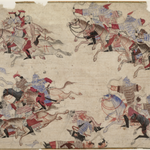
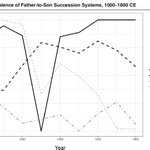
My piece on warfare and succession institutions is out @apsrjournal! I re-examine theories linking warfare to capacity-building institutions in a consequential but understudied geopolitical context, that of Inner Asian Cavalry Warfare. 🧵(1/n) @osupolisci @mershoncenter

#OpenAccess from @apsrjournal -
Storm from the Steppes: Warfare and Succession Institutions in Pre-Modern Eurasia, 1000–1799 CE - cup.org/429Rc0C
- DANIEL STEVEN SMITH (@OhioState)
#FirstView

ALT APSR logo featuring the hashtag "#OpenAccess" in white text on a green background above the name "American Political Science Review" in white text on a blue background.
Daniel S Smith retweeted

Where the Romans fought: 1,709 land and sea battles, from Romulus (753 BCE) to the fall of Theodoro (1475), in 44 of today’s countries. Rome won 916, drew 41, lost 512; 236 more were civil wars.
Interactive map, full list, the Roman armies, sources:
iosiflazaridis.github.io/bat…


Daniel S Smith retweeted

Public Bureaucracy in Europe
@Jan_Vogler presented his forthcoming book in my class. It argues that decisions largely in the 19th century created persistent effects & challenges Weber's prediction of uniform bureaucratic rationalization. It's a book I'll be reading
See cambridge.org/us/universityp…

Daniel S Smith retweeted

I would like to invite you to VWHPE’s inaugural session of the 2026–2027 academic year on Sep. 17, 2026 (12:30 PM ET).
The session will feature a presentation by @AlexanderMkLee & @jackpaine_prof on “Colonial Origins of Democracy and Dictatorship.”
Sign-up link right below. 👇

Daniel S Smith retweeted

🧵1/ You'd expect the Thirty Years' War (1618–1648) to have wiped out German printing. It's stranger than that. The cities that were sacked or besieged saw their presses collapse, but neutral cities boomed. The trade didn't die. It moved.

Daniel S Smith retweeted

Request for proposals: Special Issue of @JHPE_journal on The HPE of Taxation and Regulation.
Details below. Proposal deadline: **This Wednesday, July 22.** Conference @USCPrice: December 1.

Daniel S Smith retweeted

🚨New article🎉
➡️ Parliamentary power in early representative assemblies: evidence from XVII century England, published at @JHPE_journal and co-authored with @tpaskhalis emerald.com/jhpe/article-abs… (1/n)

Daniel S Smith retweeted

Bringing War Back In: Victory, Defeat and the State in Nineteenth Century Latin America (CUP) rose today to the position of #4 Best Seller in Latin American History! Thanks to @lasaintcongress for all the promotion during our conference in Paris, and to all of you for your interest amazon.com/gp/bestsellers/bo…
Daniel S Smith retweeted

Premodern societies tended to be rent by terrible wars. In the early modern period, tens of millions died in wars in Europe, India and China. Just one society found a kind of solution: Japan. Between 1603 and 1853, Japan enjoyed near-perfect peace. The ruling Tokugawa family achieved this through creating what might be seen as the largest prison in the history of the world, the city of Edo (modern Tokyo).
worksinprogress.co/issue/sam…
Most of Japan was governed by about 260 nobles, called ‘daimyo’ (see first map). To secure their loyalty, the government required that the daimyo leave their families permanently in Edo, essentially as hostages to the state. Most daimyo women thus never saw the domains over which their husbands and sons ruled. The daimyo were also required to alternate years in Edo personally.
The result was that most of the surface area of Edo was given over to daimyo palaces, or to accommodation for the hundreds of thousands of samurai retainers they brought with them (see second map). This was arranged through an elaborate zoning system, probably the largest use of zoning before modern times.
Edo was extraordinarily top-heavy socially: about half of its population were samurai. Samurai were theoretically a warrior class, but since Japan was at peace, they did little real work apart from gentlemanly occupations like calligraphy. Their main income came in the form of tiny hereditary stipends from their daimyos or the government.
These stipends were fixed in perpetuity around 1600, declining gradually with inflation over the next quarter of a millennium. Most samurai thus lived in dignified but extreme poverty, their income determined by the favour in which one of their ancestors had stood centuries earlier.
The commoner population was also tightly controlled. Commoner Edo was divided into some 1,500-2,000 fenced and gated blocks. These were then subdivided into gated alleys lined with small houses (see third map). The Low City was thus divided up by tens of thousands of internal checkpoints, all of which closed at night. Edo was not under threat of attack in the Tokugawa period and the city as a whole was not fortified. The purpose of this immense labyrinth of walls and gates was to control and monitor the movement of the population.
Prisons are useful things, and the Tokugawa system was a kind of success, making Japan the most peaceful society on earth. But it is also a disconcerting reminder of the power of rent-seekers, and how a whole city can be warped by the political exigencies they create. Edo is a particularly striking case of this, but it is far from alone.


Daniel S Smith retweeted
Third Annual Historical Political Economy conference @USCPrice: October 16-17, 2026.
Proposal deadline: **TODAY** (May 30)
Keynote: Anna Grzymala-Busse (Stanford)
Google form to apply (as paper giver, discussant, or attendee): docs.google.com/forms/d/e/1F…

Daniel S Smith retweeted

How many Roman cities survived the Dark Ages collapse?
Comparing a database of 405 Roman cities to a database of medieval cities, we can see that around 33 Roman cities survived as cities into the 8th century.
The rest — around 372 (92%!) — were destroyed or depopulated to become small towns or settlements.

Daniel S Smith retweeted
Third Annual Historical Political Economy conference @USCPrice: October 16-17, 2026.
Proposal deadline: May 30
Google form to apply (as paper giver, discussant, or attendee): docs.google.com/forms/d/e/1F…
Daniel S Smith retweeted

A thread on the 50 best fortifications to go and visit in the world according to me. They are all fun for at least one in the family. They are listed in reverse rank order as determined by how much fun, unique and awesome they are.
Daniel S Smith retweeted
🚨 Coming soon: “The Political Economy of Public Bureaucracy” 🚨
My book is forthcoming in 2026 with @CambridgeUP! A preview of the cover art is below. Thanks to Dan Carpenter, @SeanGailmard, & @jrgingrich for their endorsements! 🙏
More details will follow in future posts. 😊

Daniel S Smith retweeted

A fundamental lesson from my posts these last two weeks on modernization, industrial policy, and development is that development economics should be about understanding why South Korea got rich but Bolivia did not.
The current field has largely given up on that question. Sharply identified RCTs on small micro programs are a fine way to publish in the AER and get tenure at a fancy university, but a profession that knows everything about microfinance impact evaluations and almost nothing about industrialization has misallocated its own intellectual capital on a pretty heroic scale.
Four images of Seoul:

Daniel S Smith retweeted

From our FirstView: Consequences of the Black Sea Slave Trade: Long-Run Development in Eastern Europe by @vcharnysh and RANJIT LALL doi.org/10.1017/S00030554261…

Daniel S Smith retweeted

Read #OpenAccess article by Daniel Steven Smith in American Political Science Review, "Storm from the Steppes: Warfare and Succession Institutions in Pre-Modern Eurasia, 1000–1799 CE"
buff.ly/4eVd32l #APSR

Daniel S Smith retweeted
Third Annual Historical Political Economy conference @USCPrice: October 16-17, 2026.
Google form to apply (as paper giver, discussant, or attendee): docs.google.com/forms/d/e/1F…
Daniel S Smith retweeted

In preindustrial Japan, the widespread distribution of land among peasants led to lower wages and GDP per capita than in England, says @YuzuruKumon of @OfficialUoM. #ResearchHighlight aeaweb.org/research/equality…


Daniel S Smith retweeted

Our encomienda paper is now out at @EJ_RES! Ten years of hard work. Alternatively, 10 years spent trying to break down results that withstood everything we & others threw at them.
Thank you @fabiosanchez_to, @CamiloMatajira, Diego Duarte & @laurasotope!
academic.oup.com/ej/advance-…
