

The universe is indifferent, but astronomy, science, and nature help us make sense of its mysteries.✨🚀
Milky way
Joined July 2021
- Tweets19.9K
- Following820
- Followers5.7K
- Likes24.8K






🌍 What If You Fired a Cannonball So Fast That It Never Hit the Ground?
Imagine firing a cannonball from a mountain. At first, it travels a short distance before gravity pulls it back to Earth. Fire it faster, and it lands farther away.
But Isaac Newton imagined something extraordinary: what if the cannonball travelled so fast that, while falling toward Earth, the planet’s curved surface kept dropping away beneath it?
At the right speed, the cannonball would keep falling without ever reaching the ground.
This is the idea behind Newton’s cannonball thought experiment, a powerful way to understand how orbit works.
Near Earth’s surface, an object travelling horizontally at roughly 7.9 kilometres per second can enter a low circular orbit, assuming air resistance and terrain are not in the way. It is still falling because gravity continuously pulls it toward Earth. But its sideways speed carries it forward fast enough to keep missing the surface.
Go faster, and the orbit can become elliptical rather than circular.
Increase the speed to about 11.2 kilometres per second, and an object can escape Earth’s gravity without needing further propulsion, provided it receives no additional energy or significant external influence. This is Earth’s approximate escape velocity from the surface.
The astonishing part is that orbit and escape aren’t different kinds of motion. They are different outcomes of the same force: gravity.
The Moon follows the same basic principle. It is continually falling toward Earth, but its sideways motion keeps it in orbit.
So the next time you look at the Moon, remember: it’s falling, too. 🌙

What is a Faraday cage? ⚡️🛡
A Faraday cage is a device that protects equipment from strong electromagnetic interference. It works by distributing electric charges or radiation around the exterior, preventing them from reaching the inside. 🧲🔒
In the photo, you can see it being used to isolate a television antenna, shielding it from external electromagnetic signals. 📡📺

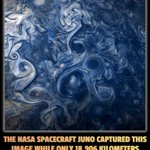
🌀 Jupiter's Clouds Look Like Swirling Paint, But This Is A Real Photograph
At first glance, this looks like an abstract painting, deep blues bleeding into pale swirls, curling and folding into one another like ink dropped into water. But this is not art, it is an actual photograph of Jupiter's atmosphere, captured by NASA's Juno spacecraft from just 18,906 kilometers above the planet's cloud tops, close enough to reveal detail no telescope from Earth could ever capture.
What looks like brushstrokes are massive storm systems and turbulent cloud bands, some stretching for thousands of kilometers, twisting around each other in patterns shaped by Jupiter's extreme wind speeds and constant atmospheric turbulence. The pale, almost white regions are ammonia ice clouds rising from deeper within the atmosphere, while the darker blue tones reveal areas where those clouds thin out, letting slightly deeper, warmer layers show through.
Jupiter's atmosphere is in a constant state of violent motion, driven by wind speeds that can exceed 600 kilometers per hour in certain jet streams circling the planet. Unlike Earth's weather, which is shaped largely by oceans, landmasses, and a relatively thin atmosphere, Jupiter has no solid surface at all. Its storms churn endlessly within a massive gaseous envelope, swirling and colliding on a scale that dwarfs anything experienced on Earth.
Juno was specifically designed to capture imagery like this, orbiting Jupiter in tight, elliptical passes that bring it remarkably close to the planet's cloud layer during each flyby. These close approaches allow cameras to reveal intricate atmospheric detail that would otherwise remain completely invisible from farther away, turning raw scientific data into images that look more like fine art than planetary science.
It is easy to forget this is a real place, an actual, physical storm system captured in a single frame rather than something imagined or painted. Jupiter's chaos, frozen for a moment in stunning, swirling detail.
Some of the most beautiful art in the universe was never painted, it was photographed 🌀

❄️ Greenland's Ice Sheet Looks Otherworldly From Space — And It's Disappearing Fast
From orbit, Greenland looks like a planet wrapped in white silk. This satellite view captures one of the largest ice sheets on Earth, a frozen mass so vast it holds roughly 10% of the world's fresh water. If it ever melted completely, global sea levels would rise by about 7 meters.
What makes this image striking isn't just the scale, it's the texture. Those subtle blue-grey streaks aren't shadows, they're meltwater channels carving their way across the surface, a sign of just how much the ice sheet shifts even in its "frozen" state. Satellites like this one let scientists track that movement in real time, watching Greenland lose an average of over 270 billion tons of ice every year.
Seen from hundreds of kilometers up, it's easy to forget this quiet white expanse is one of the most closely watched indicators of our planet's changing climate. Beauty and warning, wrapped in the same photograph.
One planet, endlessly changing. 🌍❄️

🏔️ A cliff on Mars just collapsed, and a spacecraft happened to catch the dust cloud mid-fall
This image, captured by NASA's Mars Reconnaissance Orbiter, shows an active landslide cascading down a cliff roughly 500 meters high near Mars' north pole, with a visible plume of reddish dust still hanging in the thin Martian atmosphere from the collapse. Catching a moment like this is rare, most geological activity on Mars happens so gradually that spacecraft rarely photograph an event actually in progress.
Mars' north polar region is layered with alternating bands of ice and dust, built up over countless seasonal cycles, and cliffs like this one form as those layered deposits gradually erode and destabilize over time. When enough material finally gives way, it collapses suddenly, sending debris and fine dust particles cascading down the slope and briefly lifting into the atmosphere, exactly what's frozen in this photograph.
Because Mars' atmosphere is roughly 100 times thinner than Earth's, dust clouds like this one behave differently than similar landslides would on our planet, settling more slowly and spreading further before finally resettling onto the surface. Studying active landslides like this one gives scientists valuable insight into how Mars' polar ice caps are shaped and reshaped, layer by layer, over long stretches of time.
Events like this remind us that despite looking like a frozen, unchanging world, Mars' surface is still quietly reshaping itself, sometimes suddenly and violently enough for an orbiting spacecraft to capture it happening in real time 🏔️

🕳️ A Gold mine in South Dakota just picked up something odd
Physicists are calling it "interesting," which is code for pay attention
There's an old gold mine in South Dakota called the Sanford Underground Research Facility, and nearly a mile down, sealed off from cosmic rays and surface noise, sits a tank holding 10 tons of liquid xenon. That's the LUX-ZEPLIN experiment, run by a team of 250 scientists across 39 institutions, and it's the most sensitive dark matter detector ever built. It's been running since 2021, watching for a single flash of light that isn't supposed to be there.
Going back through 220 days of data collected between 2023 and 2024, researchers widened their search to look for more energetic particle collisions. And they found one event that doesn't match anything ordinary matter should produce. If it really did come from a dark matter particle, that particle would weigh over 200 times more than a proton, landing right in the range scientists have spent decades hunting for.
Nobody's ready to call it a discovery, though. The signal sits at 2.6 sigma, and physicists need 5 sigma before they'll use that word. There's still about a 0.5 percent chance it's just an ordinary background event dressed up as something unusual. Rick Gaitskell, the Brown University physicist who leads the project, said it best: "We are not claiming to have seen dark matter. But we have seen something interesting."
This mystery goes back to the 1930s, when astronomer Fritz Zwicky noticed galaxies moving like something invisible was holding them together, and it deepened in the 1970s when Vera Rubin found the same pattern across countless other galaxies. Nearly a century later, dark matter still makes up 27 percent of the universe and we still don't know what it actually is. One flash a mile underground won't solve that. But it's the closest anyone's gotten in years, and other detectors in Italy and China are now watching just as closely.
Somewhere in South Dakota, a room full of physicists is staring very hard at one line on a chart. 👀🌌
Photo credit: Matthew Kapust / Sanford Underground Research Facility

An 8km moon is making 1,500km waves in Saturn's rings.
Daphnis is tiny enough to fit in a city, but its gravity sculpts waves bigger than continents.
Cassini caught this before it died in 2017 — and we're still learning from it.
Cracked detail: That gap is the Keeler Gap, 42km wide. Daphnis' orbit is slightly inclined...

POV: You go to repair Hubble 400 miles above Earth and find out YOU'RE the exhibit. 🔭👽
He thought he was fixing a telescope to look at stars... turns out the telescope was an apartment with tenants inside.
"Thanks for fixing our skylight! 5 stars, great view!"

A Salt Flat Beneath the Galaxy: Milky Way Over Badwater Basin
Cracked salt polygons stretch across Badwater Basin in Death Valley, California, with the Milky Way's colorful core rising overhead, pink with glowing star-forming clouds. Badwater sits 86 meters below sea level, the lowest point in North America, and the dry desert air here makes for some of the darkest, clearest night skies on the continent.
That dryness, paired with almost no light pollution for miles around, is what lets faint details in the galactic core show up so clearly in a single long exposure — details you'd never catch with the naked eye. 🌌

The Solar System's Tallest Peak: Olympus Mons Rises Above Mars
This is Olympus Mons, a massive shield volcano on Mars that stands roughly 21.9 km high — nearly three times the height of Mount Everest — with a base spanning about 600 km, wide enough to cover an area the size of Arizona. Its summit caldera and gently sloping flanks, visible here against the planet's curved limb, formed over billions of years as lava flow after lava flow built the mountain up in Mars' low gravity.
That same low gravity, combined with the absence of shifting tectonic plates to carry the volcano away from its magma source, is exactly what let Olympus Mons grow so much larger than anything found on Earth. 🔴

🔭 Two Astronauts. 400 Miles Above Earth. Fixing The Most Important Telescope Ever Built.
December 1993. Story Musgrave and Jeffrey Hoffman are perched at the end of Space Shuttle Endeavour's robotic arm, 400 miles above the coastline of western Australia, making final repairs to the Hubble Space Telescope.
By hand.
When Hubble launched in 1990 it was supposed to revolutionize astronomy. Instead scientists discovered its primary mirror had been ground to the wrong shape by just 2.2 micrometers. Less than a fraction of a human hair. Enough to make every image it sent back slightly blurry. A billion dollar telescope that could not see clearly.
The world was not kind about it.
NASA had three years to figure out a fix. The solution required building corrective optics, essentially contact lenses for a space telescope, and then sending astronauts to install them while orbiting Earth at 28,000 kilometers per hour.
Five spacewalks over eleven days. The most complex repair mission ever attempted in the history of spaceflight.
Musgrave and Hoffman alone performed two of those walks. Working in pressurized gloves that reduce hand sensitivity dramatically, handling precision instruments, working against a backdrop of the entire planet below them, with no margin for error.
When Hubble sent back its first corrected images in January 1994 the astronomy community was stunned. Every single one was sharper, deeper, and more extraordinary than anything ever captured before.
The telescope that became a punchline became the greatest scientific instrument humanity had ever built.
🔭 They fixed a telescope 400 miles above Earth with their hands. And everything we know about the universe changed because they did.

A Dragon's Breath at Sunset: Frozen Lake Baikal
This jagged rock formation rises like a dragon's spine along the shore of Lake Baikal, its cracked cliffs draped in thick icicles as a lone figure crosses the frozen surface below. Baikal is the world's deepest and oldest lake, holding roughly 20% of Earth's unfrozen fresh water, and each winter its surface freezes into clear, cracked ice up to 2 meters thick.
The glowing sky and fractured ice sheet reveal why Baikal draws photographers from around the world every winter — few places combine such dramatic geology with ice this transparent, letting light and color pour through the frozen surface itself. ❄️
