

// Co-Founder @TellMeAboutCORE // Digital ID · RWA · Payments — explained 💚 // Deep dives: $XCB $CTN $ARAT $XCB:CB292120D3ABC3B8330A26DAF4BEB94B1F6A9C7B4963
Bavaria, Deutschland
Joined May 2021
- Tweets9.8K
- Following1.2K
- Followers921
- Likes75.7K


Pinned Tweet
Nobody builds anymore. They assemble.
Neobanks: 14+ rented vendors.
Digital ID: someone else's database.
RWA: tokens with no exit to cash.
Self-custody: your keys, but the exit is a CEX.
One ecosystem builds the entire stack 👇
📁 Core Ecosystem (CoDeTech)
┃
┣ 📁 L1 Chain — Core Blockchain
┃ ┣ 📁 PoW → PoDE · RandomY
┃ ┣ 📁 CPU mining · no ASICs
┃ ┣ 📁 Mine on a phone
┃ ┣ 📁 Ed448 · 224-bit, not 128
┃ ┣ 📁 ICAN · IBAN-style addresses
┃ ┗ 📁 $XCB energy · $CTN utility
┃
┣ 📁 Identity — CorePass
┃ ┣ 📁 One self-custodial ID
┃ ┣ 📁 Get paid for your data
┃ ┣ 📁 KYC once · not per app
┃ ┣ 📁 Passkeys · no passwords
┃ ┣ 📁 Multichain wallet built in
┃ ┣ 📁 Coins · RWAs · NFTs · one ID
┃ ┗ 📁 KYB · .core names · voting rights
┃
┣ 📁 Standards — PayTo
┃ ┣ 📁 payto:// · RFC 8905
┃ ┣ 📁 One URI: XCB IBAN BIC UPI PIX
┃ ┣ 📁 Payments · donations
┃ ┣ 📁 Open banking API · banks plug in
┃ ┗ 📁 PayPass · Apple & Google Wallet
┃
┣ 📁 Programmable Money — CorePay
┃ ┣ 📁 Runs on PayTo rails
┃ ┣ 📁 Links · embeds · plain HTML
┃ ┣ 📁 Recurring · daily to yearly
┃ ┣ 📁 Split bills · many payers
┃ ┣ 📁 Deadlines · asset fallback
┃ ┣ 📁 Signed webhooks · EdDSA
┃ ┗ 📁 Routing decided on-chain
┃
┣ 📁 Stable Tokens — MoneyX
┃ ┣ 📁 USDX · EURX · CNYX · THBX
┃ ┣ 📁 First four · any fiat can follow
┃ ┣ 📁 Strict 1:1 · fiat in reserve
┃ ┗ 📁 Mint on deposit · burn on redeem
┃
┣ 📁 Settlement — Core Network
┃ ┣ 📁 Own rails · no card networks
┃ ┣ 📁 No bank account · no credit check
┃ ┣ 📁 One wallet · every asset
┃ ┗ 📁 Send to a handle · not an address
┃
┣ 📁 Banking — Wall Money
┃ ┣ 📁 First hybrid self-custodial bank
┃ ┣ 📁 Bank + blockchain · one account
┃ ┣ 📁 Not a card wrapper · a real bank
┃ ┣ 📁 Visa · UnionPay · legacy bridge
┃ ┣ 📁 Any card becomes a crypto card
┃ ┣ 📁 Gift cards · insurance · lounges
┃ ┣ 📁 Self-custody toggle
┃ ┗ 📁 Merchant kickback · mint and earn
┃
┣ 📁 Markets — Ping Exchange
┃ ┣ 📁 Four exchanges in one
┃ ┣ 📁 Crypto · stocks · commodities · FX
┃ ┣ 📁 Real humans · CorePass-verified
┃ ┣ 📁 No market makers · real prices
┃ ┣ 📁 CEX speed · DEX-grade custody
┃ ┗ 📁 Nothing moves without you
┃
┣ 📁 RWA — Core Tokenizer
┃ ┣ 📁 Copper · silver · commodities
┃ ┣ 📁 Working hours · whiskey barrels
┃ ┣ 📁 If it holds value, it tokenises
┃ ┣ 📁 Digital Product Passports
┃ ┗ 📁 Proven in store · Riflessi, NYC
┃
┣ 📁 Merchant — Commerce
┃ ┣ 📁 WooCommerce · recurring built in
┃ ┣ 📁 ARK · Shopify · one-click tokens
┃ ┗ 📁 Shop plugin · serverless store
┃
┣ 📁 Connectivity
┃ ┣ 📁 Luna Mesh · DePIN · no internet
┃ ┣ 📁 TxMS · transactions over SMS
┃ ┗ 📁 Heyo · calls & chats · no SIM
┃
┣ 📁 Social — Ting
┃ ┣ 📁 Streaming · creators · OBS
┃ ┗ 📁 Your ID is the account
┃
┣ 📁 Dev Toolchain
┃ ┣ 📁 Ylem · compiler
┃ ┣ 📁 Foxar · build & test
┃ ┗ 📁 MOTA · dApp framework
┃
┣ 📁 Education — TMMAC
┃ ┣ 📁 Official · verified by CoDeTech
┃ ┣ 📁 Podcast · articles · archive
┃ ┗ 📁 Your entry point · start here
┃
┗ 📁 Enterprise
┗ 📁 Arax · BaaP
🟢 Live: Core · CorePass · Ping · CorePay
🟡 Final testing: Wall Money · KYB · stables
🔵 Announced: CorePort · Ping trad-fi markets
⚪ Building: Luna Mesh · Ting · Heyo
Assembled stacks rent every folder.
One key opens all of them. That is Web4. ✍️
No key had to leak. A laptop reached a service container, the container asked, and the signing system signed. Across ten chains.
The freezes caught about $3B, but only where an issuer holds an admin key. The ETH and BTC were gone the moment the signature existed.
So the real question was never freeze or no freeze. It is who has to sign before money leaves.
On @PingHEX, every withdrawal needs an authorization signed offline with your own CorePass ID. A server can ask. It cannot produce your signature. ✍️

Binance's initial investigation suggests that the security incident may involve a compromised DevOps engineer’s laptop, which allowed an attacker to gain access to a service container and submit unauthorized withdrawal transactions. We have found no evidence of any wallet private key leak. We will share a detailed technical post-mortem once the investigation is complete and the facts are fully verified.
The estimated total impact sits at around $6.3B. We have worked with blockchain partners to freeze affected assets, with ~$3 billion frozen on-chain so far.
Binance will cover all losses from the SAFU fund and the company’s funds. User funds are safe. We will also publish an updated Proof of Reserves once the remediation is complete.
As an immediate precaution, Binance has:
- temporarily suspended deposits and withdrawals while security checks are completed;
- revoked the affected address authorisation;
- engaged law enforcement and blockchain intelligence partners to trace and recover funds.
Our teams are working around the clock to resolve this issue safely and thoroughly. We are working closely with our law enforcement partners to confirm the identity of these criminals and bring them to justice.
Please rely only on official Binance channels for updates. Please feel free to contact Binance Customer Support if you have any further questions.
binance.com/en/support/annou…

Some days don't announce themselves. ✍️
Today was one of them. 💚
Looking back, this is the moment we'll point to and say: that's where it truly began. A foundation has been laid, quiet in the moment, but built to carry everything that comes next.
Great things aren't rushed. They're built, stone by stone.
Stay tuned. A lot is coming. @TellMeAboutCORE 💫
#XCB #CTN #TMMAC
$XCB $CTN $ARAT
Two buttons on every login screen, and both keep your login on someone else's server. Easy to use, and easy to forget who actually holds the account.
We made a 40 second film about the third button.
What stuck with me while building it: a site doesn't need your email to know it's you. With the CorePass Connector it receives your Core ID, and nobody gets in until you approve the sign-in on your phone. No password to reset, no email or phone number to give away just to log in.
For builders it is about five minutes of work. For users it is a QR code and a single approval.
The third button is the one you hold.✍️

Most login screens give you two buttons. This film is about the third.
Sign in with Google or Apple is easy, but your login lives on their servers. The CorePass Connector moves it to your phone: scan a QR code, approve the sign-in in the CorePass app, and you are in.
The app receives your Core ID, the only identifier it needs to keep. No password, no email address, no phone number stored.
For builders, a working login takes about five minutes: connector.corepass.net
Someone asks what Core is. You can give a lecture, or you can send a link. ✍️
tellmemoreaboutcore.com, your entry point into Core, documented first-hand since 2022.
Next time someone asks, this is where they start.

Tokenization debates start at the asset: which asset, which chain, which wrapper. The harder question comes right after. Who may act for the owner?
A company that holds or trades anything onchain needs three answers. Who is the company, who speaks for it, and what is each person allowed to do.
Verification answers the first. Ping Exchange now takes the answer to the market: every trader works inside a defined mandate, and moving funds needs the member approvals the company has set. Identity, then authority, then the market.
That order is the point. An asset is only as usable as the authority behind it, and that layer is being built first.

PING EXCHANGE. BUSINESS TRADING.
CorePass verifies the business.
Ping connects it to the market.
We're introducing a major expansion of Ping Exchange, built for how real organisations operate.
This goes far beyond business accounts.
🎬 Watch the new Core Chronicle.
youtu.be/min56wg2HQU
Your business. Your people. Your rules.
#PingExchange #CorePass #CoreBlockchain

Read this “Update” carefully again. 😎✍️

Thank you 🤝
Quick course, short syllabus: one Core ID instead of email and password, and the email goes to the museum. Some prefer the spotlight and say they found it themselves. Giving credit costs nothing, and it makes builders want to help the next one.✍️

Van „misschien eerst vragen voordat je conclusies trekt“ naar „e-mail hoort in het museum“ in 24 uur 😄
Shoutout naar @Daniel_StotheC voor de snelle cursus 🙏
Welkom aan de wachtwoordloze kant 💚
Posted this in the Core Telegram group today, here it is again for everyone on X: how to add "Login with CorePass" to your website or app.
What you can do with the Connector:
• Login without passwords: users just scan a QR code with their CorePass app
• Check verified info about a person (date of birth for an age check, email, address, etc.)
• Verify companies too (business identity)
What you need:
• The CorePass app with a verified (KYC) account
• A website or app of your own
No servers to run, no tokens needed.
Steps:
1. Go to dashboard.corepass.net and log in by scanning the QR code with the CorePass app
2. Register your website there and create a "login client" (the dashboard guides you)
3. Add "Login with CorePass" to your site. Users scan the QR code and you get their CoreID back
Full guide with code: docs.corepass.net → CorePass Connector → Quickstart
We'll also publish a short article on this. If you get stuck, just ask.
For context: we shared this guide in the Core Telegram group earlier today. Nice to see another project adding CorePass login, greetings to Ingrid. It's far better than an email login ;)
I can't repost her post, as I'm blocked. Everyone is welcome to build with the Connector, we're happy to help. 💚

Papers describe who may act for a company. They cannot enforce it.
CorePass KYB puts the rule onchain: an action without the required member approvals does not go through, and the answer to a partner comes back signed.
Right now the proof is still a stack of notarized copies. Fax machines were a standard once, too. ✍️
A request. A vote. A signed answer.
CorePass KYB is live: the company itself becomes a smart-contract wallet.
Today, every new partner asks the same three questions. Who is behind the company? Who decides? Where is the proof? The answer is a stack of papers: commercial register, power of attorney, shareholder list, notarized copies. And the next partner asks again.
With CorePass KYB the company gets a name, a team of members and approval rules for every kind of action. Once all voting members have signed, the wallet is active.
From then on, when a partner asks for data, the members vote and the answer comes back signed. There is no single key.
A form can say who may sign. A wallet can require them to.
@CorePassCC
The most important line is the last one: trust can't be fixed with a firmware update.
The implant didn't break the chip. It read the screen, at the exact moment the 24 words were displayed. The weak point was never the secure element. It was a device you buy specifically for crypto, from a reseller.
That is what makes hardware wallets the perfect target: whoever buys one holds crypto. Every tampered unit is a hit. A phone isn't untouchable, but it isn't a device only crypto holders buy, and it's usually one you've been using yourself for years.
CorePass takes exactly that route: the keys are generated on your phone, never leave it, and CorePass can neither see nor recover them.
So the question is no longer whether you hold your keys. It's which device you see them on for the first time.

Un Ledger peut passer tous les tests d'authenticité… et envoyer tes 24 mots à un inconnu par réseau mobile.
❌ Pour moi, c'est terminé. Je raccroche les hardware wallets.
Et ça me fait mal de l'écrire. Pendant des années, c'était LE conseil. "Not your keys, not your coins." Achète un Ledger, range ta seed, dors tranquille. Je l'ai répété moi-même.
Ce qu'on a trouvé dans des Nano X vendus neufs, sous blister intact :
1️⃣ Une deuxième carte cachée derrière l'écran, à la place du coussinet
2️⃣ Une batterie remplacée par une plus petite pour faire de la place
3️⃣ Une puce, une antenne, une eSIM et un modem 4G
L'implant ne touche pas la puce sécurisée. Il lit l'écran au moment où ta phrase de récupération s'affiche, puis il l'envoie. Le "Genuine Check" reste au vert.
Ledger a confirmé un implant dans l'appareil d'une victime. Plus de 70 millions de dollars auraient été vidés chez des clients d'un revendeur officiel en Asie du Sud-Est.
🚨 Et ça ne resterait pas en Asie. Un acheteur affirme avoir trouvé des câbles en trop dans un Ledger acheté en magasin, chez un revendeur officiel européen. Selon Mark Karpelès (ex-patron de Mt. Gox), l'antenne porterait une étiquette "version eurasienne". Il pourrait donc y en avoir d'autres en circulation.
📍 Et le plus beau : la réponse officielle. Leurs systèmes ne sont pas compromis et il faut acheter chez le fabricant ou chez un revendeur agréé.
Et devinez quoi ? Le revendeur était agréé.
⚫ Rien ne prouve que tous les Ledger soient piégés. Mais c'est justement le problème : tu ne peux plus le prouver toi-même. Tout le trajet entre l'usine et ton salon est une boîte noire.
Le hardware wallet n'avait qu'une seule promesse : ne faire confiance à personne. Aujourd'hui, il faut faire confiance à l'usine, au transporteur, au revendeur, au magasin… et à un tournevis.
🚩Je pense que cette industrie n'a plus d'avenir. Pas parce que la puce est mauvaise. Parce que la confiance ne se répare pas avec un firmware.
Verification is only the beginning. For RWAs, what comes after it is the interesting part.
Tokenization usually stops at the asset. The company behind it, who may sign for it and which approvals an action needs still live on paper. CorePass KYB puts that side on-chain: the business is a self-custodial wallet with a DAO behind it, and an action without the required approvals does not go through.
Not the company itself. The authority to act for it.
teapawt.net/CorePassCC/status/2108…

COREPASS KYB IS LIVE.
Digital identity is expanding from people to businesses.
But verification is only the beginning.
What CorePass has built goes much further, and we believe it represents another world first.
🎬 Watch the new CC:
youtu.be/7FJUZLEGhjE
#KYB #DAO #RWA

$USDT “Decentralized” 🙈😅😂😂😂
Most people don't know what real decentralization is 🙏

TETHER CAN DELETE YOUR BALANCE. IT'S WRITTEN INTO THE CODE.
Not freeze it. Delete it.
The USDT contract has a function called destroyBlackFunds. It has been there since the 2017 Ethereum deployment.
Here is what it does, in order. It checks that your address is already blacklisted. It reads your balance into a variable the developers named "dirtyFunds". It sets your balance to zero. It subtracts that amount from total supply. Then it logs the event.
No function can reverse it. Once it runs, that balance is gone forever.
The blacklist function names the address it targets "_evilUser". That is how the code sees you before anyone has proven anything.
Only Tether's owner multisig can call it, on Ethereum and on Tron. A court can't. A regulator can't. When a government wants your money, Tether is the one that executes.
Then comes step two. Tether mints the same amount fresh to whoever it chooses: a victim, a court address, a government address. Net supply change is zero. Your money just changed owners.
The DOJ described this exact process in a forfeiture case filed in Massachusetts in March 2025, over roughly $9,016,612 in USDT. Burn, then reissue.
USDC can block a wallet but can't burn the balance. Tether built the eraser in from the start.
They keep promising you there will be no CBDC.
It already exists. It runs on Tron and Ethereum, and it has an owner.
Bitcoin doesn't. Exit with Bitcoin.

S_tothe_ ₡ORE retweeted
Here is where @CoDeTechCC shows up on the map: one entry, filed under tokenization infrastructure. That is the layer the directory has a box for. The stack behind it reaches further, with identity, payments and an exchange built as layers on Core.
@CorePassCC is the identity layer. Ping, the exchange, verifies its accounts through it. A user verified once carries that identity from one to the other, instead of clearing a new check at every box on this map.
Payments and the exchange are in production. Tokenization and cash-out on the same identity are still in testing, which is the correct order, because trust matters more than speed there.
Every box on the map can be excellent on its own. The open question is which of them will accept a verification they did not run themselves.

Read and understand ✍️

第13柱:無血の開国 🗝️解錠
ひとよひとよの大予言ー2026年、真の審判がBlockIndexの刻印と共にやってくるー|HITOYOHITOYONI @hitoyo2023 note.com/cute_ixora24/n/n77c…

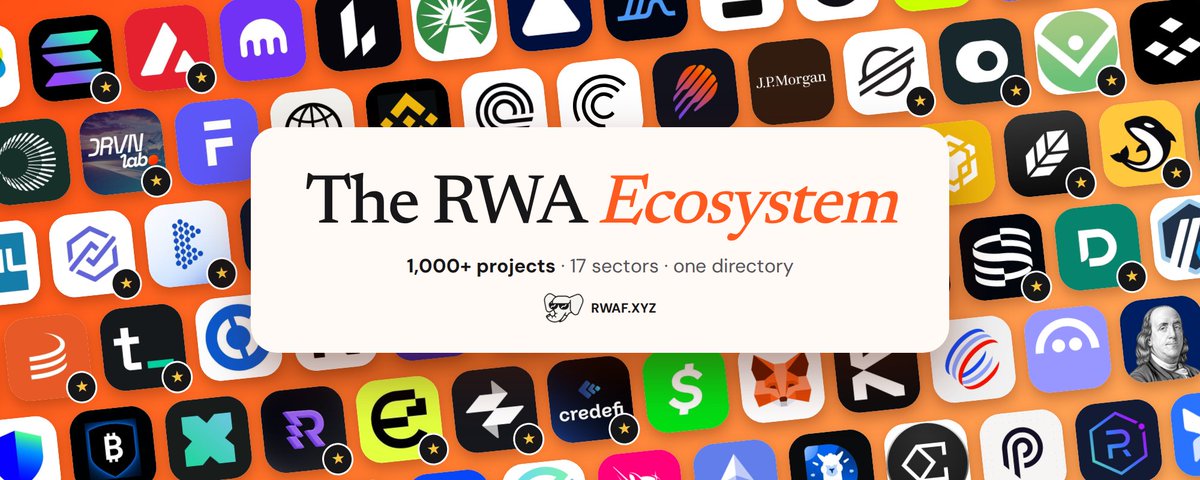
Good map, and it shows the real state of RWA better than any chart. By RWAF's count: 1,000+ projects, 17 sectors, 81 stablecoin issuers, 78 chains.
Read it as a stack: chain, wallet, custody, oracle, exchange, lender, off-ramp. Almost every box is its own company with its own onboarding, its own verification and its own exit. Tokenizing the asset was the easy part. The hard part is everything between the boxes.
@CoDeTechCC took the other route and builds identity, payments, markets and tokenization as one ecosystem on Core. The user verifies once, and the pieces share a layer instead of sharing adapters. Slower to build, for exactly that reason.
The map shows who is building. Now count how many of those boxes share an identity layer.


Look at what Ockert Loubser and his father Michael built in 2003.
POS terminals in rural South Africa that sent every transaction over GPRS to a ledger instead of keeping it on the device. Funeral businesses that had run on paper receipt books suddenly had records nobody could quietly lose. Four years before M-Pesa, four years before the iPhone.
If you use CorePass, trade on Ping or mine XCB, this is the line you are standing in. Not a team that discovered payments in the last cycle. Twenty-three years of the same people solving the same problem, with blockchain from 2013 and Core mainnet in 2022.
Most people in this space never look at who built the rails they are on. Now you know.
2003. Rural South Africa. POS terminals on GPRS, a shared ledger, and the funeral industry replacing paper receipt books.
That is five years before the Bitcoin whitepaper, and it is where this team started building payment rails. Nobody called it blockchain because the word did not exist yet.
Twenty years of building in places where failure has consequences shapes how you ship.
Opening 📁 Chain: Core Blockchain ($XCB)
Every folder in this tree stands on one floor. Most stacks rent theirs: a chain someone else runs, with rules written for someone else's use case.
Core is the floor @CoDeTechCC builds on: an independent L1 from a team working together since 2013, live since May 2022. Its own consensus, its own cryptography, its own address format.
📁 Decentralization starts with hardware you already own
Classic proof of work turns security into a bidding war for electricity, and AI datacenters now win that auction. PoDE, the next step from proof of work, never bids. Its RandomY algorithm needs a 256 MB dataset and a cache small enough for a phone chip. Decentralization was never a property of the hash function. It depends on who can afford to take part, and here the entry device is already in your pocket.
📁 No halving, no cliff
Every block pays 5 $XCB, and that never runs out. Bitcoin halves its reward until fees alone have to pay for security. The amount per year stays fixed while the supply grows, so the inflation rate falls every year on its own.
📁 Ed448 and SHA-3, not secp256k1 and Keccak
Signatures use Ed448 from RFC 8032, a 224-bit curve. Bitcoin and Ethereum sign at roughly 128 bits. Core even wrote its own HD wallet standard for it (CIP-99). Hashing uses SHA3-256, the finished NIST standard, where Ethereum uses Keccak, the version from before standardization.
📁 Addresses built like an IBAN
ICAN follows the IBAN structure: a network prefix, two check digits, modulo 97. The network is part of the address, cb for mainnet, ab for testnet, so a test address can never pass for a real one. Almost every typo gets caught before the money moves.
📁 Internet optional
A signed Core transaction fits in a few text messages. TxMS, maintained inside the ecosystem, relays it over a basic cellular network, no data plan needed. Core's own site lists mesh networks and satellite streams next to mobile internet, and Luna Mesh, in development, carries transactions device to device where there is no internet at all.
📁 Standards of its own
31 public Core Improvement Proposals. Beyond the familiar token standards, Core writes its own: ICAN addresses (CIP-100), Ed448 wallets (CIP-99), payto:// payments (CIP-10), and RWA metadata that links a tokenized asset to its lab certificate (CIP-150, CIP-152).
📁 One address for the whole stack
Your CorePass ID is a Core address. The same key that signs a transaction logs you into Ping, authorizes every withdrawal and is tied to your verified identity.
You use the other folders. This one is why they hold.

Nobody builds anymore. They assemble.
Neobanks: 14+ rented vendors.
Digital ID: someone else's database.
RWA: tokens with no exit to cash.
Self-custody: your keys, but the exit is a CEX.
One ecosystem builds the entire stack 👇
📁 Core Ecosystem (CoDeTech)
┃
┣ 📁 L1 Chain — Core Blockchain
┃ ┣ 📁 PoW → PoDE · RandomY
┃ ┣ 📁 CPU mining · no ASICs
┃ ┣ 📁 Mine on a phone
┃ ┣ 📁 Ed448 · 224-bit, not 128
┃ ┣ 📁 ICAN · IBAN-style addresses
┃ ┗ 📁 $XCB energy · $CTN utility
┃
┣ 📁 Identity — CorePass
┃ ┣ 📁 One self-custodial ID
┃ ┣ 📁 Get paid for your data
┃ ┣ 📁 KYC once · not per app
┃ ┣ 📁 Passkeys · no passwords
┃ ┣ 📁 Multichain wallet built in
┃ ┣ 📁 Coins · RWAs · NFTs · one ID
┃ ┗ 📁 KYB · .core names · voting rights
┃
┣ 📁 Standards — PayTo
┃ ┣ 📁 payto:// · RFC 8905
┃ ┣ 📁 One URI: XCB IBAN BIC UPI PIX
┃ ┣ 📁 Payments · donations
┃ ┣ 📁 Open banking API · banks plug in
┃ ┗ 📁 PayPass · Apple & Google Wallet
┃
┣ 📁 Programmable Money — CorePay
┃ ┣ 📁 Runs on PayTo rails
┃ ┣ 📁 Links · embeds · plain HTML
┃ ┣ 📁 Recurring · daily to yearly
┃ ┣ 📁 Split bills · many payers
┃ ┣ 📁 Deadlines · asset fallback
┃ ┣ 📁 Signed webhooks · EdDSA
┃ ┗ 📁 Routing decided on-chain
┃
┣ 📁 Stable Tokens — MoneyX
┃ ┣ 📁 USDX · EURX · CNYX · THBX
┃ ┣ 📁 First four · any fiat can follow
┃ ┣ 📁 Strict 1:1 · fiat in reserve
┃ ┗ 📁 Mint on deposit · burn on redeem
┃
┣ 📁 Settlement — Core Network
┃ ┣ 📁 Own rails · no card networks
┃ ┣ 📁 No bank account · no credit check
┃ ┣ 📁 One wallet · every asset
┃ ┗ 📁 Send to a handle · not an address
┃
┣ 📁 Banking — Wall Money
┃ ┣ 📁 First hybrid self-custodial bank
┃ ┣ 📁 Bank + blockchain · one account
┃ ┣ 📁 Not a card wrapper · a real bank
┃ ┣ 📁 Visa · UnionPay · legacy bridge
┃ ┣ 📁 Any card becomes a crypto card
┃ ┣ 📁 Gift cards · insurance · lounges
┃ ┣ 📁 Self-custody toggle
┃ ┗ 📁 Merchant kickback · mint and earn
┃
┣ 📁 Markets — Ping Exchange
┃ ┣ 📁 Four exchanges in one
┃ ┣ 📁 Crypto · stocks · commodities · FX
┃ ┣ 📁 Real humans · CorePass-verified
┃ ┣ 📁 No market makers · real prices
┃ ┣ 📁 CEX speed · DEX-grade custody
┃ ┗ 📁 Nothing moves without you
┃
┣ 📁 RWA — Core Tokenizer
┃ ┣ 📁 Copper · silver · commodities
┃ ┣ 📁 Working hours · whiskey barrels
┃ ┣ 📁 If it holds value, it tokenises
┃ ┣ 📁 Digital Product Passports
┃ ┗ 📁 Proven in store · Riflessi, NYC
┃
┣ 📁 Merchant — Commerce
┃ ┣ 📁 WooCommerce · recurring built in
┃ ┣ 📁 ARK · Shopify · one-click tokens
┃ ┗ 📁 Shop plugin · serverless store
┃
┣ 📁 Connectivity
┃ ┣ 📁 Luna Mesh · DePIN · no internet
┃ ┣ 📁 TxMS · transactions over SMS
┃ ┗ 📁 Heyo · calls & chats · no SIM
┃
┣ 📁 Social — Ting
┃ ┣ 📁 Streaming · creators · OBS
┃ ┗ 📁 Your ID is the account
┃
┣ 📁 Dev Toolchain
┃ ┣ 📁 Ylem · compiler
┃ ┣ 📁 Foxar · build & test
┃ ┗ 📁 MOTA · dApp framework
┃
┣ 📁 Education — TMMAC
┃ ┣ 📁 Official · verified by CoDeTech
┃ ┣ 📁 Podcast · articles · archive
┃ ┗ 📁 Your entry point · start here
┃
┗ 📁 Enterprise
┗ 📁 Arax · BaaP
🟢 Live: Core · CorePass · Ping · CorePay
🟡 Final testing: Wall Money · KYB · stables
🔵 Announced: CorePort · Ping trad-fi markets
⚪ Building: Luna Mesh · Ting · Heyo
Assembled stacks rent every folder.
One key opens all of them. That is Web4. ✍️
GM ☕️

Need a Core ecosystem logo? Take the original file, not a screenshot.
corecdn.info has the marks and badges as SVG and PNG, 16 to 1024 px. The official TMMAC logo is in there now too, next to the CoDeTech products.
Mark: no background. Badge: with background.
That position was never conservative. It was the design brief, written at a time when most of the industry could not yet picture tokenized assets at all, let alone what they would need.
A token that stands for a real asset is only worth something if someone is legally on the hook for the asset and someone holds the money that settles it. Drop the regulator and nobody has to honor the claim. Drop the bank and there is no dollar behind the token, only a promise about one.
CoDeTech saw that before it was a conversation, and built for it. The stack starts at the bank account instead of avoiding it. The fiat sits there uninvested, and the token only exists while the dollar does.
Built to be read by a regulator, not built around one.
Around 2018, at Money 20/20 in Copenhagen, tokenizing real-world assets was a fringe topic, and the room treated it that way.
Michael Loubser, co-founder of CoDeTech, remembers the position they took back then: it never works without regulation, and never without a bank.
That sounded conservative in a year when crypto was supposed to replace banks. Today regulation and banks are exactly where the serious conversations about real-world assets happen.
Founders Tell All, December 2024.
