

If knowledge can create problems it is not through ignorance that we can solve them.
Worcestershire, UK
Joined September 2012
- Tweets28.2K
- Following6.5K
- Followers5.6K
- Likes83.3K



DavidRowe ⧖ - Caution, you may encounter nuance. retweeted

You could watch the news 24/7 & not know that:
Our planet’s at its hottest in 120,000 years.
Methane levels are their highest in MILLIONS of years.
CO2 levels their highest in 3 MILLION years.
We're in a climate crisis. Denying it won't solve the problem.
#ActOnClimate #climate #energy #panelsnotpipelines


DavidRowe ⧖ - Caution, you may encounter nuance. retweeted

Visitor: "Where's the fruit? Gorillas eat fruit."
Keeper: "Not here. We took it off the menu in 2014. Most big zoos have since."
Visitor: "Why would you take fruit off a gorilla?"
Keeper: "Because it isn't fruit any more. Everything in a supermarket's been bred for a century to be sweeter. A wild fig's about as sweet as a carrot. A supermarket banana's a pudding."
Visitor: "And the gorillas?"
Keeper: "Got fat. Teeth went. Two of the males were pre-diabetic. The vet said feeding them modern fruit was like feeding them chocolate bars with the wrapper left on."
Visitor: "What do they get now?"
Keeper: "Leaves, stems, a bit of veg. They sulked for a fortnight and lost the weight."
Visitor: "So the fruit was too sugary for a 180-kilo animal built to eat it."
Keeper: "That's the paperwork, yes."
Visitor: "I've got a bag of grapes in the buggy for my two-year-old."
Keeper: "Lovely. We'd not be allowed to give those to the chimps."

DavidRowe ⧖ - Caution, you may encounter nuance. retweeted

I haven't had a chance to read this BBC article until now as I've been busy all day, but allegations of government doom-mongering aside, I am a bit of a civil defence/resilience nerd. A few things caught my eye:
"An example of this is the new communication system being adopted by the emergency services, which will replace radio comms with mobile phone network technology, says Lord Harris, 'so if the mobile phone goes down it will also impact on emergency services communications'."
The system the Beeb is referring to here is ESN (Emergency Services Network - known within policing as "ESWhen?"), which is supposed to be replacing the old system, Airwave. I used Airwave in a previous life, and even back then we were being told ESN was imminently coming (it's currently nine years late). But I digress…
ESN is built on EE Business commercial 4G/5G mobile infrastructure, whereas Airwave uses dedicated TETRA (Terrestrial Trunked Radio) technology, which is seen as outdated. Which do you think will be the more reliable option in an emergency? Well, the one we’re getting rid of, of course.
In essence, if 4G/5G were to go down post-ESN rollout (whenever that happens), the emergency services would lose all ability to communicate effectively and quickly. Madness.
"The current urgency for disaster planning is coming at an interesting moment for technology we used to rely on. The UK's copper wire landline system - which would work even in a power cut - will be switched off on 31 January 2027."
Why are we ditching the copper wire landline system? It clearly serves a purpose in the event of failure of other systems. I keep saying that analogue systems work when digital systems fail. Cash works when cards don't. Landline telephones work when mobile phones are down (assuming it's not a power issue). Many such examples. Why on earth are we ditching a reliable system - one which can withstand even a power cut - like the copper wire landline?
"The future of FM radio is also under government review."
Again, why?! We've already ditched long wave (in June of this year, when BBC Radio 4's long wave service on 198 kHz officially ceased transmissions). We know that FM will work when DAB and internet radio don't.
During the post-Cold War optimism of the 1990s and 2000s, we dismantled pretty much our entire civil defence/contingency infrastructure in Britain - a terrible decision in hindsight. But we know that the legacy analogue systems we still have (such as copper wire telephone systems and FM radio) will still serve us well when all our exciting modern technology fails us. So why in God's name are we getting rid of these systems?
I often think about public warning systems. When we dismantled all our civil defence infrastructure, we physically removed our air raid sirens (alongside leaving bunkers to rot, among other things). But that's not a problem, right? Because now we have the "Emergency Alerts" system (which I, perhaps controversially, support - if it's not misused by the state). But that, much like the new ESN, will only work if 4G/5G works!
We have myriad professionals working within the civil contingencies and preparedness arena in government - why is, as it seems, nobody thinking of this stuff?

What happens if the internet goes down? BlackSky - the UK's emergency backup plans bbc.in/4BLDC3u

DavidRowe ⧖ - Caution, you may encounter nuance. retweeted

November 3rd saw the highest temperature on record for our rapidly heating planet equalled - at 2.04C above pre-industrial
The 2C mark will be exceeded ever more frequently until it is crossed permanently in the late 2030s, if not earlier

DavidRowe ⧖ - Caution, you may encounter nuance. retweeted

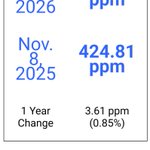
Your 'moment of doom' for Nov. 6, 2026 ~ Record CO₂ rise incoming.
"That could make it significantly harder for the world to keep global warming below the 1.5°C threshold set out in the Paris Agreement, with potentially devastating consequences."
dailymail.com/sciencetech/ar…

DavidRowe ⧖ - Caution, you may encounter nuance. retweeted

Tesla remains the UK's best-selling EV brand of 2026
UK BEV registrations jumped 53.7% in October to 49,155 cars, reaching 31.8% of the entire new-car market
• Tesla leads year to date with 9.53% of UK BEV sales
• Tesla registrations are up 25.4% compared with 2025
Once, electric cars were a rare sight on British roads
Now nearly one in three new cars sold in the UK is fully electric

DavidRowe ⧖ - Caution, you may encounter nuance. retweeted

🚨🇷🇺🇺🇸🇮🇷 BREAKING: The Russian Government has reportedly informed Washington, through back channels, that the usage of any Nuclear Weapons on Iran would free Russia to take equal measures in Ukraine.

DavidRowe ⧖ - Caution, you may encounter nuance. retweeted

BREAKING:
Iran issues instructions to all citizens on what to do in the event of a nuclear strike.
DavidRowe ⧖ - Caution, you may encounter nuance. retweeted

THE MOST INCOMPETENT WAR IN HISTORY: SARAH PAINE ON TRUMP’S IRAN DISASTER
Dr. Sarah Paine, a leading historian of great-power conflict and strategy, delivers a blunt verdict on the Iran war. She calls it one of the most incompetent wars in human history. The decision ignored basic principles of assessment, put maximum costs on America itself, and left permanent damage to the country’s power and alliances. This is not hindsight—it is the predictable result of hubris meeting reality.
THE CORE VERDICT
➡️ “The Iran war is probably one of the most incompetent wars in human history.”
➡️ A competent war puts the costs on the enemy and minimizes them for yourself.
➡️ This one did the opposite.
THE COST CATASTROPHE
➡️ It trashed the US economy.
➡️ It blew the US alliance system.
➡️ Iran is hurting, but the collateral damage is taking down the world’s economy.
➡️ That transforms the United States from a partner into an annoyance—and for many, a primary adversary—because it is threatening their economies.
➡️ “That’s breathtakingly incompetent.”
THE STRATEGIC BLIND SPOT
➡️ Any serious assessment looks at the enemy’s strengths and your own weaknesses, plus everyone else who might intervene.
➡️ That was absent.
➡️ The first thing Iran would do is shut Hormuz. Narrow seas close in wartime. Ukraine already showed this with the Black Sea.
➡️ Shore artillery, mines, and other tools stop traffic. There is no mystery here.
➡️ The big naval base in Bahrain becomes unreachable. The fallback is Diego Garcia, 2,500 miles away in the middle of nowhere. “That would be a mess.”
THE HUBRIS THAT MADE IT POSSIBLE
➡️ The people making the calls are historically unqualified for the job. That makes them profoundly dangerous.
➡️ Type A hubris assumes all decisions that matter happen in the United States.
➡️ Type B hubris assumes being good at one thing makes you good at everything.
➡️ Half-court tennis: you only watch your own side and never study the other team.
➡️ The Iranians understand Americans far better than Americans understand them.
THE UNFEASIBLE OBJECTIVE
➡️ Trying to “solve” Iran with 90 million people was never realistic.
➡️ Nazi Germany had roughly 80 million and required an occupation force of about 1.5 million just to hold it after the war—before counting everyone else.
➡️ The goal was unattainable. Pursuing it guarantees overextension and a bad ending.
➡️ The lesson the world takes is simple: get a nuke. The war incentivized proliferation.
➡️ This was a pivotal error. The choices that existed before are gone and will not return. “We will never be the trusted partner ever again. It’s done.”
THE BOTTOM LINE
The Iran war did not merely fail. It maximized American costs, destroyed trust with allies, and handed every rival a clearer reason to treat the United States as a threat to their own prosperity. Competence would have contained the problem at affordable cost. Hubris chose the opposite.
This is what permanent strategic damage looks like.
#IranWar #SarahPaine #StrategicIncompetence #HormuzDisaster #USHubris #AllianceCollapse #CatastrophicMistake
HT: YouTube The Diary Of A CEO

DavidRowe ⧖ - Caution, you may encounter nuance. retweeted

BREAKING: Anthropic warns in its IPO filing that a catastrophic AI-related incident could cause harm on a scale that no single insurer, and “potentially the insurance industry in the aggregate,” could cover.
The filing says Anthropic’s insurance may not be enough to cover the liabilities it faces, especially if one incident or a group of incidents causes disproportionate harm.
DavidRowe ⧖ - Caution, you may encounter nuance. retweeted
Breaking News!
Code UFB!!!
It takes 2 weeks to confirm ocean sea surface temperatures and the long wait is finally over. The first day in recorded history with Nino 3.4 SST at or above 30.0°C is now officially on the record.
October 7, 2026: 30.000°C.
climatereanalyzer.org/clim/s…

DavidRowe ⧖ - Caution, you may encounter nuance. retweeted

# Black October
For anyone who knows me even somewhat well, it's clear that I am a 99th percentile tech optimist. However, the vibes have shifted for me quite a bit in the last 18 hours, and I feel a moral imperative to share what I'm thinking and feeling with my circles so that everyone can understand, and hopefully take seriously, what's happening right now. I think October 2026 will have many chapters written about it in the history books.
You know those scenes in financial movies like Margin Call where someone realizes that they're all fucked, and no one else sees it yet? And that person feels like they're crazy, and then suddenly everyone is pulling an all-nighter in a boardroom and freaking out? Yeah, that's kind of how this is feeling right now in the SF/Bay Area/AI circles.
We're 48 hours into what is being called Black October. In the last 2 days there have been several dozen cyber attacks which, in isolation, would each have been the worst to happen in an entire calendar year. Every sector from government to education to big tech and banks is being massively affected, and people are starting to freak out.
In a nutshell, what's happened is that frontier AI models have gotten to a point where they are as advanced as the most sophisticated programmers, with one critical difference: they can work 24/7, and you can spin up 10,000 of them with a single command and they'll work together tirelessly until they accomplish their task. The most advanced models today are from companies like Anthropic and OpenAI, whose current best technology is so good that they haven't been able to roll it out to everyone yet because of the national security risks it poses.
Meanwhile, the best open source models (where anyone can just download the model weights and do whatever they want with them, uncensored) are slightly behind the frontier but still 90-95% as capable. These models, developed primarily in China, are being used by black hat hackers to wreak havoc on the Western capitalist structure. Presumably, this has been part of China's plan the entire time, and we're seeing its implications fall out in real time.
In red-pilled AI circles, we've been sharing and reading papers called things like "Situational Awareness" and "AI 2027" for the last year or so, which at the time felt a bit like near-term speculative fiction. They laid out the case for why Artificial General Intelligence (AI smarter than any human at any knowledge task) and Recursive Self-Improvement (models that are able to use themselves to get better) weren't half-baked future ideas anymore, but instead an inevitable outcome of the linear progress that's happening.
These papers would then talk about things like "takeoff scenarios," trying to envision how that moment would come to be and what it would be like when it happened. It would either be a "slow takeoff" that would play out over the course of months and quarters, happening subtly and only obvious to a few. Or, it would be a "fast takeoff" where it would pretty much happen instantly, like a bit flipping from 0 to 1.
From everything that I can see and am feeling, we are currently experiencing the fast takeoff scenario. Beyond the crazy security vulnerabilities that have come out recently, there have also been massive breakthroughs in life sciences, fundamental computer science, materials science, and pure mathematics that have all landed in the same time frame. While I still firmly believe that AI will be a net positive for humanity, it's more clear to me than ever that the societal and individual risk is very real, and is playing out NOW.
For as much conviction as I have that this is happening, the thing that's caused me to lose sleep is that I don't really know what to do about it, or more importantly, what to tell you, reader, to do about it. So, the best I can do is make a few suggestions that have always been a good idea but are more timely now than ever:
Set up 2-factor authentication for everything. I use Duo.
Use a password manager across your devices. I use 1Password.
Get an identity protection app set up. I use Alta.
Move your IoT devices to their own network. Claude helped me do this.
And last, but certainly not least, if you've been avoiding leaning into AI, see this as a catalyst to wake up and start using it. Don't just use the chat mode version of ChatGPT/Claude; click that Code/Work button and see how easily you can have AI write code to help you with your job. One of the biggest vulnerabilities was in a massively popular programming language called PHP, and the prompt that set it off was literally, "Find vulnerabilities in php."
This is an unprecedented time for humanity, but as we've done with many things before, we will prevail so long as we are kind, loving, and open-minded to the world.
Much love.
DavidRowe ⧖ - Caution, you may encounter nuance. retweeted

Yes, back up key cloud files to external drives for local redundancy (3-2-1 rule helps). Scan every download with updated antivirus first. Prefer official client apps or selective transfers over bulk. Keep the drive disconnected when idle and re-scan periodically. Verify files open cleanly after copy.
DavidRowe ⧖ - Caution, you may encounter nuance. retweeted

as bad as things have gotten in the past 4 days, they are going to get a lot worse before they get better. security leaders, never let a crisis go to waste: please go to your boards and ask for help right now. not for ai, for the basics. (we need to hold on for ~18 months.)




DavidRowe ⧖ - Caution, you may encounter nuance. retweeted
The parking lot at Disneyland #Paris went #solar. 67,000 #solarpanels will make it one of the largest solar canopies in Europe. Time to give every parking lot a #solarpower upgrade.
We have the solutions. Implement them. #ActOnClimate
#climateAction #climate #endfossilfuels
DavidRowe ⧖ - Caution, you may encounter nuance. retweeted

Electrified transport has changed London forever.


DavidRowe ⧖ - Caution, you may encounter nuance. retweeted

For reasons still unknown, Earth's energy imbalance is rising much faster than models can account for.
Earth's energy imbalance is rising much faster than scientists expected — and now researchers worry they might lose the means to figure out why
livescience.com/planet-earth…
