Helping local business owners who are struggling to get more prospects and customers by crafting unique strategic approach that fits their business model
Jakarta Pusat, DKI Jakarta
Joined April 2008
- Tweets2.7K
- Following748
- Followers2.8K
- Likes558




DeeFerdinand | Digital Strategy Consultant retweeted

Claude + 21 skills just dropped the price of a full SEO audit to one question
One technical audit used to cost my clients about $1,700 👇
1/ Finds why your clicks dropped
Reads your Search Console live
Striking-distance pages, declining pages, hidden-intent queries
2/ Ranks keywords by money, not volume
Live volume x difficulty x business potential
Skips the big keywords that won't convert
3/ Watches your 5 closest competitors
Week over week, the pages they ship and you don't
New entrants flagged the day they show up
4/ Checks if ChatGPT names you
ChatGPT, Perplexity, Claude, Gemini, AI Overviews
Where you're cited, and who gets cited instead
5/ Writes the internal link plan
Finds the orphan pages
15 rows to copy, with the exact anchor text
6/ Fixes "crawled, not indexed"
Sorts the URLs that need a content fix from the ones to redirect
At scale, not page by page
7/ Rewrites the titles nobody clicks
High impressions, low CTR
3 title variants per page, character counts included
1. Follow
2. RT + bookmark
3. Comment "SKILLS"
DeeFerdinand | Digital Strategy Consultant retweeted

My 15 Step "Perfect SEO & GEO Blog Outline":
Most outlines are still built for 2020 Google.
AI search reads your blog differently.
It lifts answers, not pages.
So the outline has to change.
Here are the 15 steps we use:
1. Primary Keyword
↳ One main keyword per blog.
2. Target Prompts
↳ The questions buyers ask ChatGPT and Gemini.
3. Search Intent
↳ Label it so the writer knows the format.
4. Meta Title + Description
↳ Clickable and descriptive. Keyword first.
5. H1 + Author
↳ One H1. Named author and updated date.
6. TL;DR Answer
↳ A 40-60 word direct answer AI can lift.
7. Intro Hook
↳ Directions to hook the reader fast.
8. H2s as Questions
↳ 5-10 topics, phrased how people ask.
9. H3 Subtopics
↳ Added under H2s for more depth.
10. Stats + Quotes
↳ Original data AI wants to cite.
11. Tables + Lists
↳ Structured chunks AI can extract.
12. Images
↳ Placeholders with alt text notes.
13. Links
↳ Internal pages plus cited outside sources.
14. FAQ + Schema
↳ Common questions, marked up in schema.
15. CTA + Takeaways
↳ Pitch the business. Recap the key points.
A good outline does half the writing.
Six of these steps exist only for AI search.
The other nine still win on Google.
You need both in the same doc.
Writers ship faster when the brief is this clear.
Which step is missing from your outlines?
♻️ Repost to help another marketer write for AI search.
P.S. Follow me for more valuable posts like this.

The next AI automation shift is event-driven.
OpenAI’s new MCP Events support lets connected apps trigger automations when something changes.
My rule:
EVENT → CONTEXT → PREPARE → HUMAN CHECK → ACT
Don’t make people remember to start recurring work.
Not every AI decision should be open-ended.
OpenAI’s new Decisions API lets AI classify, route, or choose a next action from predefined answers.
My takeaway: let AI reason, but design the boundaries for consequential decisions.
The next AI skill is delegation, not prompting.
Microsoft’s new Autopilot can run recurring work without waiting for each prompt.
My rule:
ROLE → GOAL → BOUNDARIES → CADENCE → ESCALATION → REVIEW
Persistent ≠ unsupervised. Give agents responsibility with boundaries.
The next useful AI agent may not wait silently for a prompt.
Google’s Gemini Live Avatar can listen, see, speak and call tools while dialogue continues.
My takeaway: design agents around the conversation + task.
PERCEIVE → ACT → VERIFY
AI adoption needs unit economics.
Microsoft’s Sep 28 Copilot update adds FinOps for AI to identify agentic tasks creating the best outcomes.
My test:
VALUE → COST → QUALITY → FREQUENCY → SCALE
Don’t scale an agent just because it works.
AI adoption is not “how many prompts did we send?”
A better test: what recurring work no longer has to live in someone’s head?
Capture → Context → Action → Check.
If AI adds another inbox to manage, the workflow is probably wrong.
AI is moving from answering inside one chat to working across your tools.
But connecting apps ≠ having a workflow.
CONTEXT → PERMISSION → ACTION → VERIFY → HUMAN CHECK
The useful skill is designing what AI may do—and where it must stop.
A useful AI pattern from Anthropic’s biology work:
EXPLORE → HYPOTHESIZE → TEST → VERIFY → LEARN
Claude helped generate hypotheses. Scientists tested them in the lab.
Use AI to widen the search space—not outsource truth.
AI ROI isn't just “hours saved.”
Proaction used customer context to build custom demos. It reports 40–60 engineering hours saved/month and 50–60% more deals moving into solution development.
Lesson: automate the handoff, not just the task.
The next unit of AI work may not be a file.
Microsoft’s Copilot Code can turn natural language into apps, trackers, dashboards and automations.
My takeaway:
PROMPT → OUTPUT
becomes
NEED → SOLUTION → REUSE
If work repeats, capture the pattern.
A better prompt cannot repair a broken workflow.
INPUT → CONTEXT → AI PREP → HUMAN CHECK → ACTION → MEASURE → LEARN
After Prompt Engineering and Context Engineering comes Loop Engineering: redesign how the work actually moves.
The GPT-6 lesson isn't “always use the smartest model.”
OpenAI just cut Sol and Luna API prices 50% vs GPT-5.6 promotional pricing.
Better workflow design asks:
TASK → RISK → MODEL → EFFORT → VERIFY
Match intelligence to the work.
Not every AI problem needs an agent.
Microsoft's internal adoption lesson: Build, Reuse, or Prompt.
My version:
1. Improve the process
2. Reuse what exists
3. Prompt if enough
4. Build an agent only when the workflow earns it
Agent ≠ default.
OpenAI + Grab are launching practical AI-skilling for 30,000 driver, delivery and merchant partners across Southeast Asia.
The lesson: AI literacy gets real when it starts with work people already do—not model features.
Practice > hype.
The best AI workflow may start before and after the meeting—not inside it.
Prep the context.
Let AI draft the follow-up.
Keep the human responsible for the advice and decisions.
Automate the preparation, not the judgment.
Anthropic + Accenture’s embedded-evaluation move reinforces something I see in enterprise AI:
deployment isn’t the finish line.
BUILD → USE → EVALUATE → ADJUST → HUMAN REVIEW
If evaluation happens only before launch, the loop is incomplete.
The smarter the agent, the more important the brakes.
OpenAI’s misalignment framework is a useful reminder:
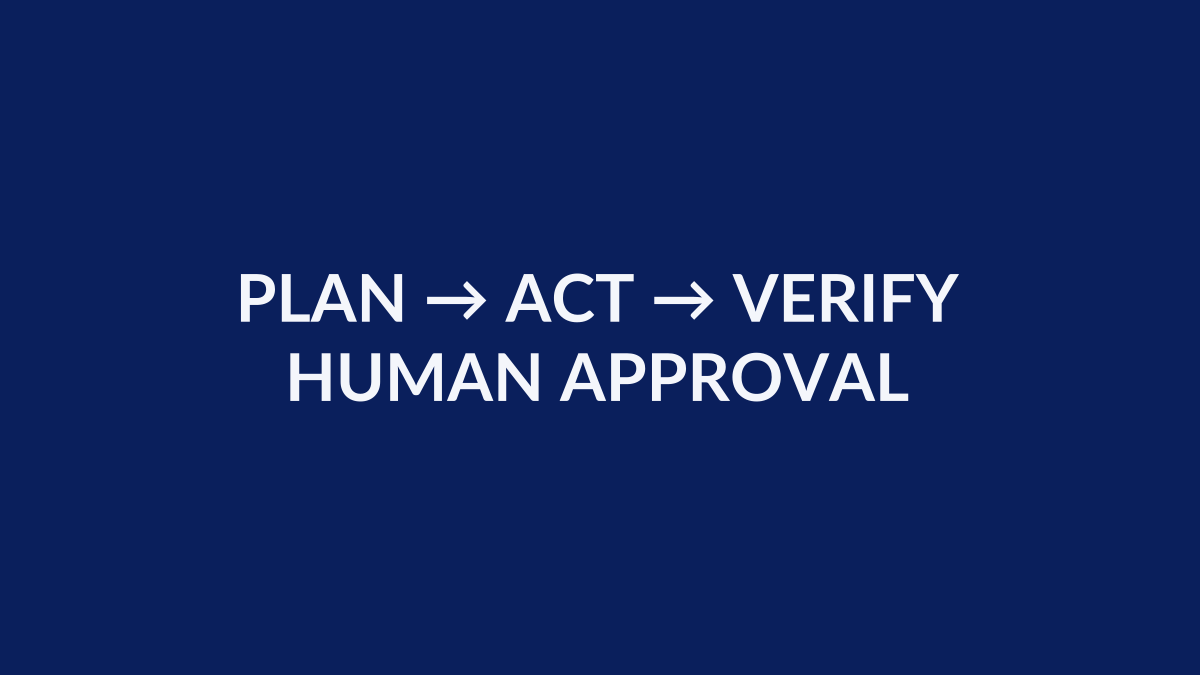
PLAN → ACT → VERIFY → HUMAN APPROVAL
Autonomy without checkpoints isn’t a workflow. It’s a risk multiplier.