

Idler. Bibliophile. Observer. Wagnerian. Library owner. Spaniel-keeper. Wild gardener. Zarathustra wrangler.
Lower Saxony, Germany
Joined September 2023
- Tweets9.1K
- Following1.6K
- Followers1.7K
- Likes80.2K




Pinned Tweet
Beyond the Silver Screen
An avuncular invitation to the young admirers of Anakin Skywalker
I went to see Star Wars with my father in 1977. We enjoyed it enormously. The cantina scene, with its wonderfully incongruous jazz band, was a particular family favourite. Nearly fifty years later, I find myself rather pleased that a new generation is taking these films seriously enough to argue about them.
In particular, young men seem to have discovered something in Anakin Skywalker that my generation largely overlooked. We saw Luke as the hero: the ordinary young fellow who leaves home, discovers his powers and saves the day. They see Anakin: extraordinarily gifted, misunderstood by his elders, frustrated by an institution that fails to recognise his needs, and ultimately betrayed by the promise that obedience and patience will bring fulfilment.
I think they've noticed something worth noticing.
But I'd like to offer a friendly suggestion. Having discovered this territory through George Lucas, why not explore a little further? There's a vast country beyond the familiar scenery, and much of it is rather more extraordinary than anything Hollywood has managed to put on the screen.
Why not try Richard Wagner?
Now, don't misunderstand me. I'm not proposing a course of cultural improvement, still less suggesting that young men ought to cultivate a taste for opera because it is respectable. Wagner was scarcely a model of respectability himself.
I'm suggesting that you follow your curiosity.
If Anakin interests you, I suspect Siegfried will too.
Here is another fatherless young man of extraordinary gifts, brought up by an inadequate guardian, manipulated by older powers, and impatient with the laws and conventions of a world he never chose. Siegfried forges his father's broken sword, kills a dragon and ultimately shatters the spear of Wotan, ruler of the gods, upon which the authority of the existing order depends.
It's exhilarating stuff. Indeed, the young Nietzsche thought so.
But Wagner has something more interesting to tell us than that the young hero is magnificent and his elders corrupt.
Siegfried knows no fear. He cannot even understand what other people mean by it. Neither dragons nor gods frighten him.
Then he encounters Brünnhilde, discovers love, and suddenly experiences fear for the first time.
Anakin presents almost the opposite case. His extraordinary abilities cannot free him from fear. He loses his mother and becomes terrified of losing Padmé. His love gradually becomes inseparable from the desire to control death itself.
Where Siegfried must learn that he is vulnerable, Anakin cannot bear the vulnerability he already knows.
And this is where the comparison becomes fascinating.
Wagner gives us Wotan, a man of immense power who discovers that power cannot release him from the consequences of his own decisions. The more desperately he attempts to control events, the more thoroughly he destroys what he loves.
He also gives us Amfortas, the wounded king who cannot heal himself.
And in Parsifal we encounter a very different hero, an innocent fool who must learn to recognise another man's suffering before he can accomplish his destiny.
Doesn't that remind you of Luke, refusing to kill his defeated father, recognising the suffering human being within Darth Vader's monstrous armour?
Anakin begins with something of Siegfried's gifts, acquires something of Wotan's fatal desire for mastery, and ends in a condition resembling that of Amfortas. His son must discover the compassion of Parsifal before the father can finally be redeemed.
I don't suggest George Lucas secretly adapted Wagner's dramas. The connections are more interesting than that.
Lucas acknowledged his debt to Joseph Campbell, whose studies of myth explored many of the ancient stories that also fascinated Wagner. John Williams inherited a musical tradition profoundly shaped by Wagner, often through the great composers of early Hollywood.
And behind Wagner himself stretches an inheritance so extensive that nobody could reasonably hope to exhaust it.
Ancient Greek tragedy; the Germanic heroic traditions; the Icelandic sagas and Eddas; the medieval Nibelungenlied; Wolfram von Eschenbach's Parzival; the rediscoveries of Herder and the Brothers Grimm; the German Romantics; Beethoven, Feuerbach, Schopenhauer.
Wagner drew from all these sources, argued with them, transformed them, and created something that was entirely his own.
You could spend a lifetime discovering what went into his work and still be finding new things.
That is part of its attraction.
And it suggests a different way of thinking about culture.
Enjoying Wagner isn't necessarily evidence of superior intelligence, maturity or breeding. Quite unpleasant people have been enthusiastic Wagnerians. Nor is there anything shameful about enjoying Star Wars.
What matters is continuity: discovering that the stories which move us belong to a conversation extending across centuries, through generations of poets, musicians, philosophers and storytellers who have wrestled with the same questions.
What makes a man heroic? What does he owe his ancestors? Can he escape the authority of his fathers? Is love a source of strength or vulnerability? Why do exceptional men so often destroy themselves? Can power ever provide the freedom it promises?
The questions don't become obsolete because the costumes change.
Wagner himself wasn't merely preserving old stories. He was making something new out of them. That's how a cultural inheritance stays alive: not by being kept under glass, but by being encountered, questioned and transformed.
And here I think Nietzsche has something useful to tell us.
It's all very well to identify with an exceptional hero. But identifying with Siegfried doesn't make one heroic, any more than watching Anakin wield a lightsaber makes one particularly formidable.
There is a difference between consuming images of greatness and cultivating one's own capacities.
Learning to enjoy Wagner might be a small but worthwhile part of that cultivation.
Not because difficult art is automatically better, but because it can reward sustained attention, patience, memory and curiosity. It invites us to follow an argument that cannot be reduced to a slogan, to understand characters without necessarily approving of them, and to discover meanings that change as our own understanding develops.
And then there is the music.
Ah, the music!
If you have loved the excitement of John Williams, you already know something of the power of a great orchestra. Wagner takes that power much further. His orchestra doesn't merely accompany the drama. It remembers, anticipates, contradicts and reveals. It tells you things the characters themselves do not yet know.
A musical idea heard hours earlier returns, changed by everything that has happened since. The meaning is not simply explained to you. You hear it becoming something else.
That is a pleasure worth acquiring.
And there's a wonderful practical advantage to the whole enterprise: you needn't know all the mythology, philosophy or musical theory before you begin. Nobody does. You can enter through the music and allow curiosity to lead you backwards through the centuries.
I did not know, sitting beside my father in 1977, that the space adventure we were enjoying would one day provide an occasion for discussing Siegfried, Wotan, Parsifal and the medieval Grail romances. We were perfectly happy with the little jazz band in the cantina.
And I wouldn't exchange that memory for anything.
But I rather like the thought that the boy who enjoyed the cantina band might eventually discover the orchestra pit at Bayreuth.
So this is my recommendation to the young men debating Anakin's rebellion against the Jedi.
By all means enjoy your films. Argue about them. Find yourselves in their heroes, if that helps you begin asking worthwhile questions.
But don't stop there.
Look beyond the silver screen. Discover the stage, and beneath it the orchestra pit. Then look behind Wagner himself, at the immense inheritance of stories and ideas from which he fashioned his dramas.
You'll never see all of it. Neither have I, and I've been looking for a good many years.
But that is hardly a reason not to begin.
You have discovered the hero's journey. Now discover the civilisation that spent centuries imagining it.
And when you've listened to Wagner, read Nietzsche.
He'll make you question the whole business all over again.
Which is rather the point.

Roger Köppel is talking to Ian Proud, the former British diplomat who served at the embassy in Moscow from 2014 to 2019.
Their central contention is that European integration has ceased to be principally about cooperation between nations and has increasingly become a means of governing them from above.

Europe is shooting itself in the head and Switzerland is the next target.
Moralism in Europe is running wild and silencing all debate. Don't talk to the Russians! My conversation with @KoeppelRoger goes live today at 1200 GMT on the Peacemonger.
youtube.com/@IanProud
The Empty Shell
An Industrial Natural History of Berenbostel
There is a peculiar pleasure in examining a landscape through a succession of old maps. What appears immutable to the inhabitant, whose experience of change is measured in years and decades, becomes fluid. Villages swell, roads appear, fields vanish, woods retreat. The seemingly permanent features of one's surroundings reveal themselves as comparatively recent deposits upon a much older geography.
I have before me a series of maps of Berenbostel and the neighbouring villages, extending from the nineteenth century to the present day. The earliest depict a recognisably rural landscape: small settlements connected by roads, surrounded by long strips of cultivated land, patches of woodland, streams and meadows. There is nothing here to suggest the great industrial organism that would eventually establish itself upon the landscape.
And yet, beneath the modern town, that older geography persists. The ancient village nuclei remain identifiable. Roads follow alignments determined by people long dead. The shapes of fields, the courses of streams, even the boundaries between settlements preserve decisions made centuries before the arrival of the motorcar.
The landscape has grown without entirely consuming its earlier forms.
To an amateur malacologist, there is something familiar about this.
The shell of a cone snail, Conus, grows by accretion. The animal extends the margin of its shell, laying down successive increments of calcium carbonate. The earlier structure is retained, incorporated into an ever-enlarging whole. Along the growing edge, the activity of pigment-producing cells generates the intricate markings characteristic of the family: triangles, zigzags, branching lines, bands and extraordinary networks of colour.
These patterns are not painted upon a finished object. They are records of the process by which the object came into existence.
The shell is, in a quite literal sense, a history of its own growth.
So, I suggest, is Berenbostel.
The earliest substantial industrial markings appeared long before Volkswagen. Brickworks exploited the local clay, bringing workers, buildings and new roads into the agricultural landscape. Their excavations left permanent alterations to the ground. When production ceased, some of the pits filled with water, becoming the lakes which now appear so naturally at home in their surroundings.
The industry disappeared; its handiwork remained.
Meanwhile, larger forces were rearranging the countryside.
The Mittellandkanal advanced across northern Germany, connecting rivers and industrial regions through a new artificial waterway. The old highways were widened, straightened and incorporated into an increasingly ambitious network of national transport. Railways, roads and canals established connections between places which had previously belonged chiefly to their immediate neighbourhoods.
The maps of the 1920s and 1930s reveal the beginnings of a new geometry. The old villages remain small, their surrounding fields still dominant, but great linear structures have begun to assert themselves across the landscape. They are indifferent to the ancient arrangements of parcels and paths. Their scale is regional, their purposes increasingly national.
An extraordinary atlas of Niedersachsen, published in 1934, captures this transforming world with remarkable graphic sophistication. Coloured circles, graduated by size, record proposed works in agriculture, forestry, settlement and road construction. The familiar geography of rivers and towns lies beneath a second landscape: one of projects, labour requirements and planned intervention.
The map records sixty million working days. It renders an entire region as a field of possible activity.
Here the shell acquires its first bold geometric ornament. The relatively delicate tracery of an agricultural landscape is interrupted by long, decisive strokes.
But the great widening of the aperture is still to come.
On 8 March 1956, Volkswagen began producing Transporters at its new factory in Hannover-Stöcken. The works had been erected in approximately a year, on a scale that seems almost extravagant today.
It was an appropriate monument to the Wirtschaftswunder. The little Transporter, originally conceived as a practical vehicle for tradesmen and businesses, became one of the most recognisable products of postwar German industry. It carried builders, shopkeepers, families, holidaymakers and hippies. It transported goods and people across the world. Its usefulness was almost infinitely adaptable.
The factory itself was an enormous productive undertaking, but its effects extended far beyond its walls.
Workers needed homes. Families required schools, shops, churches, roads and public facilities. Existing settlements expanded, new estates appeared, and the spaces between the old villages gradually filled. A place which had been recognisably rural within living memory was absorbed into the suburban geography of an industrial city.
In Berenbostel the population more than quadrupled between the mid-1950s and mid-1960s.
The change is unmistakable on the maps. Where the earlier sheets show a collection of separate villages surrounded by fields, the later ones reveal an increasingly continuous urban fabric. Dark areas spread outward from the original settlement cores; new roads cross the old field boundaries; industrial buildings appear as immense rectilinear blocks.
The shell has entered a phase of extraordinary growth.
The following decades brought further accretions. Housing estates expanded, new civic institutions appeared, roads were improved, and the municipalities were reorganised. The growth of the 1970s and 1980s was often less spectacular than that of the preceding generation. It was a process of consolidation, infilling and thickening.
By the beginning of the twenty-first century, the characteristic form was established.
And yet, viewed from above, the old villages remained legible beneath the accumulated ornament. The primitive whorls had survived within the mature shell.
There is something wonderfully misleading about the beauty of a cone shell.
The family Conidae includes some of the most exquisitely patterned molluscs in existence. Their markings have fascinated collectors and naturalists for centuries. The geography cone, Conus geographus, even bears upon its shell an intricate design suggestive of an antique map.
One might imagine such a creature to be harmless: a small, exquisitely decorated inhabitant of tropical seas.
But the cone snail is a predator.
Concealed within its soft anatomy is a formidable apparatus: a specialised radular tooth, fashioned into a hollow, detachable harpoon through which the animal can inject venom. Some species employ complex mixtures of toxins capable of rapidly incapacitating fish.
The exquisite shell conceals a sophisticated instrument of violence.
There is no need to press the comparison too far. Industrial civilisation is not a predatory mollusc, and the prosperity of Berenbostel cannot be explained entirely by the activities of a single factory. Yet the naturalist's perspective is useful.
The visible pattern of an industrial landscape is the consequence of activities which are largely invisible in its final form. Materials are extracted, energy consumed, machines operated, goods manufactured and transported. Workers arrive, capital accumulates, waste is produced, and the landscape is continuously reorganised to sustain the productive organism.
We admire the shell, but we seldom consider the metabolism which created it.
Nor do we generally contemplate what happens when that metabolism falters.
The Volkswagen works at Hannover-Stöcken now faces an uncertain future.
Its significance as an employer and manufacturer remains considerable. But the circumstances which made its extraordinary postwar expansion possible have altered. Automotive production has become more competitive, the technological direction of the industry is changing, and the old German industrial model faces questions which extend well beyond Volkswagen.
The vast factory buildings remain. The roads, railways and waterways still serve them. The housing estates, schools, commercial districts and municipal structures brought into being by successive generations of industrial growth remain embedded in the landscape.
The shell is intact.
What is becoming uncertain is the future of the organism that made it.
There is an irony here which might have appealed to a naturalist with an especially dark sense of humour.
In October 2026 it emerged that Volkswagen had held discussions with the Czech defence group CSG about the possible manufacture of military lorries at Hannover. The proposal was tentative, its outcome undecided. Nevertheless, its symbolism was extraordinary.
A factory established in the 1950s to build vehicles for the reconstruction and commercial life of a defeated country might eventually find new employment producing vehicles for military purposes.
The apparatus which once served the tradesman, the builder and the travelling family could be adapted to serve armies.
The shell would find a new occupant.
And the harpoon would return.
Of course, military vehicles are not themselves the weapons they transport, and the preservation of industrial employment is a serious consideration. There are arguments of national security, strategic independence and industrial survival. A factory capable of producing civilian vehicles may possess skills and machinery that can be turned to other purposes.
But the historical movement remains arresting. An industrial complex conceived in an age of reconstruction and expanding civilian prosperity is being considered for participation in a new European rearmament.
The proposed metamorphosis is not merely technological. It raises the question of what, precisely, the inherited industrial apparatus is now expected to accomplish.
Giovanni Battista Piranesi, wandering among the monuments of eighteenth-century Rome, found in the ruins of antiquity an inexhaustible subject.
In his etchings, the buildings of an earlier civilisation tower above the inhabitants of his own. Tiny figures conduct their insignificant business among colossal arches, fallen columns and abandoned structures whose original purposes have frequently been forgotten.
The contrast is sometimes almost cruel.
The living appear diminished by the achievements of the dead.
Piranesi's Rome was not uninhabited, nor were its people incapable of enterprise. But the architectural remains of an earlier age possessed a magnitude which made the activities of the present seem strangely provisional.
The ruins had become the measure against which contemporary life was judged.
Something of this sensibility may be felt in the industrial landscape around Hannover.
The enormous factory halls, the canal, the motorway, the railway yards, the bridges and interchanges: all testify to generations which transformed the physical world on an immense scale. Their constructions have become so familiar that their extraordinary character is scarcely noticed.
They are simply there, like geological formations.
One drives beneath the bridges, passes the factory walls, follows roads laid out before one's birth. The original acts of imagination, ambition and labour have become the unremarkable background of daily existence.
Yet the structures themselves outlast the circumstances which created them.
The maps preserve the entire history. The delicate markings of the old agricultural villages, the first industrial excavations, the great transport corridors, the astonishing postwar expansion, and the subsequent consolidation of the modern town: each survives as another band in the shell's intricate ornament.
For the moment, unlike Piranesi's Rome, our great structures are not ruins. The factory gates still open, the machines still operate, and the buildings retain their utility.
But a new question has entered their history.
Not whether we can still inhabit the immense structures left to us by our predecessors, but what purposes remain sufficiently compelling to sustain them.
We are not yet looking at ruins, but at the machinery of a civilisation changing its purpose while the buildings are still standing.
And somewhere, within the beautiful old shell, the harpoon is being prepared.


**Nero fiedelte. Merz tingelte. Klingbeil legierte.**
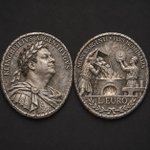
Caracalla führte den Doppeldenar ein, der weniger als das Doppelte an Silber enthielt. Fast 1.800 Jahre später entdeckt Finanzminister Klingbeil die römische Münzkunst wieder.
Aus der geplanten 25-Euro-Silbermünze mit rund 22 Gramm Feinsilber wird eine 50-Euro-Münze mit nur noch 13,1 Gramm.
Wären das unsere regulären Silbermünzen, entspräche das einer Entwertung des Silbergehalts je Euro um rund 70 Prozent.
Während Merz in Ostasien auf Staatsbesuch tingelt, lautet die neue Berliner Münzdevise:
MINUS ARGENTI, PLUS NOMINALIS.
Rom ist nicht an einem Tag gefallen.


NICHT MAL DAS KANN ER!
KLINGBEIL lässt Silbermünzen prägen, um noch mehr Geld in die Staatskasse zu spülen.
Doch dann stellt sich heraus, dass der Silberpreis den Nennwert der Münzen übersteigt.
Nun lässt er sie für 1,4 Millionen Euro einschmelzen. 😂😡
Für diese Stümperei erhält er monatlich mindestens 30.000 Euro.


The Zoomer Anakin Meme youtu.be/JAKQdIrr4Qg?si=0P3M… via @YouTube Anakin Skywalker: Siegfried, Amfortas, and the Failure of the Pure Fool
As a Wagnerian, I think there is a more interesting explanation for Anakin's peculiar appeal than George Lucas having prophetically anticipated the resentments of Generation Z. The story is much older, and Joseph Campbell provides a likely route by which Lucas encountered its underlying structure.
Anakin begins as something like Siegfried: fatherless, extraordinarily gifted, innocent of the world, surrounded by older figures who understand more of his destiny than he does. Both possess powers they cannot fully comprehend, and both are vulnerable to manipulation.
But there is a crucial difference. Siegfried does not know fear; he sets out to discover it. Anakin is almost constituted by fear — first of losing his mother, then of losing Padmé.
And here the comparison with the Grail legend becomes especially revealing.
In Wolfram von Eschenbach's Parzival, the hero's marriage to Condwiramurs is not an obstacle to spiritual fulfilment. It belongs to his destiny. Campbell regarded this freely chosen love, combined with fidelity and individual moral discovery, as central to Wolfram's achievement.
Wagner transforms the story. Condwiramurs disappears, the Grail community becomes an ascetic brotherhood, and salvation is attained through Mitleid: suffering with another.
Now consider Anakin. He wants precisely what Wolfram's Parzival possesses: a wife, children and a life in which love and spiritual purpose are reconciled. Yet the Jedi, something resembling Wagner's Grail order, regard attachment with suspicion.
The tragedy is that Anakin cannot distinguish love from the desire to prevent loss. His love becomes fear; fear becomes the pursuit of power over death.
Palpatine, a splendidly Klingsorian figure, understands this weakness and offers him forbidden knowledge. Anakin accepts.
And Siegfried becomes Amfortas.
The promised redeemer is transformed into the wounded man who needs redeeming. Vader's mutilated body, imprisoned within its life-preserving armour, becomes an almost literal embodiment of Amfortas's unhealing wound.
Now the story requires another innocent: Luke.
Luke's great achievement is not defeating Vader in combat, but refusing to kill him. Against the expectations of his teachers, he recognises the suffering human being inside the monster.
Here is Wagner's durch Mitleid wissend.
Yet Luke's compassion is also profoundly Wolframian. It arises not from the renunciation of personal love, but from his fidelity to his father. He succeeds where Anakin failed because he can love without demanding mastery over death.
And Anakin's final sacrifice completes the reversal. The man who destroyed everything in his attempt to prevent the death of someone he loved now willingly accepts his own death to save his son.
This is why I think the contemporary political reading, while entertaining, misses the essential tragedy.
Anakin's resentment is understandable. His response to it is catastrophic. His rebellion against the Jedi does not liberate him; it delivers him into a servitude more absolute than anything the Jedi demanded.
He mistakes the acquisition of power for the overcoming of suffering.
Luke discovers that the two are not the same.
The myth does not culminate in Anakin's vindication against the establishment, but in the discovery of a wisdom that transcends both the establishment and his rebellion against it.
The pure fool becomes the wounded king; his son becomes the pure fool who heals him.
That is a rather more enduring story than the grievances of any particular generation.
NIETZSCHE, Stefan George
Schwergelbe wolken ziehen überm hügel
Und kühle stürme – halb des herbstes boten
Halb frühen frühlings ... Also diese mauer
Umschloss den Donnerer – ihn der einzig war
Von tausenden aus rauch und staub um ihn?
Hier sandte er auf flaches mittelland
Und tote stadt die lezten stumpfen blitze
Und ging aus langer nacht zur längsten nacht.
Blöd trabt die menge drunten · scheucht sie nicht!
Was wäre stich der qualle · schnitt dem kraut!
Noch eine weile walte fromme stille
Und das getier das ihn mit lob befleckt
Und sich im moderdunste weiter mästet
Der ihn erwürgen half sei erst verendet!
Dann aber stehst du strahlend vor den zeiten
Wie andre führer mit der blutigen krone.[12]
Erlöser du! selbst der unseligste –
Beladen mit der wucht von welchen losen
Hast du der sehnsucht land nie lächeln sehn?
Erschufst du götter nur um sie zu stürzen
Nie einer rast und eines baues froh?
Du hast das nächste in dir selbst getötet
Um neu begehrend dann ihm nachzuzittern
Und aufzuschrein im schmerz der einsamkeit.
Der kam zu spät der flehend zu dir sagte:
Dort ist kein weg mehr über eisige felsen
Und horste grauser vögel – nun ist not:
Sich bannen in den kreis den liebe schliesst ..
Und wenn die strenge und gequälte stimme
Dann wie ein loblied tönt in blaue nacht
Und helle flut – so klagt: sie hätte singen
Nicht reden sollen diese neue seele!
Bertram writes (in Nietzsche / chapter Arion) :
„... das bedeutsamste deutsche Gedicht, welches bis heute dem Namen Nietzsches geschenkt wurde ...“
He means Stefan George's poem Nietzsche, from the Zeitgedichte section of Der siebente Ring (1907).
This is an explicit elevation of George's poetic response to Nietzsche above every competing German tribute.
And Bertram doesn't even feel the need to name George. His intended readers would presumably recognise the lines immediately.
The poem begins with the thunderer Nietzsche in his final isolation at Weimar, and gradually becomes an elegy for the immense suffering of a man who could create gods only to destroy them.
Its conclusion is wonderfully significant:
Und wenn die strenge und gequälte stimme
Dann wie ein loblied tönt in blaue nacht
Und helle flut – so klagt: sie hätte singen
Nicht reden sollen diese neue seele!
But here's the really clever detail: George is quoting Nietzsche himself.
In the 1886 Versuch einer Selbstkritik, prefacing the new edition of Die Geburt der Tragödie, Nietzsche had written:
„Sie hätte singen sollen, diese ‚neue Seele‘ — und nicht reden!“
Nietzsche was looking back at his younger, excessively theoretical self and wishing he had expressed his Dionysian insight through poetry rather than philosophical exposition.
George takes Nietzsche's own self-criticism and turns it into an epitaph.
And Bertram takes George's epitaph and makes it evidence for his argument that Nietzsche was fundamentally a musician.
A rather beautiful chain of appropriation: Nietzsche → George → Bertram.

„Wo Gerechtseinwollen des Denkers, wägendes Gewissen des Gelehrten begegnet dem Ungerechtseinmüssen des Künstlers, des seherisch gerichteten Menschen, der Zukunft will, weil er Zukunft ist.“
— Ernst Bertram, Nietzsche: Versuch einer Mythologie, S. 106.
My translation:
“Where the thinker's will to be just, the scholar's weighing conscience, encounters the artist's necessity of being unjust, the visionary man who wills the future because he himself is the future.”
GUMS, NOT BUTTER!
Kritik der reinen Rosine
Prolegomena zu einer jeden künftigen Zuckerabstinenz, die als Steuerprotest wird auftreten können
Die Bundesregierung hat eine bemerkenswerte Entdeckung auf dem Gebiet der politischen Ökonomie gemacht: Zucker ist gleichzeitig ein öffentliches Übel und eine öffentliche Einnahmequelle.
Einerseits ist sein Konsum verwerflich. Er verursacht Übergewicht, Diabetes und Karies, insbesondere bei Kindern und Jugendlichen. Andererseits ist sein Konsum dem Fiskus offenbar so lieb und teuer, dass man ihn besteuern möchte, um damit die Finanzierung des Gesundheitssystems zu unterstützen.
Der Staat befindet sich damit in der eigentümlichen Lage, seinen Bürgern weniger Zuckerkonsum zu wünschen – allerdings möglichst nicht so viel weniger, dass die erhofften Steuereinnahmen ausbleiben.
Philosophen nennen so etwas einen Widerspruch. Ökonomen sprechen von einem Lenkungsinstrument. Politiker nennen es einen Erfolg, vorzugsweise noch bevor die Folgen eingetreten sind.
Julian Reichelt hat dieser Problematik nun eine zusätzliche zahnmedizinische Dimension verliehen. Er erinnert an Friedrich Merz' frühere Empörung über Zahnbehandlungen für abgelehnte Asylbewerber und stellt einen Zusammenhang mit der Finanzierung versicherungsfremder Leistungen her.
Der Gedanke, der eigene Zuckerkonsum könne mittelbar zur Sanierung fremder Gebisse beitragen, sorgt begreiflicherweise für einiges Zähneknirschen. Das alles ist politisch umstritten; die Einnahmen einer Zuckersteuer wären schließlich nicht einzelnen Zahnarztrechnungen zugeordnet.
Doch was soll der gewissenhafte Staatsbürger nun tun?
Die Antwort lautet: Nicht gegen die Zuckersteuer protestieren, sondern ihren erklärten gesundheitspolitischen Zweck mit geradezu fanatischem Eifer verwirklichen.
Wir entsagen dem Süßen.
Toffee wird zum Tabu. Die Limonade wird limitiert, die Cola kaltgestellt, das Bonbon boykottiert und der Lutscher aus dem Verkehr gezogen.
Keine Zuckerflut mehr für den Fiskus!
Der Staat wünscht unsere Enthaltsamkeit. Wir werden ihm diesen Wunsch erfüllen.
I. Der kategorische Imperativ
Immanuel Kant verlangt bekanntlich, nur nach derjenigen Maxime zu handeln, durch die man zugleich wollen könne, dass sie ein allgemeines Gesetz werde.
Betrachten wir also folgende Maxime:
Ich verzichte auf unnötigen Zuckerkonsum, um meine Gesundheit und die meiner Mitmenschen zu schützen.
Lässt sich diese Maxime verallgemeinern?
Ohne Zweifel. Es handelt sich sogar um genau jenen Zustand, den die Bundesregierung nach eigenem Bekunden herbeiführen möchte.
Was aber geschieht, wenn sämtliche Bürger dieser Maxime folgen?
Die erhofften Steuereinnahmen lösen sich auf.
Damit haben wir eine Form des politischen Protestes gefunden, dessen vollständiger Erfolg zugleich die vollständige Erfüllung des gesundheitspolitischen Regierungsziels und die vollständige Vereitelung seiner fiskalischen Erwartungen darstellt.
Der tugendhafte Bürger erweist sich als der unangenehmste aller Steuerzahler.
Ein strenger Kantianer könnte freilich einwenden, dass ein aus steuerpolitischen Motiven vollzogener Verzicht bloß einem hypothetischen und keinem kategorischen Imperativ folge.
Wir nehmen diesen Einwand zur Kenntnis und reichen dem Herrn einen zuckerfreien Keks.
Die Vernunft wird praktisch, der Nachtisch theoretisch.
II. Die Dialektik des Naschwerks
Hegel hätte die Struktur sofort erkannt.
These: Der Staat besteuert Zucker, um dessen Konsum zu verringern.
Antithese: Der Bürger verzichtet daraufhin vollständig auf Zucker.
Synthese: Der Bürger wird schlanker, während die erwarteten Staatseinnahmen ebenfalls abspecken.
Wir haben es hier mit einer Negation der Negation zu tun, ganz ohne Zuckerzusatz.
Die süße Versuchung wird aufgehoben – im dreifachen Hegelschen Sinne: beseitigt, bewahrt und auf eine höhere Stufe gehoben. Bewahrt bleibt freilich nur die Versuchung; beseitigt wird das Gebäck.
Auch Descartes' berühmter Satz bedarf unter den neuen Verhältnissen einer gewissen Aktualisierung:
Ich kaue, also zahle ich.
Erst im Verzicht auf das Kauen entdeckt der Staatsbürger die Grenzen seiner fiskalischen Knechtschaft.
Zwar soll die Steuer zunächst zuckerhaltige Getränke und nicht sämtliche Süßwaren betreffen. Doch eine philosophische Bewegung, die an den Grenzen des geltenden Verbrauchsteuerrechts haltmacht, verdient ihren Namen nicht.
Wir müssen über die bloße Gesetzestreue hinausgehen.
Wir müssen gelangen:
Jenseits von Gut und Gebäck.
III. Also sprach Zuckerathustra
Nietzsche wusste, dass der höchste Sieg der Sieg über sich selbst ist.
Wer einer Tafel Schokolade nicht widerstehen kann, ist noch lange nicht Herr seiner Triebe.
Wer ihr lediglich deshalb widersteht, weil die Regierung sie verteuert hat, bleibt ebenso sehr ihr Untertan.
Wer aber aus freien Stücken auf die Süßigkeit verzichtet, im Bewusstsein, damit die moralischen Ansprüche des Staates zu erfüllen und zugleich dessen fiskalische Erwartungen zu durchkreuzen, hat etwas Bemerkenswertes erreicht.
Er hat den Gehorsam in Widerstand verwandelt.
Hier beginnt die eigentliche Selbstüberwindung.
Der letzte Mensch blinzelt und fragt: »Was ist Liebe? Was ist Schöpfung? Was ist Sehnsucht? Was ist Stern?«
Und greift zur Gummibärchentüte.
Der höhere Mensch hingegen geht am Süßwarenregal vorüber.
Er braucht keine Barrikaden, keine Transparente und keine Straßenblockaden.
Sein Wille zur Macht äußert sich im Willen zum Nichtkauf.
Nicht einmal eine Praline vermag ihn vom rechten Weg abzubringen.
Toffee oder nicht Toffee?
Diese Frage hat er längst überwunden.
Es bleibt nur die größere, wahrhaft staatsphilosophische Frage:
Kann sich der Staat die Tugend seiner Bürger überhaupt leisten?
IV. Zur Genealogie der Naschmoral
Schon die christliche Askese lehrte den Verzicht auf irdische Genüsse. Der moderne Steuerstaat hat diese Tradition auf bemerkenswerte Weise fortentwickelt.
Früher entsagte der Gläubige den Süßigkeiten, um seine Seele zu retten.
Heute entsagt er ihnen, um seinen Körper zu retten.
Und nebenbei gefährdet er die Einnahmeprognose des Finanzministers.
Das ist der Fortschritt der Moral.
Der Staat sagt: »Du sollst nicht naschen.«
Der Bürger antwortet: »Dein Wille geschehe.«
Und der Finanzminister murmelt: »Aber doch nicht so konsequent!«
Hier tritt der fundamentale Widerspruch des modernen Wohlfahrtsstaates offen zutage: Er will die Sünde abschaffen, ohne auf die Sündensteuer verzichten zu müssen.
Er predigt Wasser und kalkuliert Limonade.
V. GUMS, NOT BUTTER!
Aus diesen Überlegungen ergibt sich die Notwendigkeit einer neuen bürgerlichen Bewegung:
Die Gesellschaft zur freiwilligen Unterdrückung steuerpflichtiger Süßgelüste.
Ihre Mitglieder verpflichten sich zu vorbildlicher Staatsräson.
Keine Demonstrationen. Keine Sitzblockaden. Kein ziviler Ungehorsam.
Im Gegenteil: Wir werden so gehorsam sein, dass die Regierung uns schließlich bitten muss, wieder Limonade zu trinken.
Wir werden gesünder, schlanker und moralisch unangreifbar.
Unsere Waffen sind die Enthaltsamkeit, die reine Vernunft und die kategorische Weigerung, einen einzigen unnötigen Cent Zuckersteuer zu entrichten.
Unsere Losungen:
GUMS, NOT BUTTER!
Es werde nicht gekaut!
Keine Macht den Naschgelüsten!
Süßes für niemanden, Saures für den Fiskus!
Und vor allem:
Lieber Kant als Kandis!
Sollte der Bundesfinanzminister eines Tages feststellen, dass seine Einnahmen aus der Zuckersteuer hinter den Erwartungen zurückgeblieben sind, werden wir ihm mit aller gebotenen Höflichkeit erklären, dass wir lediglich den Ratschlägen seiner eigenen Regierung gefolgt seien.
Er wird doch wohl nichts dagegen haben?
Wir verlangen nichts Unmögliches.
Wir verlangen lediglich das Recht, genau das zu tun, was man uns empfiehlt.
So möge der Fiskus die bitteren Früchte unserer Tugend kosten.
Sapere aude! – Habe Mut, dich deines eigenen, ungezuckerten Verstandes zu bedienen.

BREAKING NIUS: Als Oppositionsführer sagte Merz, die Leute würden "wahnsinnig" werden, wenn sie sehen, dass 300.000 abgelehnte Asylbewerber sich in Deutschland "die Zähne machen lassen", also versicherungsfremde Leistungen in Anspruch nehmen. Nun kommt raus, wofür die Zuckersteuer WIRKLICH verwendet wird: 100 Millionen Euro aus der neuen Zuckersteuer fließen in die versicherungsfremde medizinische Versorgung von (illegalen) Migranten im Bürgergeld. Bedeutet: Mit jedem Kasten Cola zahlen wir in Zukunft 50 Cent für genau das, was Merz eigentlich komplett abschaffen wollte, für medizinische Versorgung von abgelehnten Asylbewerbern im Bürgergeld.
GUMS, NOT BUTTER!
A Critique of Pure Raisin
Towards a categorical imperative of confectionery abstinence
The German government has discovered a remarkable new principle of political economy: sugar is simultaneously a public evil and a public asset.
On the one hand, its consumption is deplorable. It produces obesity, diabetes and dental decay, particularly among the young. On the other, its consumption is sufficiently desirable to the Treasury that the government proposes to tax it in order to support the nation's health insurance system.
The state thus finds itself in the uncomfortable position of wishing its citizens to consume less sugar, but not so much less that the revenue disappears.
This is what philosophers call a contradiction. Economists call it a fiscal instrument. Politicians call it a success, preferably before the consequences become apparent.
Julian Reichelt has introduced a further dental complication, recalling Chancellor Merz's earlier indignation about the treatment of rejected asylum seekers' teeth. The implication that our sugar consumption might help finance someone else's dentistry has produced considerable gnashing of teeth, some of them presumably still in their original condition.
What, then, is the conscientious citizen to do?
The answer, I submit, is not to protest against the tax, but to embrace its stated purpose with an almost fanatical enthusiasm.
Let us eschew the chew.
Let toffee become taboo. Let us renounce the lollipop, boycott the bonbon, give cola the cold shoulder and consign the fizzy drink to the dustbin of dietary history.
Let there be no more sugar rush to the Treasury.
The government desires our abstinence. We shall oblige.
The categorical imperative
Kant instructs us to act according to principles we could will to become universal laws.
Consider, therefore, the maxim: I shall abstain from unnecessary sugar consumption, for the benefit of my health and that of the community.
Could this maxim be universalised? Certainly. Indeed, it is precisely the outcome the government professes to desire.
And what happens if everyone follows it?
The anticipated tax revenue evaporates.
We have thus constructed a protest whose complete success would simultaneously constitute the complete success of government health policy and the complete frustration of its revenue expectations.
The Kantian citizen is revealed as a most troublesome taxpayer.
A purist might object that a politically motivated boycott is merely a hypothetical imperative masquerading as a categorical one. We acknowledge the objection and offer the gentleman a sugar-free biscuit.
The dialectic of confectionery
Hegel would have recognised the structure immediately.
Thesis: The state taxes sugar to discourage its consumption.
Antithesis: The citizen responds by abandoning sugar altogether.
Synthesis: The citizen becomes healthier while the state's anticipated revenue becomes thinner.
Here is the negation of the negation, with no added sweeteners.
Descartes, meanwhile, might have reformulated his celebrated proposition for the modern welfare state:
I chew, therefore I owe.
It is only by ceasing to chew that the citizen begins to discover the limits of his fiscal servitude.
Admittedly, the proposed tax applies to sugary beverages rather than toffees. But a philosophical movement that stops at the precise boundaries of excise legislation is hardly worthy of the name. We must go beyond mere compliance.
Indeed, we must go Beyond Good and Éclair.
The triumph of the will — over the sweet tooth
Nietzsche understood that the highest victory is victory over oneself.
The man who cannot resist a chocolate bar is scarcely master of his appetites. The man who resists it only because the government has made it expensive remains equally dependent upon the state.
But the man who freely rejects the sweet, knowing that his abstinence fulfils the government's moral ambition while frustrating its fiscal one, has achieved something rather more interesting.
He has turned obedience into resistance.
There is no need to storm the barricades. One need only walk past the confectionery counter.
Toffee or not toffee? That is no longer the question.
The question is whether the state can afford the virtue it so energetically recommends.
Gums, not butter!
And so we propose a movement of exemplary civic responsibility.
There will be no demonstrations, no roadblocks, no civil disobedience. We shall simply decline the products whose consumption our government wishes to discourage.
We shall be leaner, healthier, and morally unimpeachable.
We shall defeat temptation, tooth decay and the Chancellor's revenue projections in a single stroke.
Our weapons are abstinence, sweet reason and the categorical refusal to contribute one unnecessary cent to the sugar levy.
Our battle cry:
GUMS, NOT BUTTER!
Our programme:
Eschew the chew!
Our solemn undertaking:
Not a penny for your thoughts, not a cent for your mints.
And if the Finance Minister complains that his sugar revenues have fallen short of expectations, we shall be delighted to explain that we have merely followed government advice.
Surely he cannot have wanted us to do otherwise?
Let the Treasury taste the bitter fruits of our virtue.
BREAKING NIUS: Als Oppositionsführer sagte Merz, die Leute würden "wahnsinnig" werden, wenn sie sehen, dass 300.000 abgelehnte Asylbewerber sich in Deutschland "die Zähne machen lassen", also versicherungsfremde Leistungen in Anspruch nehmen. Nun kommt raus, wofür die Zuckersteuer WIRKLICH verwendet wird: 100 Millionen Euro aus der neuen Zuckersteuer fließen in die versicherungsfremde medizinische Versorgung von (illegalen) Migranten im Bürgergeld. Bedeutet: Mit jedem Kasten Cola zahlen wir in Zukunft 50 Cent für genau das, was Merz eigentlich komplett abschaffen wollte, für medizinische Versorgung von abgelehnten Asylbewerbern im Bürgergeld.
Lilliput vs Brobdingnag. 6pt vs 42pt in an Elephant Folio!
Designed by Bruce Rogers, for the Limited Edition Club 1950.


A personal view of "The Gentlemen" on Netflix. Full of odd spoilers!
The Gentlemen turned out to be much better as a cabinet of quotations than as a crime drama. The plot was often flimsy, occasionally rushed, and by the final two episodes positively in need of a forcemeat ball to soak up the gore. But Ritchie’s real pleasure lay elsewhere: costume, staging, music, literary memory and indirect quotation.
The obvious DNA is familiar enough — Bond, The Godfather, Breaking Bad, Downton Abbey, Ritchie’s own Lock, Stock / Snatch world — but the more enjoyable layer was the half-buried stuff.
Macbeth is actually named at the outset. In 1.1 Freddy calls his sister Charly “Lady Macbeth”; later the ghosts, blood-guilt, kingship, and the King’s visit make that throwaway joke look rather programmatic. Charly’s access to the royal household through her husband, the King’s equerry, makes the joke more pointed still. Eddie increasingly becomes the man who discovers that power is easier to wield once one stops pretending to be horrified by it.
The strongest oddity, though, was Wagner. Bobby Glass increasingly reads as a Wotan figure: old authority, rules, bargains, principles and paternal command. Eddie becomes the Siegfried type who simply refuses to recognise inherited restraints as binding. Susie is more Brünnhilde than Lady Macbeth: she acts against the father’s explicit command because she thinks she understands his deeper interests better than he does. Episode 2.4 comes closest to outright Walküre: paternal confrontation, tenderness, exile, then sleep and fire imagery — though Ritchie cheekily scores it with Bellini’s Casta Diva rather than Wagner. Keep the Wagnerian architecture, swap in Italian opera.
Withnail and I was another especially enjoyable hit. Lord Hawthorne’s pursuit of Jack has the Uncle Monty/Marwood geometry almost intact: cultivated older Englishman, beautiful younger man, hospitality shading into sexual pressure, rejection treated as wounded social theatre. Freddy himself has some Withnail-ish wreckage, but Hawthorne/Jack is the real quotation.
Then there is Lady Chatterley in the gamekeeper affair, Jacob and Esau in Freddy’s explicit inheritance grievance, and a persistent biblical register: snakes, crawling, blood, sacrifice, “Do You Reject Satan?”, Gospel John, and finally the severed-head tableau.
The Italian excursion also gave us one of the season’s nicest Bond rhymes. Eddie’s romance, marriage and almost immediate bereavement strongly recalled On Her Majesty’s Secret Service: the rare Bond film that allows 007 a genuine emotional attachment and then kills the bride almost at once. Ritchie even surrounds the episode with late-1960s grand-tourer glamour. Marco calls Eddie’s Ferrari a 1968 Ferrari, while the actual production car was a 1966 Ferrari 330 GTS; Bond’s Aston Martin DBS in OHMSS is likewise a 1968 car. Not an exact replica, but the same visual and emotional vocabulary: beautiful roadster, romance, old-world elegance, sudden death. The Italy material generally felt richer than England — villas, lake, tailoring, opera, Ferrari — almost as though Ritchie spent his romance budget there and sent the invoice home.
The finale makes Caravaggio the other great high-culture patron of the season. The title image and Freddy presenting Gospel John’s severed head invoke Salome with the Head of John the Baptist rather than the more famous Judith Beheading Holofernes. That specificity matters: John, severed head, presentation, grotesque ritual. Ritchie seems to like Caravaggio for much the same reason he likes Wagner: both make moral murk look magnificent.
There were plenty of smaller visual echoes too: Eddie crawling half-dead through the field in a way that recalled The Walking Dead; Giancarlo Esposito importing Gus Fring’s criminal froideur but dressed with something of Mads Mikkelsen’s Hannibal peacockery; and perhaps Johnston as a Loge-like interpreter and tempter, explaining the orb and sceptre, sending Eddie toward the Trojan Stone, and moving between worlds without quite belonging to any of them.
The music helped more than I initially gave it credit for. Chris Benstead says Ritchie specifically wanted a completely fresh score for the series, and that Freddy’s inheritance meltdown led them toward an ecclesiastical, Latin, quasi-operatic sound because of the dialogue about “divine right.” The score was meant to be bold, almost a character in itself, and the staccato choirs deliberately tell us, in effect, “this is grand, but also a bit ridiculous.” That turns out to be a fair description of the show as a whole.
So my verdict remains: not a great crime series, but a very entertaining cultural scavenger hunt. The costumes were often better than the plotting, the references often better than the dialogue, and the show was at its best when it trusted the viewer to recognise a shape rather than announce an homage.
The film, by contrast, was unwatchable. So my Ritchie excursion ends with one enjoyable series, several excellent coats, one regrettably expensive tweed shirt, a 330 GTS singing over Lake Maggiore, and rather more Wagner than one had any right to expect.
On rewatch, the whole Glass family is looking more systematically Ring-like than I initially thought:
Bobby’s Valhalla entrance;
Susie as the father’s knowing/disobedient daughter; Eddie increasingly Siegfried-like in his contempt for inherited rules; and now Jack getting his own little Siegmund/Hunding sacrificial combat.
That’s quite a lot of Wagner for a programme ostensibly about cannabis and good jackets.


Three Generations of Paradise
After Joni Mitchell
I. What We Had
Grandad saw the lapwings fly,
A million feathers in the sky.
They built a road and cleared the trees,
Put up a sign saying "Progress, please!"
You don't know what you've got till it's gone.
II. What We Lost
Daddy saw a smaller show,
A few more birds with miles to go.
They sold the meadow, fenced the lot,
And put a garden centre on the spot.
You don't know what you've lost till it's gone.
III. What We Cannot Know
They put the birds in a museum,
Charged the kids a fee to see 'em.
They sold them wings made out of plastic,
Said, "Our biodiversity's fantastic!"
You can't know what you've lost, 'cos it's gone.
Coda — Progress!
Then they closed the old museum,
Said nobody came to see 'em.
Tore it down and paved the lot —
Now there's parking on the spot!
Beep, beep!
“And you don't know what you've lost —
'Cause you've forgotten what you've got!”


I'm a bit fed up with being shadow banned so hard, so I shall be starting a new user, let me know if you want to follow. Or even if you see this.
Sieht ihr mich?

