

Generalist, Adventurous, Curious.
Ogbomoso, Nigeria
Joined December 2018
- Tweets10K
- Following2.1K
- Followers1.2K
- Likes14.9K








F.A retweeted

I checked my 2027 ballot for Ogbomosho North, Oyo. Two Saturdays, five offices. Check yours: whyvote.ng/ballot

F.A retweeted

Pub/sub is one of the most popular patterns with message based architectures.
If you want to learn event-driven architecture it's worth understanding.
Here are my notes and bunch of extra resources to dive deeper.

F.A retweeted

wish someone sent me this when i started kubernetes
kelsey hightower's kubernetes the hard way. you'll never be scared of a cluster again
thank me later
github.com/kelseyhightower/k…

F.A retweeted

🚀 I'm opening up my new app for testing!
Create fictional group chats, build conversations, and turn them into videos you can share.
It's still in beta, so I'd love for you to try it out, explore, and share any bugs or feedback.
Your feedback will help make it better. ❤️
F.A retweeted

Ever wanted to learn electronics but had no idea where to begin?
I made an app to help you get started.
48 lessons with circuit diagrams, charts, the maths behind them, and plenty of things to experiment with.
Available in 13 languages.
electronics-101-six.vercel.a…


F.A retweeted
The full first episode of Coffee with Debbie.
How tech hiring really works right now, why so much of it still comes down to who you meet, and what that means if you live nowhere near San Francisco.
Grab a coffee and tell me what you think.


F.A retweeted

But why’s it so hard for a lot of women to accept that there are men above their league?
F.A retweeted

the talent pool in 2026 is like eleven people

I've joined OpenAI!
I'm very proud of my time at Anthropic, and I'll continue to root for my former colleagues. Both companies have important roles to play in the future.
There is a tremendous amount of work ahead of us to bring AI to the world, and it will demand the very best of all of us. I felt that I could personally contribute the most to this effort at OpenAI.
I believe this is one of the great strengths of Silicon Valley, the flow of ideas and people.
I'm excited to join a team I've long admired, building incredible AI products for over a billion people, and to work alongside friends like @_catwu, @thsottiaux, @ajambrosino, @sharifshameem, @jxnlco and many others to push the frontier forward.
More than anything, I hope to make your experience of using AI just a little bit better.
I am once again at your service.
Thariq
F.A retweeted
Made an app for learning electricity, step by step.
How everyday things in your home work, what keeps you safe, and a few tricks that feel like magic.
37 lessons. 21 languages.
how-its-wired.vercel.app


F.A retweeted

How did Anthropic rewrite the API all Claude tokens from Python to Rust, why did eng teams remove coding interviews, and why do devs spend a LOT more time building internal tools than before? Super interesting details from @katelyn_lesse
Timestamps:
00:00 Intro
03:09 Stripe
07:04 How the Claude API works
10:21 The Rust rewrite of the Claude API
23:40 Verifying the rewrite with shadow traffic
31:11 Onboarding new hires with Claude
44:35 Building Claude Managed Agents
53:59 How engineering teams work at Anthropic
58:43 What agents handle on their own
1:04:47 Human code review
1:06:41 Oncall with Claude
1:09:31 Product managers shipping to production
1:16:25 Anthropic’s software factory
1:24:13 Phasing out traditional coding interviews
1:28:24 Levels, promotions, and performance reviews
1:33:21 The software engineer identity crisis
1:47:23 Book recommendation
1:48:12 Closing takeaways
Brought to you by:
• @turbopuffer – a vector and full-text search engine built on object storage. It’s fast, cheap, and extremely scalable. Anthropic is one of their many customers. turbopuffer.com/pragmatic
• @AntithesisHQ – verify your system’s correctness without human review or traditional integration tests – and avoid bugs or outages. Check out their coding agent plugin and use the code PRAGMATIC50 to get 50% off your first month at antithesis.com/pragmatic
• @GoEntire – The Git forge for agent-human collaboration. Built for the scale and throughput of agentic coding. Mirror your repo with one click (or move over fully) at entire.com/pragmatic
Three interesting details from inside this leading frontier AI lab:
1. The rewrite was done without Rust experts on the team or strict code reviews.
A year earlier, the same team picked Go for their new services because it was a language that team members knew how to read and write. But by 2026, they felt that Claude was good enough at Rust, and Claude helped engineers learn more about Rust during the rewrite. Katelyn estimates that engineers looked closely at only ~20% of the code generated:
“As long as you can really boil something down to make it verifiable in some way, then you don't have to look at every single line of Rust code that's getting written.”
2. A Claude agent is paged before a human for API oncall.
For months, a Claude agent has been shadowing the API oncall rotation of the API team for training. As the team have gained confidence that Claude can tell if an alert is “real” or “noise,” they now let this agent categorize an incoming alert first. The long-term goal is for Claude to handle actual incidents without waking up a human – but they’re not there yet.
3. One thing that has not changed since "pre-AI" is two-pizza teams.
Teams at Anthropic are still two-pizza teams of around 5-8 people. Katelyn says it’s because this is the right size for understanding a complex system and staffing an oncall rotation. Teams still own systems, and get paged. And it is a team – not an individual – that’s responsible for each system!
F.A retweeted

Principles of Outcome Engineering
In 2027 the the most effective engineers will channel their craft into defining outcomes
My attempt at defining what working this way looks like:
outcomeengineering.systems


F.A retweeted

Anthropic engineer, Addy Osmani (ex-Google):
"Google hired me at $600K–$1.2M a year because I know how to make AI agents write code that doesn’t break."
In this 41-minute workshop he shows exactly how to build that system from scratch
Claude Code → Prompts → Agent Skills → AI agents → Harness → Agents That Ship Without You
step 1 → Refine the idea - drop in a vague thought, the agent interviews you and comes back with 3 directions
step 2 → Write the spec - success criteria, stack and open questions locked before a single line of code
step 3 → Plan in small tasks - each one gets acceptance criteria and a list of files it's allowed to touch
step 4 → Build test-first - red to green, slice by slice, so nothing that already works breaks
step 5 → Verify and review - the agent opens the app in a browser, checks security and simplifies its own code
He open-sourced all 24 skills, and the repo is close to 100K stars
Google calls this "agentic engineering"
95% people spend weeks building this by hand
You don't have to
Bookmark it and watch it rn
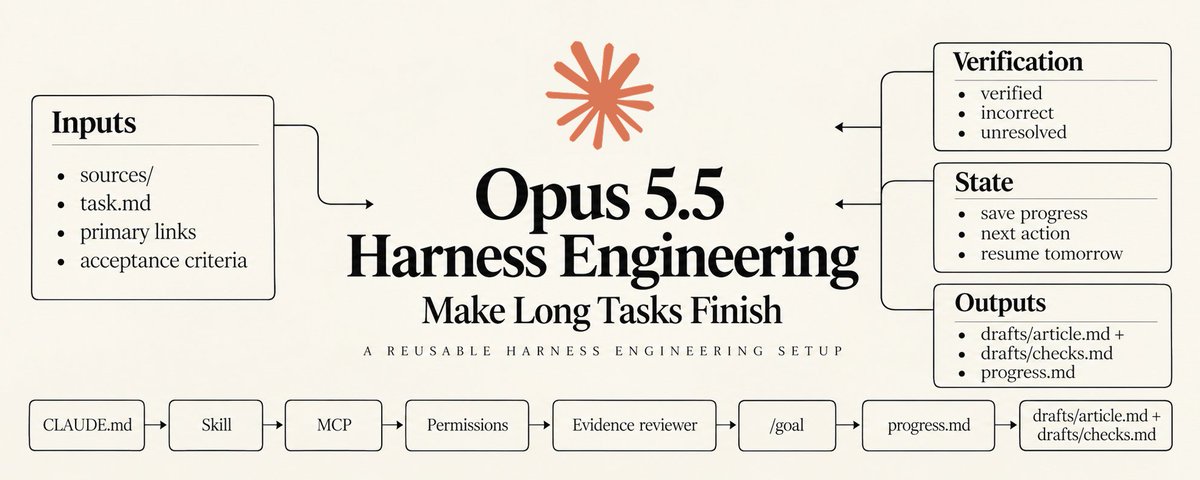
Then read the full Opus 5.5 harness engineering guide below ↓



F.A retweeted

Instagram can hand out 1024 new IDs every millisecond on every shard without a single ID server
They were writing 25 photos and 90 likes a second and had started splitting Postgres across a bunch of machines. Once several databases take inserts at the same time, a normal auto incrementing key on one database stops working
They looked at Twitter's Snowflake but didn't want to run ZooKeeper and a whole ID service on top. Feels like a lot of how they scaled with so few engineers was just avoiding new moving parts
So Postgres makes the ID itself at insert time. It's 64 bits. The first 41 are milliseconds since their own epoch, which is good for about 41 years, and that's why the IDs are already sorted by time. The next 13 say which shard the row lives on, so the ID tells you which database to go to. The last 10 are a counter that resets every millisecond
I love the shard part. Those 13 bits name a logical shard, and there are thousands of them, each just a Postgres schema, sitting on far fewer machines. To add a machine you move some logical shards over and no ID ever changes
Source: medium.com/instagram-enginee…

F.A retweeted

keep pushing forward.
blog.stackademic.com/keep-pu…
