

Building the future of crypto || Crypto Mathematician || LBank Angel || #Blockchain #Crypto
Joined February 2023
- Tweets16.2K
- Following517
- Followers791
- Likes49.6K









This is probably one of the more interesting Binance Card use cases.
Imagine some of your supported crypto is sitting in Simple Earn Flexible.
Then you need to make an everyday purchase.
For eligible Binance Card users, Simple Earn Flexible can be enabled as a payment source alongside supported Funding and Spot balances.
That creates a useful connection between different parts of the Binance ecosystem.
But there is an important detail.
If funds from your Flexible balance are actually used for a Card transaction, the corresponding amount is redeemed and stops earning new rewards.
So I would not describe it as “spending while still earning on the same money.”
The practical benefit is flexibility.
Your eligible balance can become available when you need to spend it without making the whole process feel disconnected.
There is also up to 3% cashback on eligible monthly spending, subject to applicable terms.
Crypto involves risk, so understand both the product and the asset before using it.
I found this pretty interesting, check it out for yourself.
#Binance #BinanceAcademy #LearnWithBinance #BinanceCard

Many beginners ask:
“Which Earn product gives the best return?”
Better question:
“Which Earn product matches my risk level?”
Because Binance Earn is more like a ladder.
Lower steps are easier to understand.
Higher steps need more knowledge.
Flexible products give more access.
Staking requires understanding the asset and network.
Advanced products like Dual Investment, Smart Arbitrage, and On-Chain Yields can involve market-linked outcomes or DeFi-related risks.
That does not make them bad.
It means they are not for blind clicking.
Learn the risk tier before looking at the reward.
Where do you draw your line: simple, staking, or advanced?
binance.com/en/earn?utm_sour…
#Binance #BinanceAcademy #LearnWithBinance #Staking

“Binance Card works at 90M+ merchants.”
That sounds impressive, but beginners should understand what it actually means.
It does NOT mean 90 million shops suddenly started accepting BTC directly into crypto wallets.
The important bridge is the card network.
For eligible users in supported markets, Binance Card lets supported crypto balances participate in a familiar card payment process at compatible online and offline merchants.
That distinction matters.
The merchant can operate through the traditional payment infrastructure while the user manages the crypto side through the Binance ecosystem.
That is why I find crypto cards interesting.
They do not necessarily require every shop owner on Earth to learn wallets, private keys and blockchains before crypto becomes useful for spending.
Eligible users can also receive up to 3% cashback on eligible monthly spending, subject to applicable terms.
Availability, fees and supported assets vary, and digital assets involve risk.
I found this pretty interesting, check it out for yourself.
Could bridges to existing payment networks drive adoption faster than asking every merchant to accept crypto directly?
#Binance #BinanceAcademy #LearnWithBinance #Binancecard

Most people hear staking and think:
My coins will be stuck.
Liquid staking is different.
On Binance, staking ETH gives WBETH.
Staking SOL gives BNSOL.
These are liquid staking tokens, meaning they can remain usable while staking rewards continue to accrue.
That matters most for people who already planned to hold ETH or SOL for the long run.
But do not treat it like free yield.
The asset price can still fall.
Using the token in DeFi can add more risk.
You still need to understand terms, redemption and eligibility.
Crypto rewards make more sense when the risk is visible.
Would you stake for the long term, or keep your assets liquid?
binance.com/en/earn?utm_sour…
#ETH #Stake #Blockchain

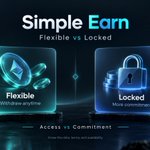
Simple Earn is not about becoming a trading expert.
It is about understanding what your idle crypto can do.
Flexible is the beginner-friendly starting point because you can subscribe supported assets and withdraw anytime.
Locked is for people who are more certain about their time horizon.
The trade-off is simple:
Flexible = more access
Locked = more commitment
But higher rewards should never make you ignore risk, terms, or regional availability.
For beginners, the smartest move is often learning how the product works before chasing the biggest number.
What matters more to you in crypto: access, rewards, or peace of mind?
binance.com/en/earn?utm_sour…
#Binance #BinanceAcademy #LearnWithBinance #Blockchain

Convert and Spot are like two different ways to enter the same shop.
Convert is the quick counter.
I have this. I want that. Show me the quote. Confirm.
Spot is the full trading desk.
Choose the pair. Check the chart. Pick market or limit. Review price and amount. Place the order.
For beginners, both can be useful depending on what they are trying to do.
But both require attention.
The mistake is not using Convert.
The mistake is using anything without understanding it.
The mistake is not placing a market order.
The mistake is thinking price does not matter.
Crypto trading becomes less scary when you learn the basic language first.
Pair. Price. Order. Fill. Risk.
accounts.binance.com/en/regi…
Which felt easier when you started, Convert or Spot?
#Binance #BinanceAcademy #LearnWithBinance

Creating a Binance account is like opening the door to a new city.
At first, everything looks busy.
Wallet.
Spot.
P2P.
Convert.
Academy.
Security.
Verification.
A beginner can easily feel lost.
That is why the first goal should not be speed.
The first goal should be orientation.
Create the account through the official app or website.
Complete identity verification carefully.
Use clear documents.
Avoid blur and glare.
Make sure the information matches your ID.
Then secure your login before exploring anything else.
You do not need to master Binance on day one.
Just learn where things are, what they mean and what risks to avoid.
A good crypto journey starts with a calm setup.
accounts.binance.com/en/regi…
What confused you most the first time you opened a crypto exchange?
#Binance #BinanceAcademy #LearnWithBinance

Devid James retweeted

Chairman Pakistan Virtual Assets Regulatory Authority Bilal Bin Saqib says we need to move from being consumers of technology to becoming creators and owners of it. He stresses the need to move from freelancers to founders, from outsourcing services to building world-class AI, fintech, blockchain and other frontier technology companies. He further says that with one of the youngest populations in the world, Pakistan has the potential to become a nation of builders, not just consumers.
@Bilalbinsaqib
@PakistanVARA
#Pakistan #Technology #AI #Fintech #PakistanTV
Blockchain events shouldn’t just be about finding the next big coin.
The more important conversation is about what is actually working.
Are people using crypto to solve real problems, or are we still building things because they sound exciting?
Can we make wallets, payments, DeFi and onchain apps safer without turning the user experience into a maze?
Can regulation give everyday users more confidence while still leaving enough room for builders to experiment?
And maybe the hardest question:
What are we building today that nobody actually needs?
That’s where events like Binance Blockchain Week become valuable.
You get builders, founders, users, creators, investors, regulators and skeptics in the same room. Different perspectives, different incentives, but one industry being pushed to answer tougher questions.
For me, the next stage of Web3 is not about getting more people interested in “blockchain.”
It is about making blockchain useful enough that people can use it every day without even thinking about the technology behind it.
The real milestone will be when someone uses a blockchain powered product, gets value from it, and does not care whether it was built on blockchain or not.
That is when we know the industry has moved beyond hype.
If I could add one question to the Binance Blockchain Week agenda, it would be:
How do we build products that people genuinely need, even when they don’t care about crypto?
What part of the blockchain industry do you think deserves more attention right now?
#Binance #BinanceAcademy #LearnWithBinance

Gen Z is not waiting for “one day I will learn investing.”
They are learning early, mostly through screens.
Finance apps.
Market news.
Short videos.
Creators.
Online communities.
Global platforms like Binance.
This changes the investing conversation.
Older generations often entered markets through banks, brokers or office advice.
Gen Z enters through curiosity.
They compare products faster.
They ask more questions publicly.
They care about access to global markets.
They learn by testing tools, not only by reading books.
But there is a risk too.
Easy access should not mean careless decisions.
The best Gen Z investor is not the one who clicks fastest.
It is the one who learns risk before chasing opportunity.
Financial markets are becoming more open.
Now financial education has to move just as fast.
#Binance #BinanceAcademy #LearnWithBinance

Buying your first Bitcoin should not feel like jumping into deep water.
Make it simple.
First, understand what $BTC is.
A digital asset with a maximum supply of 21 million.
Second, understand volatility.
The same asset people praise today can drop tomorrow.
Third, remember you do not need to buy 1 full Bitcoin.
Fractions exist for a reason.
Fourth, avoid FOMO.
If your only reason is “everyone is talking about it”, pause.
Binance’s My First BTC campaign may help eligible first-time users with 7-day price protection on qualifying first trades, subject to terms.
Helpful, yes.
Risk-free, no.
Learn first. DYOR. Then decide.
#Binance #BinanceAcademy #LearnWithBinance

First salary advice nobody likes hearing:
Do not try to look rich in month one.
That first paycheck can disappear fast if every decision is emotional.
Before spending or investing, learn the basics:
Budget: what came in and what went out.
Emergency fund: money kept aside for surprises.
Saving: protecting money for near needs.
Investing: taking risk for possible growth.
Diversification: not depending on one asset.
Risk tolerance: knowing how much loss you can handle.
If you are curious about crypto, Binance Academy is a good place to understand Bitcoin, markets, blockchain and DYOR.
Your salary should build habits, not pressure.
#Binance #BinanceAcademy #LearnWithBinance

A beginner mistake:
Seeing a familiar company name and assuming every product around it works the same way.
Traditional stock and Binance bStock may both relate to company exposure, but the structure is different.
A traditional stock is usually bought through a broker.
A Binance bStock is a tokenized stock product for eligible users in supported regions.
That difference matters.
Before exploring any financial product, ask simple questions:
What exactly am I holding?
Do I directly own the share?
How does trading work?
Is it available in my region?
What risks apply?
The name may feel familiar.
The product structure still needs learning.
Educational only. Not financial advice.
#Binance #BinanceAcademy #LearnWithBinance

Traditional markets have a closing bell.
Crypto does not.
That one difference changes the whole feeling of the market.
You can sleep at night and wake up to a different chart.
You can open your phone on Sunday and the market is still moving.
You can check during a public holiday and trading has not stopped.
Why?
Crypto markets are global, digital, and active across time zones.
There is no single exchange office deciding when the entire market opens or closes.
But 24/7 trading does not mean 24/7 opportunity.
It also means 24/7 risk.
For beginners, the lesson is simple:
Understand the market structure before reacting to price movement.
Educational only. Not financial advice.
#Binance #BinanceAcademy #LearnWithBinance

Here is a simple way to explain crypto earning products:
Trading asks:
“Can I buy or sell at the right time?”
Holding asks:
“Do I want to keep this asset?”
Earning products ask:
“Can this supported asset be used under certain terms to receive rewards?”
That small difference can save a lot of confusion.
Binance Simple Earn offers Flexible and Locked products.
Flexible products give users more flexibility around redemption.
Locked products usually involve a fixed period, so users need to understand the commitment before subscribing.
This is not something to use blindly.
Check the asset.
Check the rate.
Check the lock period.
Check redemption rules.
Check eligibility.
Check regional availability.
Understand price volatility.
A product is only simple when the user understands the terms.
#Binance #BinanceAcademy #LearnWithBinance

A beginner does not enter crypto asking for 20 products.
They usually ask simple questions:
Where do I learn?
Where do I buy?
Where do I convert?
Where do I hold?
Where do I pay?
Where do I check my options?
This is why the super app idea matters.
It organizes the journey around user needs instead of forcing users to jump between different platforms.
Binance brings multiple tools into one ecosystem, including Academy, Spot, Convert, Simple Earn, P2P, Wallet, Pay, Card and more depending on region and eligibility.
That does not mean every user needs every product.
It means the path is easier to understand when the tools are connected.
Good financial design is not only about access.
It is about reducing friction, improving clarity and helping users know what each product is actually for.
#Binance #BinanceAcademy #LearnWithBinance

Most people think investing and trading are the same thing.
They are not.
Investing is usually like planting a tree.
You choose an asset, give it time, and focus on long-term growth.
Trading is more like reading the weather.
You watch price movement, timing, market mood, and risk in shorter timeframes.
Both involve buying and selling assets.
But the mindset is different.
An investor asks:
“Can this grow over time?”
A trader asks:
“Can I manage this move right now?”
Neither approach should start with hype.
It should start with education.
Before buying your first asset, understand your goal, your timeframe, and how much risk you can actually handle.
Learn first. Decide later.
#Binance #BinanceAcademy #LearnWithBinance

Stablecoins are not the loudest part of crypto.
No hype chart. No “100x” energy. No dramatic price swings every minute.
But that is exactly why people talk about them.
A stablecoin is designed to track another asset, often the US dollar, so users can move value inside crypto with less volatility than many other digital assets.
People use them for trading, transfers, payments, and moving between crypto products.
But “stable” should not make anyone careless.
Before using any stablecoin, ask:
What backs it? Who issues it? Can it depeg? Are reserves transparent? What rules apply in my region?
The real skill is not just knowing what stablecoins are.
It is knowing what keeps them stable.
Educational only, not financial advice. Always use official sources.
#Binance #BinanceAcademy #LearnWithBinance

The most interesting thing about tokenized assets is not the hype.
It is the bridge.
Traditional finance has stocks, commodities, funds, and structured products.
Blockchain brings digital ownership records, faster settlement, and programmable infrastructure.
Tokenization is where these two worlds may start meeting.
But users should stay careful.
A tokenized product can involve market risk, issuer risk, liquidity risk, technology risk, custody risk, and regulatory risk.
Even when a product tracks a real-world asset, the token may not give the same rights as holding that asset directly.
That is why “tokenized” should never be treated as a shortcut.
Read the structure. Check eligibility. Use official sources.
Educational only, not financial advice.
#Binance #BinanceAcademy #LearnWithBinance
