

builder, ai, markets, and general data nerd | https://xitter.cf/t.co/zs1Hb6u5e0
In the lab 🧪
Joined March 2025
- Tweets19.1K
- Following1.3K
- Followers1.6K
- Likes17.5K






Pinned Tweet
Foliome now prices every goal in your household's plan and gives you everything you need to monitor and manage your wealth. Not just another dashbaord. Open source, runs on your machine.

S-1s make the numbers audited.
Until now, Anthropic's revenue and burn have come from leaks and run-rate claims. An S-1 puts audited revenue, gross margin and cash burn in one document, with securities liability behind every line.
Gross margin shows what it costs to serve Claude versus what customers pay. The compute purchase commitments in the notes could show how much future revenue is already spoken for.


Meta is selling shares for AI.
Up to $95B in stock against up to $145B in CapEx this year. If fully raised, equity would cover roughly two thirds of the spend.
Funding data centers with new shares instead of cash flow passes the cost to existing holders. Their slice of whatever the buildout earns gets smaller.
A fixed dollar raise also costs more shares whenever the stock dips, so the dilution depends on where META trades while the offerings run.

BREAKING: Meta, $META, will raise up to $95 billion through a series of stock offerings in order to fund the development of AI.
The financing plan comes just days after Meta said it would spend up to $145 billion in CapEx this year.
The Fed's cushion is thin.
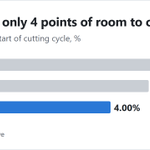
Rate cuts are the standard recession fix, and with the Fed funds rate at 4 percent there's only about four points of room before zero. Krugman's argument is that an AI spending bust would hit harder than the late-90s IT bust, with less ammo to answer it.
Past zero, the remaining options are fiscal spending or the Fed buying assets, and the first one needs Congress to act.


“a bursting AI bubble would be a much bigger shock to the economy than the bursting IT bubble at the end of the 1990s that brought us to the edge of a liquidity trap. Yet the Fed has much less room to cut rates now than it did then: the current Fed funds rate is only 4 percent. So if huge AI spending is a bubble, and that bubble bursts, I can’t see how the U.S. can avoid plunging into a liquidity trap — a situation in which the Fed simply lacks the tools to get us out of a slump. If this should happen, the economy is likely to remain depressed for years.”
-@paulkrugman
Checking got cheap.
An agent solving 49 of 50 research-level physics problems at under $3 each pushes the cost somewhere else: confirming the problem it solved was the one you meant.
Math shows the size of that shift. OpenAI's August corpus had 20.6 MB of machine-checked proof against 55.6 KB of statements and definitions a human still has to read. That's 379 to 1, and I broke down what it means in the post below.
Those few pages are the only place a mistake can hide. Two days after the release, a Lean contributor passed 8 of the repo's challenges without doing any math.
dodatathings.dev/blog/verifi…


OpenAI just released 300 AI-written math proofs, each checked line by line by a computer. The repo still labels them unchecked, and that label is honest.
Two days after the release, a Lean contributor showed you could pass 8 of the repo's challenges without doing any math. The trick was rewriting the rule so nothing could ever meet it, which makes "nothing meets the rule" automatically true. The computer approved it, and it was right to, because it only checks the answer against the question it's handed.
AI made answers cheap and Lean made checks cheap. The question is still a person's job, and that's where this slipped. In OpenAI's August batch, machine-checked proof outweighed the statements a person still has to confirm by 379 to 1.
Tests on code, templates on contracts and validations on models carry the same stamp. So ask of each one: verified against what?
dodatathings.dev/blog/verifi…

Obsidian is just a folder.
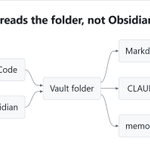
Claude Code operates on the working directory. Launch it from a vault root and it has read/write access to every markdown file, plus CLAUDE.md and memory.md for persistent context. The agent never sees Obsidian, only files.
That's why "show every note that touches customer A" works as a plain-language prompt. The linking and search features were never what made the notes active.
Obsidian still earns its place as the phone reader and the pretty graph view. The agent layer doesn't need it, and I laid out the file-access mechanism in April.
dodatathings.dev/blog/claude…

Karpathy's LLM wiki pattern keeps showing up because it works. I've been running a version of it in production for 3 months inside Foliome, a personal finance agent that syncs every bank account, classifies transactions, and remembers my financial goals across sessions.
Same three operations. Ingest: the agent processes new bank data and updates its financial memory. Query: I ask how much we spent on the kids' activities this quarter and get an answer grounded in 5 years of classified transactions. Lint: periodic checks catch stale categorizations and flag anomalies.
I also built two Obsidian plugins using related patterns before the Claude Code + Obsidian wave hit X this month. The part nobody talks about yet is how far beyond note-taking this extends. Financial data. Research pipelines. Content systems. Anywhere you need an agent to accumulate context across sessions instead of rebuilding from scratch every time.
Wrote up everything I learned shipping these systems: dodatathings.dev/blog/claude…

Two economists, same zero.
Apollo's chief economist now says AI has delivered "zero payoff" to corporate America outside Big Tech. Goldman's chief economist said something similar about the macro numbers: AI added basically zero to 2025 US GDP growth.
The mechanism is accounting. About 75% of a data center's cost is imported parts, so GPU spending lands as imports and subtracts from GDP. I wrote up that math in April.
If both hold, Big Tech's own earnings are the only place the return on this capex can show up.
dodatathings.dev/blog/ai-cap…

The NBER study is real, the $600 billion number is real, and the 90 minutes per week stat is real. But the framing here misses what makes this genuinely scary.
Goldman Sachs Chief Economist Jan Hatzius told the Atlantic Council that AI investment contributed basically zero to US GDP growth in 2025. His reasoning: 75% of a data center cost is imported chips from Taiwan and South Korea. The spending registers as imports, which subtract from GDP. $650 billion flowing out of US balance sheets this year. Most of it landing in Taipei and Seoul.
The MIT study is worse. 95% of enterprise AI pilots showed no measurable P&L impact. But companies are accelerating spend, not slowing down. Amazon: $200B. Google: $175B. Microsoft: $150B. Meta: $115B. That exceeds the Apollo program and the US interstate highway system as a percentage of GDP.
The thing the NBER survey reveals that nobody wants to sit with: this is not a technology failure. 1.5 hours per week means the technology is available and people are barely touching it. The bottleneck is organizational, not technical. No data foundations, no measurable KPIs, no executive sponsorship beyond the all-hands announcement.
J.P. Morgan projects $5 trillion in total AI infrastructure through 2030. Somebody has to earn that back. So far, the productivity data says almost nobody is.
Broke down every number on both sides of this gap, from Goldman GDP calculation to the MIT pilot data to the builders actually generating ROI.
dodatathings.dev/blog/ai-cap…

Inference is a rental business.
Rent B300s at $8/GPU-hr, load open weights like GLM, Kimi or DeepSeek, resell tokens. No training bill and no research team, which is why $1M/mo shows up so fast.
Every provider on the same weights and the same rented GPUs sells the same product. Price per token and how busy each GPU stays are the only levers, so margins might compress as fast as revenue arrives.
At $8/GPU-hr, an idle B300 still costs about $5,800 a month.

There is an absolute barrage of inference providers popping up that get to $1M/mo extremely quickly.
This is the rough economics of inference providers:
Even if you rent on-demand B300s at $8/GPU-hr, many open source models (GLM 5.3, Kimi K3, DeepSeek 4.1 Flash / Pro) can get you >$10-20/GPU-hr at reasonable throughputs (100tok/s). DeepInfer from DeepSeek directly shows they can get $38/GPU-hr on off-peak hours. Every chip / model has a different throughput / interactivity curve, but there is a lot of arbitrage between even high rental spot prices and token prices. New chips (Vera Rubins) also change this meaningfully. Your ability to be making gross margin relies on your utilization and how good your stack is.
Gateways like OpenRouter, Vercel and more help solve that problem by aggregating demand to you. May inference providers discount their tokens to get longer term commits too. I've even heard stories of selling back Chinese model tokens to Chinese labs!
One thorn in the economics of these players is that many Chinese open source model labs are now asking for rev share if you're at a certain scale, espp for pre-release access to their models for day 1 support. That further pushes the threshold to be in the money.
The barrier to entry seems low and falling. There are even stories of smaller ones who can "vibe code" a way to stand up OSS models on a cluster they rent. And as a result, we're seeing 10s of such companies pop up almost every week and immediately skyrocketing revenue at low-ish gross margin and raising rounds on the back of that.
Unsurprisingly, because the actual service provided seems commodity, this eventually drives up compute prices and drives down token prices. In theory, it would seem like neoclouds who have the lowest cost of compute and themselves have started inference businesses would win the race to the bottom (Crusoe Coreweave Nebius and GMI all have inference businesses), with larger players (Modal Fireworks Baseten) being second because they are well capitalized to make bigger compute commits cheaply and have demand (high utilization), but the reality is the pie is growing so quickly that even upstarts are absolutely crushing it and growing aggressively (inference dot net, DeepInfra, Wafer, Relace, Morph).
Strategies vary across the board: neoclouds want to serve inference, inference players want to be neoclouds and do higher margin reserved instances / post training, and some want to go heterogeneous hardware or creatively flexible compute constructs.
The risks are: do open source models continue to be competitive? Will their creators rent seek more? Will their shape change compute needs? How do different chips change economics? Who gets compute in a supply crunch?
Below is a aggressive sketch of how gross margin scales with utilization for various models / chip sets.
For now, there are many inference providers and they’re all ripping!

Plain files make apps optional.
Obsidian is a folder of Markdown files. To Claude Code, that folder looks the same with or without the app, so backlinks, search plugins and cross-note rollups collapse into one prompt: "pull every note that mentions Customer A."
What's left for the app is what a human touches: reading on a phone, a clean display, adding one line fast. Note apps might end up competing on capture and display alone once the agent does the retrieval.
Because the data is portable files, leaving costs nothing.

「Obsidianってどうですか?」とよく聞かれます。
ただ、自分がいつも参考にしている凄腕のAIエンジニアたちで、Obsidianを使っている人はほぼ見たことがありません。
自分も一応入れてはいますが、ほとんど触っていないです。
理由はシンプルで、そこまで必要なツールだと思っていないから。
Obsidianの中身はただのMarkdownファイルで、データはPCのフォルダにそのまま置かれています。
AIから見れば、Obsidianでも普通のフォルダでも同じです。
売りだった機能も、Claude Codeで代わりがききます。
・関連メモを辿る →「顧客Aに触れたメモを全部出して」で一発
・横断検索や集計 → プラグインより自然文の方が柔軟
・要約や整理 → そもそもObsidianにはできない
それでもObsidianが活きるのはこの3つくらい。
・スマホで読み返したい
・整った見た目で眺めたい
・メモを1行だけサッと足したい
これをやらないなら、Claude Code+ローカルフォルダで十分です。
これ以外に良い活用事例やメリットがあれば教えて欲しいです!!

75 days to unwind 18 months.
AI positions built over 18 months are coming out in 75 days while corporate profits still grow ~20% YoY and the S&P 500 barely moves. Earnings are intact. The selling comes from fund balance sheets.
Leveraged funds under pressure sell whatever is liquid, which would explain the spread into credit, multistrats and European bonds. Assets with zero AI exposure could take losses while the index looks calm.

AI Bubble Burst? Bitcoin to Zero? Hedge Funds Wrecked? Sounds Like a Bottom is Near
In this week's video: youtu.be/CjquP0fupG4
On many measures this is one of the largest hedge fund equity deleveraging events in the last 30 years without economic deleveraging.
For equities parallels to the 2007 Quant Quake are striking. AI positions built over 18 months are being unwound in 75 days.
This is concentration rather than factors.
But here's what matters:
Corporate profits are still growing ~20% YoY.
AI compute demand continues to exceed supply.
The S&P 500 has barely moved despite the liquidation.
Contagion has spread into credit, multistrats, and European bonds.
This is hedge fund deleveraging, NOT economic deleveraging.
And I believe based on positioning we're in the final innings.
I also cover why AI is accelerating breakthroughs in healthcare, why cybersecurity could drive tokenization, and why the convergence of AI and crypto is just beginning.
The world is changing faster than traditional leverage and risk management can handle.
The real bubble may have been in the assumption that investors still had time.

Own the harness, rent the model.
Eval criteria, routing logic and quality gates stay with the company. The LLM underneath gets swapped whenever something better ships.
A team with evals can test a cheaper model the week it lands. A team without them can't tell whether the swap broke anything, so it stays on the old model and keeps paying the old price.

There are seven main steps for your company to go from tool adoption to agentic org.
Most companies sit on step one, shopping for step seven technology. They need step four discipline.
Step one: tool adoption. AI tools exist across the org, humans run each one. Developer closes the lid, automations die. Somebody goes on vacation, the workflow goes with them.
Step two: context layer. Knowledge graphs per department, each behind its own API gateway. Sales queries engineering through an API. Separated domains keep agents from hallucinating across departmental boundaries.
Step three: harness engineering. Build evaluation criteria, routing logic, and quality gates before you pick a model. The LLM comes in last. Your harness is your IP and your capex. The model underneath is a commodity you swap when something better ships. If changing the LLM breaks your system, you built a dependency, not a platform.
Step four: go headless. Host every automation outside a laptop. It fires on schedule, on conditions, without a human logging in at 9 AM. Companies stall here because nobody forces the migration from “script on my desktop” to “service that runs on its own.”
Step five: governance. RBAC on every knowledge structure from day one. TTL on every agent. Dead agents are tech debt with active API keys. Past 100 tools, you need lifecycle management. Retire anything that hasn’t run in 90 days. Deprecate anything whose eval scores drop below threshold.
Step six: agent-to-agent. Stitch headless instances together within a value chain. Agent A finishes, hands off to Agent B. An LLM sits between them as a quality gate, judging every handoff before it passes through.
Step seven: step functions. Orchestrated, semi or fully automated workflows. Agents handle volume. Humans handle exceptions. The org runs on agent output.
We walked a VP of Engineering through all seven.
Told him: “You’re on step one. But over a hundred tools means step four is closer than you think.”
Neolabs are long GPUs.
Reserving H100/B200/B300 capacity before rental prices rose 2-3x turns a model lab into a leveraged bet on GPU scarcity. Resale pays off the contract even if the model never ships.
That only works while prices hold. A multi-year commitment signed near the top turns into a liability if rental rates fall when new supply lands, and the lab would be stuck paying for capacity with no frontier model to run on it.
Investors in these rounds are underwriting a GPU forward book, whether they priced it that way or not.

You can now run an 816-billion-parameter model on two Mac Studios on your desk. Meta's Muse Spark Open does it at about 25 tokens a second. It's also the wrong box to buy.
DeepSeek V4.1 Flash scores the same 39 on the Artificial Analysis index on one $9,499 Mac.
Even that box loses to the API. Running it 24/7 costs about $304 a month. The same tokens from DeepSeek's API cost $278. The two-Mac Muse rig, on my $28K price estimate, runs about $858.
dodatathings.dev/blog/same-s…

Open weights are about to rank 4th.
Kimi K3.1 Pro scores 55 on the Artificial Analysis Intelligence Index, 3 points behind Claude Opus 5.5 at 58. It gains 11 points over K3, and the weights are due Nov 4.
I laid out the self-hosting math in June, when K2.6's 54 led the open table. The index has been re-based since, so that 54 no longer compares. The ~10M tokens/day breakeven still frames the decision, but now against a 3-point gap to the top closed model.
The model is 2.8T total parameters with 104B active. Once the weights publish, procurement teams can price real serving costs against that gap.

Kimi K2.6 just took #1 on the Artificial Analysis Index among open-weight models at a composite score of 54. That number sits inside frontier-closed territory from 6 months ago. The post-GLM, post-DeepSeek V4 ranking is now a Chinese open-weight at the top of the open table.
The AAI Index composite blends reasoning, coding, and instruction-following across 10 evals. At 54, K2.6 clears the 50 line that was Claude 3.5 Sonnet territory in mid-2025. Open weights, 1T parameters, $0.95 per million input tokens.
The practical read: every diligence team that wrote off open weights at the GPT-4 frontier has to re-run the procurement math at the GPT-4o frontier. Self-hosting flips above ~10M tokens/day, and K2.6 just moved the quality side of that calculation up a full tier.
The leaderboard refresh is a forcing function, not a vibe. The next 4 enterprise eval cycles will tell us whether the Chinese open stack is now the default fallback when the closed labs hike API pricing in Q3.
Source: artificialanalysis.ai/articl…

Open cyber capability is being dialed down.
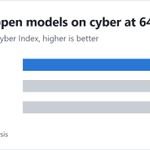
Kimi K3.1 Pro leads open models on the Artificial Analysis Cyber Index at 64, ahead of MiMo's 56 and Mistral Large 4's 49.5. Moonshot says it stripped cyber training data from the open-weights version, which cut its own cyber benchmark solve rate from 90.5% to 81%.
For a security team that rules out Chinese origin, the shortlist stays the same. GPT-6 Astra refused 100% of CyberGym tasks and Opus 5.5 refused 98.5%, while Large 4 completed 81.7%. We laid out that provenance math in the post below.
The 64 could be a pre-stripping number. The weights teams can self-host on November 4th might land closer to Large 4 than the index implies.
dodatathings.dev/blog/procur…

Banks, insurers and hospitals can finally run a near-top AI model on their own servers that no Chinese lab built. It costs them about 7 points of quality.
Until now, regulated buyers had two bad options. Run Chinese weights and fight the compliance review, or drop a full tier down to Llama 4 or Gemma 4. Mistral Large 4 is the first close-to-top option in between.
It scores 38.4 on the Artificial Analysis Intelligence Index. The best Chinese models score 45 and 46.
Cost per task is messier. Large 4 runs $1.13, against $0.13 for MiMo and about $2.00 for GLM-5.3.
So the premium is real, and now you can price it. A team whose policy rules out Chinese weights pays it. A solo builder routes to whatever passes their eval cheapest.
dodatathings.dev/blog/procur…

Same sparsity, 11 more points.
Kimi K3.1 Pro keeps the 2.8T total / 104B active spec and scores 55 on the Artificial Analysis Intelligence Index, up from 44 for K3. That puts it 4th overall while still paying per-token compute for a 104B-class model.
I laid out the 16-of-896 expert routing in July. The gain came without growing the active slice.
Open weights are due November 4. AI token spend grew just 0.2% month over month in September, and cheaper near-frontier models like this one are part of the pricing pressure.

16 of 896 experts active per token on a 2.8T parameter model, only 104B actually firing. That ratio meansKimi K3 aims for frontier-level output while paying compute for a model 27x smaller than its total weight class.
That's the economics DeepSeek's MoE approach put on the map last year, pushed further.
Open weights at this sparsity level lower the cost of running near-frontier intelligence for anyone without a frontier-scale cluster.
arxiv.org/abs/2607.24653


Softmax silently rounds gradients to zero.
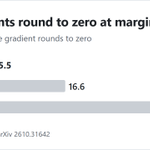
Inside softmax and cross-entropy, tiny gradients can round to exactly zero, or stay nonzero when they should vanish. That error can show up as sudden Slingshot loss spikes in training, and as distillation students drifting away from their teachers.
Higher precision is the obvious patch, and this fix skips it. On grokking benchmarks, test accuracy went from 94.3% to 100% in one setting. So far the evidence is only small-scale.


"A Fix for Softmax and Cross-Entropy"
Turns out two of the most fundamental functions in deep learning have numerical bugs that can actually destabilize training.
This paper proposes simple fixes to softmax and cross-entropy that prevent tiny gradients from incorrectly rounding to zero, or remaining nonzero when they should vanish, as these errors can cause sudden loss spikes and interfere with knowledge distillation.
On small-scale grokking benchmarks, the fixes eliminate Slingshot loss spikes and improve test accuracy from 94.3% to 100% in one setting. They also prevent student models from drifting away from their teachers during distillation, without requiring higher numerical precision.
alphaxiv.org/abs/2610.31642

Open weights are nearly caught up.
Once Kimi K3.1 Pro's weights ship, the open vs closed gap on the Artificial Analysis Intelligence Index drops from 12 points to 3 (55 vs Claude Opus 5.5 at 58).
Most of the jump is agentic work. Terminal-Bench 4.0 went from 13% to 67%, ahead of Claude Sonnet 5.5 at 64%. Agent workloads burn many model calls per task, so that's where API bills pile up.
Companies running agents at volume could start pricing a self-hosted model against their closed-lab invoices, with only 3 index points separating the two.


Kimi K3.1 Pro launches at 4th on the Artificial Analysis Intelligence Index scoring 55, making large gains in agentic performance; it will be the leading open-weights model once its weights are published
@Kimi_Moonshot's new reasoning model gains 11 points over Kimi K3 (max, 44). It trails only Claude Opus 5.5 (max with fallback, 58), Claude Sonnet 5.5 (max with fallback, 56), and Muse Wonder Full (max, 56) on the Intelligence Index.
Once the weights for K3.1 Pro are released it will be the highest-scoring open weights model and the gap between the leading open weights and proprietary models on the Intelligence Index will narrow from 12 points to 3.
Key results:
➤ Large gains in agentic performance: Kimi K3.1 Pro scores 3rd on GDPval-AA with 1,846 Elo, up 312 Elo from Kimi K3, behind only Claude Opus 5.5 (1,866 Elo) and Muse Wonder Full (1,857 Elo). Kimi K3.1 Pro also achieves the highest score of any model on Terminal-Bench 4.0. K3.1 Pro scores 67%, up from 13% for Kimi K3 and ahead of Claude Sonnet 5.5 (64%). AutomationBench-AA, which tests agentic SaaS workflows, rises from 58% to 73%.
➤ Gains in other evals are more moderate: Humanity's Last Exam rises from 47% to 52%, CritPt from 23% to 25%, and SciCode from 59% to 61%. AA-Omniscience Index rises from 20 to 30, as the hallucination rate falls from 53% to 44% and accuracy rises from 48% to 51%.
➤ Cost per Task roughly equal to Kimi K3 at $1.98 per Task: K3.1 Pro uses 55K output tokens per Intelligence Index task, 14% more than Kimi K3 at 48K, while its first-party token prices are 33% lower.
Additional model details:
➤ Context window: 1M tokens.
➤ Size: 2.8T total, 104B active parameters
➤ Input modalities: Text and image
➤ Weights and license: Weights currently not published, Moonshot is expected to release the weights soon after launch
➤ Pricing: $2/$10/$0.20 per 1M input/output/cache hit tokens, 33% lower than Kimi K3 on all three rates.
Congratulations to the team at @Kimi_Moonshot on the release!

Open weights at 2.8T.
Only 104B parameters fire per token, about 3.7%. Compute per query follows the active count, but memory follows the full 2.8T, so self-hosting takes a rack of GPUs.
The 65% hallucination drop on finance modeling is a vendor number with no baseline stated. Once weights land Nov 4, funds and banks that can't send positions to an outside API can run their own eval on their own spreadsheets, inside their own walls.

Introducing Kimi K3.1 Pro: our most capable 3T-class open-weight model.
🔹 1M-token context, 2.8T total / 104B active params (MoE), Multimodal.
🔹 Full-project coding: games in Unreal, Unity & Godot.
🔹 Excels at parametric 3D modeling in Blender & CAD.
🔹 More reliable at finance work: Accurate modeling with hallucination down by 65%.
🔹 Matching the strongest proprietary models across coding, agentic and knowledge benchmarks.
Kimi K3.1 Pro and K3.1 Pro Highspeed (2–3× faster) are now live on Kimi.ai, Kimi Work, Kimi Code, and the Kimi API.
Open weights by Nov 4, 2026.
🔗 API: platform.kimi.ai
🔗 Tech blog: kimi.ai/blog/kimi-k3-1-pro

Your best competitor is an employee.
Employees are adopting AI faster than their companies, often without telling management. AI-native startups now judge what AI can do very differently from incumbents.
I wrote up where that leads in March: a lawyer with 20 years of case law and Claude, a contractor who knows job sites. The people who know what their industry should look like already have the tool open.
The next wave of startups could come from inside incumbents, founded by their own senior staff.

Some might read this as "startups will rebuild your business using AI"
But this actually means domain experts finally have the tools to architect what their industry should be.
A lawyer with 20 years of case law now has Claude. A contractor who understands job sites has reasoning models. The window is for experts who can finally build.
That's the actual opportunity.
$0.10 is the new floor.
OpenAI is taking its Decisions API to general availability at $0.10 per million input tokens, with cached input at $0.01. GPT-6 Luna and Claude Haiku 5.5 already list at that same $0.10 input price.
On repeated prefixes like long system prompts and fixed few-shot examples, the price to beat is $0.01, not $0.10. A self-hosted fine-tuned 7B has to clear that number to justify itself.
I ran the fine-tuning break-even at this floor earlier this week. It also covers why Haiku 5.5 is 90% cheaper than Haiku 4.5 on list price while Anthropic's headline says about 75%.
dodatathings.dev/blog/fronti…

Anthropic's $16.8B is booked gross.
Anthropic books sales through AWS and Google Cloud at gross, and OpenAI books only its share. That gap is why OpenAI's figure went from $68 to $70 billion to "approaching $50 billion" on October 8. A later report says the $70 billion was net, so both numbers need loose handling.
The same issue hits the distillation math. 5% to 7% of a gross base could overstate what Anthropic actually keeps, and it won't compare cleanly with anything OpenAI reports.
I flagged the booking split in the price-floor post. The IPO filing should show how much cloud-partner revenue sits inside the $16.8B.
dodatathings.dev/blog/fronti…
