

Dedicated father, husband, and Teaching MD who ditches his lab coat to share candid insights into healthcare with leading experts in his weekly podcast.
Joined January 2024
- Tweets1.8K
- Following3K
- Followers3.3K
- Likes3.5K





I think I've asked enough questions.
At least into a microphone.
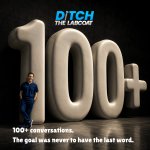
More than 100 episodes ago, Ditch the Labcoat started with a fairly simple idea.
Take people who know something worth knowing.
Lose some of the formality.
Get curious.
And see where the conversation goes.
You came with us.
You listened on commutes, walks, workouts and probably while doing dishes.
You sent questions.
You disagreed.
You shared episodes with people who needed them.
You made me reconsider things I thought I understood.
And somewhere along the way, a one-year experiment became three years of my life.
There are a lot of people behind a podcast who never appear behind the microphone.
Guests who trusted me with their stories.
A team that turned conversations into something people could actually find, watch and hear.
My family, who shared me with this project.
And all of you.
So there isn't another lesson hiding at the end of this post.
Just thank you.
For listening.
For questioning.
For sticking around.
And for giving me a very good reason to keep asking better questions.
The lab coat can go back on now.
The curiosity stays.

24 thank yous.
Thank you to every guest who trusted me with something they knew.
Thank you to every guest who trusted me with something they lived.
Thank you to the physicians who made medicine more complicated.
Thank you to the patients who made it more human.
Thank you to the scientists who brought evidence.
Thank you to the skeptics who brought questions.
Thank you to the people who changed my mind.
Thank you to the people who made me defend it.
Thank you to everyone who sat across from me and let the conversation go somewhere neither of us expected.
Thank you to the production team who somehow turned those conversations into a podcast.
Thank you for the edits, the late messages, the creativity, the patience and the hundred invisible things nobody listening ever knew happened.
Thank you to everyone who pressed play.
Thank you to everyone who made room for us on a commute, a walk, a workout or somewhere between everything else life was asking of you.
Thank you to everyone who sent an episode to someone else.
Thank you to everyone who wrote to me.
Thank you to everyone who disagreed with me.
Thank you to everyone who came back anyway.
Thank you to my family for sharing three years of me with a microphone.
Thank you for reminding me that the conversations mattered most when they followed me home.
Thank you for 100+ episodes.
Thank you for three years.
Thank you for your attention. I never took it for granted.
I started Ditch the Labcoat because I was curious.
Thank you for making me leave even more curious than when I arrived.
We're very good at celebrating beginnings.
Endings make us nervous.
Especially when something is going well.
Three years ago, I set out to record 52 episodes of Ditch the Labcoat.
We passed 100.
I could have kept going.
There are always more guests.
More questions.
More things in medicine I don't understand nearly as well as I'd like to.
But I've been thinking about our strange tendency to treat continuation as evidence of success.
Businesses should grow.
Careers should advance.
Projects should scale.
More must mean it's working.
Sometimes it does.
And sometimes something did exactly what it came here to do.
This podcast introduced me to extraordinary people.
It changed how I think about medicine, leadership, parenting, health, evidence and probably a dozen things I haven't recognized yet.
Most importantly, it made me more curious.
That's enough.
There is something deeply satisfying about being able to look at something you loved building and say:
We did good work here.
And then leave it whole.

I used to think learning a lesson meant you were done with it.
Then life has the irritating habit of putting the same lesson back on the exam.
Livia Grujich said something in our final conversation that changed how I think about that.
She used to get frustrated when an old lesson resurfaced.
Hadn't I dealt with this already???
But you're never really meeting the same problem twice.
Maybe the first time you were 25.
The next time you're 40, with children, a career, a mortgage, aging parents, a few scars and considerably less patience for nonsense.
Same lesson.
Different student.
Medicine works this way too.
Experience doesn't necessarily mean you stop encountering difficult problems. It changes what you notice when they arrive.
Perhaps growth isn't graduating from every lesson life gives us.
It's recognizing it a little sooner.
Responding a little differently.
Carrying something from the last time.
After more than 100 conversations on this podcast, I find that strangely reassuring.
Some questions are worth asking more than once.

Some days I pick up my kids after the ICU and realize they’re getting about 60% of me.
I showed up.
Technically.
That’s what we get wrong about self-care. You can neglect yourself all you want.
Eventually, someone you love gets the bill.

You don't become less ambitious when you become a parent.
You just realize every "yes" costs something.
The equation changes because you did.
Maybe success isn't lowering the bar.
Maybe it's finally deciding where to put it.
It's the last conversation with Livia Grujich.
We've somehow turned happiness into another performance metric.
Steps. Sleep. HRV. Productivity. Protein.
Career. Marriage. Parenting.
And somewhere in there:
Am I happy enough?
Livia Grujich made a point in our conversation that stuck with me.
The goal of positive psychology isn't to be happy all the time.
In fact, expecting that of yourself may be a pretty reliable way to become miserable.
A good life still contains frustration. Boredom. Grief. Stress. The Tuesday where everyone needs something from you and you've reheated the same coffee three times.
It also contains purpose, relationships, achievement, curiosity and moments that feel genuinely good.
All of it belongs.
As a physician, I probably should have recognized the pattern.
A healthy heart doesn't beat at one perfectly fixed rate.
Why would we expect a healthy life to?
Maybe we can stop grading ourselves on how good we feel and pay a little more attention to how fully we're living.
Something to think about.
My final conversation on Ditch the Labcoat with Livia Grujich is available now.

I am injured.
Anyway......what's next?
Livia Grujich tore up her knee skiing.
Her first thought wasn't: I should probably stop.
It was basically: **I need to get down this hill. And then I still need to take my daughter up.**
So she got herself down.
Her young son was with her. There were things to do. People depending on her.
Keep going.
The next day, she finally went to emergency.
ACL injury. Eventually MCL involvement. Surgery. And a recovery that required something she had apparently become very bad at:
Sitting still.
What I loved about Livia telling me this story is that she didn't retrofit some beautiful epiphany onto it.
She hated the pause.
She tried to rush through it.
She described herself as "kicking and screaming" against the very thing her body was forcing her to do.
And I suspect a lot of us recognize that person.
We talk endlessly about wanting more time.
Then someone cancels a meeting and we fill the hour.
We get a free evening and open the laptop.
We finish one thing and immediately ask what's next.
Sometimes even an injured knee isn't enough to stop the machinery.
But eventually Livia had no choice.
And sitting there recovering, she started noticing something uncomfortable.
There were already a lot of good things in her life.
Things she'd worked very hard to create.
She'd simply been moving so quickly toward whatever came next that she wasn't spending much time experiencing them.
That experience eventually found its way into *Stop Searching for Next.*
And importantly, her argument isn't to abandon ambition.
It's to occasionally interrogate it.
What am I still chasing?
Why?
Does my definition of success today even belong to the person I've become?
Because maybe we shouldn't need a torn ACL, a surgery, a power outage or some other interruption from life before we're willing to ask.
As Livia put it during our conversation:
"If you don't give yourself the opportunity to sort of pause and reflect, life will find a way to give it to you."
That one stayed with me.
The final episode of *Ditch the Labcoat* is available now.
The Art of Slowing Down: The Challenge of Pausing and Finding Fulfillment with Livia Grujich.

At what point does ambition stop moving you forward and start moving the finish line?
You get the promotion.
Build the business.
Raise the family.
Reach the number you once thought would mean you'd made it.
And somehow, "enough" moves again.
Why?
1️⃣ Why do so many capable people still feel they haven't done enough?
2️⃣ Who decided what success was supposed to look like in the first place?
3️⃣ And can we stay ambitious without becoming dissatisfied with the life we've already built?
Those are some of the questions at the center of my conversation with Livia Grujich in the final episode of Ditch the Labcoat.
And maybe that's why this conversation felt like the right place to stop.
Livia's book, Stop Searching for Next, isn't an argument against ambition. She spent years building a successful business herself.
It's an examination of what happens when achievement becomes a reflex and we stop checking whether the things we're chasing still belong to us.
That distinction matters.
Because sometimes the next goal is exactly what you need.
And sometimes you need to look around and realize you're standing inside a life an earlier version of you was desperately trying to reach.
The final episode of Ditch the Labcoat is out today.
More than 100 conversations later, I'm ending with three questions I suspect I'll be thinking about for a long time.
And perhaps you will too.
This is my last episode of Ditch the Labcoat. And somehow, my final guest wrote a book telling me to stop looking for what comes next.
When I started this podcast three years ago, I had a goal:
52 episodes. One year.
Reasonable.
Then 52 became more than 100.
Along the way, I got to sit across from physicians, scientists, athletes, researchers, writers, patients, founders and people whose lives had given them something worth saying.
It became one of the most fulfilling projects I've ever taken on.
But here's the peculiar thing about a podcast.
Nobody tells you when you're done.
There's no final patient on the list. No graduation. No finish line somebody else draws for you.
You have to decide.
And after more than 100 episodes, I did.
Which makes my final guest, Livia Grujich almost comically well timed.
Livia is an entrepreneur, educator, speaker and author of Stop Searching for Next: What if the Life You're Chasing Is the One You're Already Living?
She spent 14 years building and leading a successful marketing agency before her curiosity about human behavior eventually turned inward.
👉 Why do capable, accomplished people still feel behind?
👉 Who decided what success was supposed to look like?
And perhaps the question I needed for episode 100-something:
👉 Can you stop doing something you love without treating the decision like failure?
We talked about ambition, motherhood, identity, perfection, the strange pressure to keep achieving, and what happens when life forces you to pause long enough to notice what you've already built.
I couldn't have planned a more appropriate final conversation.
Maybe that's fitting too.
After three years spent asking people questions, Ditch the Labcoat ends with one worth sitting with:
What if the next thing you need isn't next at all?
Final episode tomorrow • Listen Wherever You Get Your Podcasts

I don't think people change because they hear something they agree with.
I think they change when they hear something they can't stop thinking about.
Something that doesn't quite fit with what they already believe.
Something that creates just enough friction that it follows them home.
Over the years, those were always my favorite conversations.
Not because everyone agreed.
Usually they didn't.
The episodes people remembered weren't the ones that wrapped everything up neatly.
They were the ones that left a loose thread.
The obesity physician who challenged decades of stigma.
The journalist who questioned the stories medicine tells itself.
The addiction specialist who asked us to rethink willpower.
The pain physician who suggested symptoms aren't always what they seem.
None of those conversations gave easy answers.
They asked better questions.
Looking back, I don't think Ditch the Labcoat was ever about changing minds overnight.
It was about introducing just enough friction that you became curious enough to keep looking.
Because that's how most real change happens.
Not in a moment of certainty.
In the quiet days afterward, when you find yourself thinking...
"What if I've been looking at this the wrong way?"

One thing surprised me after all the conversations....
The guests who left the biggest impression on me weren't the ones who sounded the most certain.
They were the ones willing to examine their own thinking.
Again and again, I'd hear some version of:
"I used to believe..."
"We've learned..."
"The evidence changed..."
"I've changed my practice because of it."
That takes humility.
It's easy to question someone else's assumptions.
It's much harder to question your own.
Medicine has always moved forward because someone was willing to look at accepted thinking and ask, "What if we're wrong?"
That happened on this podcast more times than I can count.
None of those conversations made anyone look weaker.
They made them more credible.
I've come to believe that's what real expertise looks like.
Not protecting what you already know.
Protecting your willingness to learn.
To every guest who was willing to rethink, revise, question, and sometimes even disagree with the person they used to be...
Thank you.
Those conversations didn't just change how I think about medicine.
They changed how I think about learning itself.

I expected the experts to have answers.
I didn't expect them to have so many questions.
After more than a hundred conversations, that might be the thing I remember most.
The people who had spent decades studying obesity were still asking better questions.
The addiction physicians were still refining their thinking.
The emergency doctors were still questioning old assumptions.
The researchers were still changing their minds when new evidence appeared.
None of them spoke like they'd reached the finish line.
In fact, the opposite.
The more they knew, the more comfortable they became saying:
"I don't know."
"We're still figuring that out."
"That's changed since I trained."
There's something incredibly reassuring about that.
Social media rewards certainty.
Real expertise seems to reward curiosity.
Maybe that's what I admired most about the guests on Ditch the Labcoat.
Not that they had all the answers.
That they never stopped being students.
Maybe expertise isn't the moment you stop learning.
Maybe it's the moment you realize you never will.
Thank you to every guest who reminded me that curiosity isn't something you grow out of.
It's something you grow into.

We tend to imagine learning as adding something.
One more fact.
One more book.
One more podcast.
One more degree.
I'm not sure that's how it works.
I think learning is more like folding a piece of paper.
Every experience leaves a crease.
Every difficult conversation changes the shape a little.
Every mistake.
Every patient.
Every mentor.
Every person who made you question something you thought you knew.
Eventually you become something entirely different.
Not because you added more.
Because you've been shaped by what you've carried.
Maybe that's why the best conversations stay with us long after they're over.
They don't just give us information.
They quietly change the way we think.
And once your thinking changes, it's very hard to unfold it back to where it was.
Thank you to every guest who trusted me with your way of thinking.
You didn't just share your expertise.
You quietly rewired mine.

I have a theory.
Nobody actually wants to be great.
They want to skip being bad.
That's the part we struggle with.
The first podcast episode.
The first article.
The first time speaking in front of a room.
The first business.
The first attempt at changing your health.
We treat those early versions like evidence.
"They're not very good."
Of course they're not.
They weren't supposed to be.
Somewhere along the way, we decided that beginners should produce work that looks like it's made by veterans.
It's an impossible standard.
Every person I've interviewed who became exceptional started with work they'd probably never show you today.
The difference wasn't talent.
It wasn't confidence.
It was the willingness to keep producing work while it still felt uncomfortable.
Long enough for the work to catch up to the vision.
Nobody remembers your first attempt.
They remember the person who didn't stop after it.
Truly grateful for all my guests.

One thing I've noticed after a hundred conversations:
Nobody falls in love with the trade-off.
They fall in love with the outcome.
The Olympian dreams about standing on the podium.
Not the training sessions.
The entrepreneur dreams about changing healthcare.
Not the setbacks.
The physician dreams about helping people.
Not the paperwork.
The parent dreams about having children.
Not the sleepless nights.
Then something interesting happens.
The outcome arrives.
And what's left is the work that produced it.
The trade-off.
The cost.
The thing nobody puts on the vision board.
I've started to wonder if a lot of what we call complaining is really just living with the price of something we wanted badly enough to pursue anyway.
Because every guest who came on this show had a version of that story.
They chose something difficult.
And then they spent years carrying the weight that came with it.
Not because they enjoyed the weight.
Because they believed the outcome was worth it.
Maybe that's the real question:
Not "Is this hard?"
Almost everything worthwhile is.
The question is:
"Would I choose it again?"

One of the things I've come to believe after hosting this podcast is that information changes minds.
Stories change lives.
Over the years, we talked about obesity, addiction, anxiety, chronic pain, burnout, grief, aging, and everything in between.
But the conversations were never really about those things.
They were about the stories people carried about those things.
The story that says:
"I'm broken."
"This is just how it is."
"It's my fault."
"I'm too old."
"I've always been this way."
Then someone comes on the podcast and offers a different perspective.
A different explanation.
A different possibility.
And sometimes that's enough to change everything.
Not overnight.
Not dramatically.
Just enough to take one different action.
Ask one different question.
Try one different approach.
Your inner monologue determines your outer actions.
And the most powerful story in the world is the one you tell yourself.
If Ditch the Labcoat has done anything worthwhile, I hope it's helped a few people tell themselves a better story.
One that's a little more hopeful.
A little more curious.
And a little less certain that change is impossible.

"What's the one question we never asked over 100 episodes?"
We asked our guests a lot of questions.
- How did you get here?
- What misconceptions frustrate you?
- What are you working on?
- What do people get wrong about your field?
We even asked them to share some personal tidbits about themselves before they came on the show.
You know what we never asked?
"What are your weaknesses?"
Not once.
The obesity specialist didn't spend an hour talking about the parts of medicine she wasn't good at.
The addiction physician didn't discuss his shortcomings.
The cardiologist didn't explain why he'd never make a great dermatologist.
The surgeon didn't walk us through everything he couldn't do.
Instead, they talked about the thing they couldn't stop thinking about.
The thing they'd spent years trying to understand.
The thing that made them light up.
It's funny.
People spend a lot of time telling you to work on your weaknesses.
Then they spend the rest of their lives seeking out your strengths.
Maybe that's because the most interesting people aren't the ones who can do everything.
They're the ones who found something they cared about deeply enough to keep going.
Long after everyone else got bored.
Thank you to everyone who joined and listened.