

I worked as a Doctor for NHS for 42y from 1980. I live in Ballachulish, Scotland.
Ballachulish, Scotland
Joined February 2009
- Tweets161K
- Following10.2K
- Followers20.2K
- Likes42.5K






Pinned Tweet
Lucy #Letby is Innocent and not Guilty
40 minutes discussion on what a defence expert witness could have advised defence barrister for summing up.
youtu.be/pAGZQWVKriY?is=mcGz… – at Ballachulish, Scotland

Dr Gordon Caldwell retweeted

...were little more than deliberately misleading fabrication.
Baby A:Very high-risk pregnancy. Maternal antiphospholipid syndrome, twin gestation, pre-eclampsia (labetolol treatment), obstetric cholestasis. Em CS delivery at 31 weeks. 1.6kg. No heart beat at birth. Despite pro-
Dr Gordon Caldwell retweeted
...thrombotic (clot) risk left with non-functional non-heparinised misplaced iv long-line for over 4 hours.
Baby C: Extremely high-risk pregnancy. Significant growth issues from 17 weeks gestation. Severe growth restriction. Severely abnormal placental blood flow.Delivered 31wks
Dr Gordon Caldwell retweeted
...these selected cases is to, I hope, amply demonstrate my point.
The indictment cases were very far from low-risk, uncomplicated pregnancies.
The babies were very far from matching what I believe, with 30 yrs of Obs experience, clinically constituted 'Well and Stable.'
Dr Gordon Caldwell retweeted
...without the same, if not even greater, level of multi-disciplinary review of the case management, particularly the Obstetric and Maternity care which, to date, has escaped any form of independent forensic review?
How did the Criminal Justice system allow this to happen?
Dr Gordon Caldwell retweeted
Consultant Obstetrician and Neonatologist involvement was mandated, other specialist involvement dependent on the complexity of each case.
How, therefore, was it possible for a Nurse to have been convicted and sentenced to 15 whole-life terms for murder or attempted murder...
Dr Gordon Caldwell retweeted
...disciplinary involvement. More recently HSIB, later superseded by HSSIB provided independent external assessment. In addition, multidisciplinary PMRT review of cases were also introduced.
Every tragedy, every loss subjected to detailed, senior, multidisciplinary review.
Dr Gordon Caldwell retweeted
Throughout my 3 decade career in Obstetrics every unexpected / unexplained stillbirth, intrapartum death and neonatal death was subjected to detailed Obstetric, Midwifery and Neonatal investigation. Initially conducted internally through Risk and Clinical Governance multi-...


Usually shoot past this tranquil spot on our bikes. Walking today. – at South Ballachulish, Scotland
1
12
276


Dr Gordon Caldwell retweeted

.@MartynPitman @doctorcaldwell @Michelehal7344
We still don't know who the surgeon, who did the C-section for the Mother OPR, was.
She said at TI "before Child O died,Dr Brearey was called onto the Unit...He told me that Child O had been starved of oxygen... He told me that it might be better if Child O didn't pull through bc the damage caused to his brain would be life-changing."
What does it mean?
p.12
thirlwall.public-inquiry.uk/…

Mother OPR at TI:
"I called the CoCH to let them know and they told me to come in straight away... When I arrived, the contractions were strong but they said that my cervix was not dilating so they didn't consider me to be in active labour. A nurse fr the Fetal medicine unit popped in to see me and expressed surprise that I hadn't been moved towards a caesarean section, given my state. The next day, they reviewed me and decided to do the section."
pp.4-5
thirlwall.public-inquiry.uk/…
Dr Gordon Caldwell retweeted

The Letby PM results.
The Cannings precedent dictates that when primary medical evidence finds no proof of a crime, the Crown is legally barred from prosecuting. It is a mandatory rule of law designed to stop the state from fabricating a crime out of conflicting expert opinions.
Dr Gordon Caldwell retweeted

Am fed up hearing Ministers and senior 'leaders' in the NHS declaring corridor care 'unnaceptable'. The word 'unnaceptable' implies you will do whatever it takes to quickly solve the problem-not utter platitudes & half-arsed schemes that will make little or no difference.
Dr Gordon Caldwell retweeted
So, we have to infer from this that, whoever undertook the CS to deliver #LucyLetby OPQ, one of the most momentous moments in their mother's life, did not even introduce themselves. I find that astonishing. Who consented for the procedure I wonder? Was this 'normal' at CofCH? 😳
Mother OPR didn't know either:
"My hope and expectation was that Jim McCormack was going to deliver the babies as he had scanned me every week & reassured me that everything was going really well. Unfortunately, he had booked annual leave. It was very disappointing for me that he wasn't there.
I don't know the doctor that did the C-section." p.5
thirlwall.public-inquiry.uk/…
Dr Gordon Caldwell retweeted
Mother OPR didn't know either:
"My hope and expectation was that Jim McCormack was going to deliver the babies as he had scanned me every week & reassured me that everything was going really well. Unfortunately, he had booked annual leave. It was very disappointing for me that he wasn't there.
I don't know the doctor that did the C-section." p.5
thirlwall.public-inquiry.uk/…
Dr Gordon Caldwell retweeted
Because the Crown hid the text stating the test was "not suitable" to prove poisoning, Mr Justice Goss was deceived. This led directly to the judge misdirecting the jury, instructing them to treat an unverified screening test as infallible proof of poisoning.

Dr Gordon Caldwell retweeted
In reality @rob_goudie the skin changes present in this baby and others were those typical of moribundly unwell, hypoxic perimortem babies exposed to vasoactive drugs (not previous mentioned.) That is why they weren't recorded in real time. That is why, despite retrospectively...

"Sort of mentioning it" also recalls the extraordinary way air embolism evidence evolved in the Baby A case over a period of 25 months.
This concerns the evolution of Dr Ravi Jayaram's recollection of Baby A's skin discolouration – and its subsequent resemblance to findings described in a medical paper published in 1989 – findings arguably with no direct medical relevance to venous air embolisms. But no medical expert was available at trial to carry that point on Letby's behalf.
8 June 2015: Baby A collapses and dies. Dr Jayaram's contemporaneous clinical notes record that the baby's legs appeared white and pale before cardiac arrest. There is no mention of distinctive migrating pink patches against blue-grey skin.
24 July 2015: Six weeks later, Jayaram provides a statement to the coroner investigating Baby A's unexplained death. Again, no mention of the distinctive pink-on-blue skin changes.
By 30 June 2016: Jayaram has encountered Lee and Tanswell's 1989 paper, Pulmonary vascular air embolism in the newborn, which he circulates to colleagues on that date.
June–September 2017: During the police investigation, Jayaram provides the distinctive description of flitting pink patches against blue-grey skin, appearing and disappearing – unlike anything he said he had previously encountered.
So, more than two years after the event, the clinical observation acquired significant additional detail.
Detail bearing a striking resemblance to rare skin findings described in the Lee and Tanswell paper.
What happened under cross-examination?
On 24 October 2022, Ben Myers KC explored the evolution of Jayaram's recollection in considerable detail.
He began with Jayaram's contemporaneous clinical notes, which recorded Baby A's legs as white and pale before cardiac arrest.
Jayaram initially explained that the observation had come from Dr Harkness because he had not yet been present.
But Myers examined the timing more closely.
Had Jayaram been present when CPR commenced? Yes.
Had he subsequently seen the white, pale appearance himself? Again, yes.
Of course, Harkness could have reported the pallor before Jayaram subsequently observed it himself. But it illustrates Myers's examination of the provenance of the clinical observations - what Jayaram had personally seen, what others had reported, and what he had recorded.
Myers then turned to a more consequential omission.
Jayaram had documented the comparatively ordinary finding of white, pale legs, along with numerous other clinical details, including events he had not personally witnessed.
Yet he had omitted extraordinary pink-on-blue patches he subsequently described as unlike anything he had encountered before.
Why document the comparatively ordinary pallor but omit the unprecedented discolouration?
Jayaram explained that he had not appreciated its clinical significance at the time.
Myers then asked why this unusual observation had also been omitted from his formal statement to the coroner six weeks later.
Jayaram's explanation was that a coroner's statement had to be based on the contemporaneous clinical notes.
Myers established that Jayaram's statement did, in fact, contain recollected details absent from those notes, including the withdrawal of an umbilical venous catheter.
Jayaram conceded: "I accept that."
So the supposed restriction to contemporaneous notes did not adequately explain the omission.
Pressed further, Jayaram returned to his lack of appreciation of the skin changes' clinical significance.
But Myers pointed out that an unprecedented physical observation during a fatal collapse was relevant to a coroner whether or not the attending doctor could explain its cause.
Jayaram agreed, acknowledging its relevance in retrospect.
And what did the other attending doctor remember?
A further complication.
Dr Harkness, who also attended Baby A, subsequently recalled extraordinary blue, purple, red and white skin patches. Yet neither his contemporaneous clinical notes nor his later statement to the coroner recorded that distinctive multicoloured appearance. The original records referred instead to pallor and poor perfusion.
More importantly, Harkness's recollection differed from Jayaram's in a crucial respect.
Where Jayaram described pink patches appearing, disappearing and flitting around the body, Harkness testified that the discolouration did not come and go. It appeared and remained, changing as Baby A's condition deteriorated.
Thus, two doctors who had documented no distinctive multicoloured pattern at the time subsequently provided different accounts of its behaviour.
This was no incidental detail: the alleged resemblance to Lee and Tanswell's description was being treated as diagnostically significant.
Then Dr Jayaram's cross-examination took another turn.
When challenged about his failure to report the distinctive flitting patches to the coroner, Jayaram invoked hospital management's discouragement of the consultants from raising concerns about a possible connection between Letby's presence and unexplained collapses.
He expressed regret that he had not been more courageous at the subsequent inquest.
Myers drew the crucial distinction: reporting an unusual clinical observation to a coroner is not the same as accusing a colleague of criminal conduct.
And management pressure in 2016 could hardly explain why the distinctive skin changes had been omitted from Jayaram's clinical notes in June 2015 and his statement to the coroner the following month.
Dr Jayaram ultimately accepted that nothing had prevented him from reporting the physical signs.
Thus, under questioning, several explanations for the missing observation were examined: its perceived lack of clinical significance, the supposed constraints of a coroner's statement, and, in discussing the later inquest, institutional resistance to raising suspicions about Letby.
None satisfactorily explained why such an out-of-the-ordinary, highly memorable physical observation had not been written up in the original records.
Where had the "pale and white" come from if these otherwise highly memorable flitting patches had been there from the beginning?
Finally, Myers confronted Jayaram with the resemblance between his later description and the Lee–Tanswell paper, which he had read before giving his detailed account to the police.
Could the published description have influenced his recollection?
Jayaram acknowledged the danger of confirmation bias but denied that it had affected him.
His final answer was unequivocal:
"No. Absolutely not. Categorically."
That categorical assurance is worth weighing against the documentary chronology.
It means a sincere witness can be mistaken about the accuracy or independence of a memory, particularly after exposure to subsequent information.
What the cross-examination exposed was substantial uncertainty about the provenance of a clinical observation that subsequently acquired considerable diagnostic significance.
Then we come to the paper itself.
What did Lee and Tanswell actually describe?
Lee and Tanswell's 1989 paper reviewed neonatal pulmonary vascular air embolism, predominantly associated with severe respiratory disease and complications of high-pressure mechanical ventilation.
This was the era before surfactant replacement became routine, when very premature infants frequently required substantially higher ventilation pressures.
The authors reported pulmonary air-leak syndromes in 94% of cases for which the relevant information was available.
They also reported a mean peak inspired oxygen concentration of 90% among 27 infants with recorded measurements. This was the concentration delivered during ventilation, not a measurement of the composition of the gas within the circulation.
Cutaneous signs were reported in only 11% of cases.
But the precise descriptions deserve closer attention.
Lee and Tanswell reported two distinguishable observations:
Blanching and migrating areas of pallor, noted in several cases. Bright pink vessels against a generally cyanosed background, observed in one of their own cases.
What migrated in the first observation was pallor. What appeared pink in the second was blood vessels.
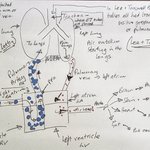
Jayaram's later description involved migrating pink blotches, approximately 1-2 cm across, against blue-grey skin.
The resemblance is interesting.
But - it is not the precise clinical description reported in the paper. Rather, it appears to combine elements of two separate observations.
Clarity matters when the apparent precision of the match is offered as corroboration in a murder case.
Was Jayaram recalling a clinical observation independently, or had his later understanding of the medical literature influenced the form in which he remembered it?
The cross-examination established the chronology and the discrepancies. It could not definitively answer that question.
What about the underlying physiology?
There is a further, potentially more fundamental problem.
Lee and Tanswell's reported cases arose predominantly under physiological circumstances substantially different from the deliberate intravenous air injection alleged by the prosecution.
Three differences matter.
1. Clinical context
Predominantly ventilator-associated pulmonary injury and barotrauma, rather than deliberately introduced intravenous air.
2. Gas composition
Highly oxygen-enriched ventilation in much of the series, versus atmospheric air containing approximately 78% nitrogen.
Oxygen and nitrogen have different solubilities and behaviour in the circulation, although the composition of the original emboli was not directly measured.
3. Circulatory mechanism
Gas entering damaged pulmonary vessels and reaching the systemic circulation through the pulmonary veins and left heart, versus injected venous air initially entering the right heart and pulmonary circulation.
The prosecution did offer an anatomically possible route across the third distinction: air passing through a patent foramen ovale into the arterial circulation.
But the existence of a possible route does not establish that it was traversed or that air introduced in this way would produce the same characteristic skin findings.
How could clinical observations arising predominantly from one physiological mechanism be given diagnostic significance for another without first establishing that they were transferable?
Lee and Tanswell acknowledged the possibility of air entering through intravascular lines.
What their paper did not provide was direct empirical validation of its distinctive cutaneous findings as diagnostic indicators of intravenous air injection.
And here there is a useful subsequent cross-check.
In their 2025 review of 117 neonatal vascular air-embolism cases, Zhou and Lee identified ten involving accidental intravenous air injection.
None reported localised, transient skin discolouration of the kind at issue, although two exhibited generalised discolouration.
Ten cases are far too few to establish that such a sign is impossible following venous injection. The published cases were also not a controlled diagnostic study.
But the findings provide little empirical support for assuming that the distinctive skin appearances from predominantly ventilator-associated literature could reliably identify intravenous air embolism.
There is another potentially relevant clinical detail in Baby A's case.
Positive-pressure ventilation using a Neopuff was administered during the emergency, and Dr Harkness's later account placed unusual skin changes after ventilation had begun.
That does not establish barotrauma, still less that resuscitation caused the original collapse. The oxygen concentration and airway pressures being delivered at the relevant moment also remain unverified in the evidence examined here.
But it does raise another question: if the characteristic skin appearances were observed during resuscitation, what excluded the collapse itself or its treatment as contributing to those appearances?
This is particularly relevant when the scientific paper being invoked concerned predominantly ventilator-associated pulmonary injury.
Where does that leave the evidence?
Myers clearly challenged the chronology of Jayaram's recollection and its resemblance to the published description.
His cross-examination of Professor Sally Kinsey subsequently exposed additional limitations in the physiological explanations advanced.
Kinsey acknowledged that she was not an expert in air embolism. Her account of how bubbles might produce unusual skin appearances drew upon general circulatory physiology and, in part, literature concerning decompression sickness in deep-sea divers.
That research concerned yet another physiological mechanism, whose limitations Myers also explored.
So the criticism is not that nobody raised these questions at trial.
It is that I can find no satisfactory demonstration in the published trial evidence that the apparent resemblance between Jayaram's later description and Lee and Tanswell's findings had the diagnostic significance attributed to it.
The prosecution also relied upon other clinical and circumstantial evidence. But the existence of other evidence cannot independently validate a disputed medical sign.
We are left with two fundamental questions.
First, how much independent corroborative weight can be placed on a distinctive clinical observation that was absent from the contemporaneous notes and coroner's statement but emerged in detail after the witness had encountered a closely resembling published description?
Second, even accepting the later recollection as entirely accurate, what established that the observed appearance was diagnostically significant for deliberate intravenous air injection, given the substantial differences between that mechanism and the predominantly ventilator-associated cases described in the original paper?
The prosecution needed more than a resemblance between a retrospective recollection and an authoritative scientific publication.
It needed to establish that the resemblance was reliable evidence of the particular mechanism alleged.
The paper was not necessarily wrong. The recollection was not necessarily false. But neither proposition established that the paper could reliably diagnose what the prosecution claimed had happened to Baby A.
And that, surely, is where the scientific scrutiny should have begun.
#LucyLetby
Principal sources
* Lee SK and Tanswell AK (1989), Pulmonary vascular air embolism in the newborn, Archives of Disease in Childhood, 64:507–510.
* R v Letby, Day 12, 20 October 2022, evidence of Dr Harkness.
* R v Letby, Day 14, 24 October 2022, cross-examination of Dr Ravi Jayaram, particularly pp. 105–119.
* R v Letby, Day 40, 29 November 2022, evidence of Professor Sally Kinsey, particularly pp. 53–69.
* Thirlwall Inquiry evidence concerning the circulation of Lee and Tanswell's paper on 30 June 2016.
* Zhou Q and Lee SK (2025), Vascular Air Embolism in Neonates: A Literature Review, American Journal of Perinatology, 42:1819–1824.
* R v Letby [2024] EWCA Crim 748, Court of Appeal judgment.
Dr Gordon Caldwell retweeted

It was not even Letby with the baby (Baby K) but, almost certainly, nurse Caroline Oakley!
Letby was on her own with two babies in Nursery 2 while Oakley and Joanne Williams were looking after one baby each in Nursery 1 (Baby K under Williams and another baby under Oakley). Joanne Williams had left Nursery 1 to update Baby K's parents. It is far more likely she asked Oakley to cover for her rather than the two babies in Nursery 2 being left unattended. Nobody remembers anything, which allowed Jayaram to tell his fibs 15 months later.
This is just one of a multitude of inconsistencies in the prosecution case in relation to Baby K. Another one? A 94% ETT air leak had been noted which required re-intubation and morphine to be taken out of the fridge in advance in anticipation thereof. It is highly likely that the sudden desaturation at 0350 was either the result of the baby finally giving in to the leak or her being prepared for the re-intubation, rather than the tube being intentionally dislodged. So I'm told by doctors.
Let's not forget that Baby K had just been born and weighed just 692g. And there were other issues, such as late administration of surfactant. Botched intubation at birth. Mass of bloody secretions noted by nurse (not Letby) at later re-intubation (which probably were related to the botched intubations and the 94% leak). Mortality risk was very very high. Again, so I'm told by doctors.
How this got past the jury is truly staggering.
#letby #LucyLetby
Dr Gordon Caldwell retweeted
Insulin fiasco.
The insulin evidence was the Crown’s absolute smoking gun and the anchor for their entire case. By completely concealing the lab's own warning, the prosecution actively deceived the bench and corrupted the foundation of the entire trial.
Dr Gordon Caldwell retweeted

I wasn't sure about Bohin, it still seemed possible that she had been inadvertently ensnared in Dewi "JK" Evans schemes for disaster.
That's all cleared up now. Another Dr Perjury for hire. Hey @gmcuk what are you sinking about?
@CPMorris1234
youtube.com/watch?v=WjUPIZhq…
