

Ops guy.
Overland Park, KS
Joined January 2010
- Tweets11.2K
- Following803
- Followers1K
- Likes7.1K





We're producing the ads for a very well-known company that did 1.2 billion in retail sales last year. We got it because of how we treat clients. I call it maniacal customer service.
And that one client has already led to two more brands doing hundreds of millions, an intro to a $300M company, and a seat on a brand launch.
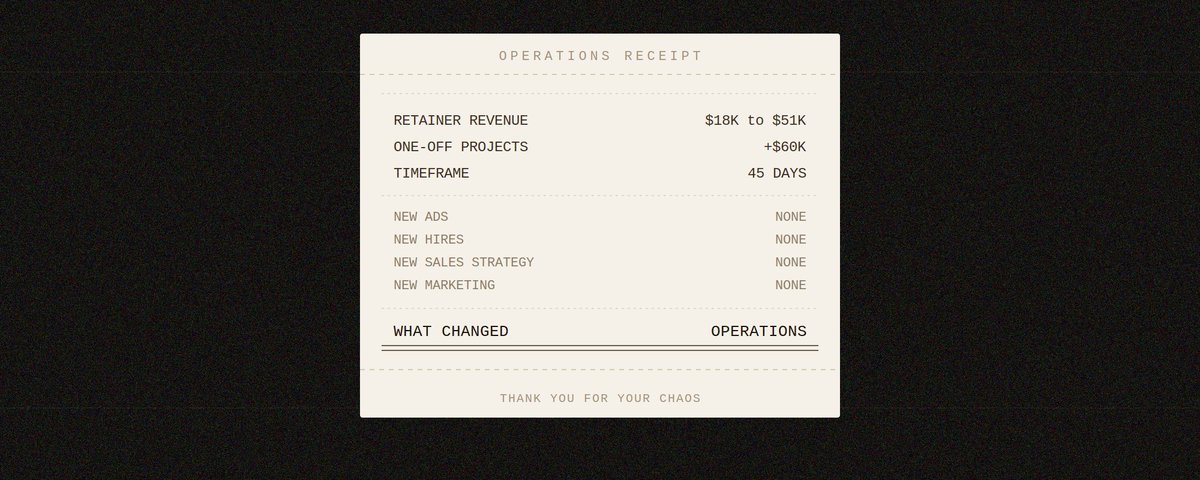
We started this offer in June, and last month we hit our first little 100K month. The growth is not as impressive as we would have liked.
We were flat for 2 months... But there have been a couple of massive developments in the way we're running things right now, and over the next 2, 3, 4 years, that could be huge.
When I came on to officially run the backend and operations, we had a massive focus on marketing and sales. We all come from direct response, info, coaching and consulting, so we know we've got to get cash in the door up front.
However, I needed to balance that side out so we could consistently grow. About 45 to 60 days ago I put this standard of maniacal customer service in play.
This doesn't mean the customer's always right. We've told a few customers who were not good customers at all to go fuck themselves. We've refunded people because we're not going to work with them. We have standards on who we work with too.
It doesn't mean being a pushover.
What it does mean is that if what the customer receives from us isn't a 10 out of 10 in their eyes, we make it right.
Sometimes we have processes for this, but sometimes we eat the cost and say fuck it. We do it because we want to do it right, because it's an important customer, and because our reputation means something. Then we live to that standard.
What does maniacal customer service look like? Fast response times. I know people are going to say you can't be too available, because then customers will expect it.
Yeah, I want them to expect it. It keeps us on our A-game, and it's a better experience overall.
We run an agency model. With an agency you want monthly recurring revenue. But if you don't have a sense of maniacal customer service and you're not willing to serve people as well as you can, you're not going to last.
If you're known for that kind of service, you can weather a lot more storms, and people will give you a longer leash. And you're probably going to fuck something up for a client at some point anyway, so it's better to have that leash.
On the team side, it's about how we split ownership of the core functions within the customer experience. Like who owns the flow of information from the client to us, and making sure all client statuses are up to date.
We needed to know how fast we're getting deliverables done for our clients. Everything we track, we track in terms of cycle times and response rates to clients.
We have agents always monitoring how long it takes for someone to get back to someone else, and they flag it whenever someone hasn't responded within an hour. We're always iterating and building.
Now, the first thing it changed was repeat business. Our front-end offer, the one that gets us clients, isn't monthly recurring. It's one-time.
But it's a repeatable purchase. Many of our clients come back every 30-60 days. It's not that sexy monthly recurring revenue you can count on, but it gives us more LTV per client over the long run. That matters this early on, while we're still figuring out what our competitive advantage is.
That same level of customer service, and the speed we get things done for clients, is what slowly led to all of this:
1.) The $1.2 billion company I opened with.
2.) Two other huge brands. Both have been around for over 20 years and are doing hundreds of millions in sales, in the health, fitness and supplement space. If I named them here you would know exactly who they are.
3.) An introduction from the same owner to another company doing 300 million a year.
4.) A spot on the creative team for the new brand he's starting. He wants us to be a key part of that launch.
All of this has taken time. We're playing a much longer game. That's something you don't see a lot, especially in the make money online, info and agency space.
If you want to be around for the long term, you need maniacal customer service. And you need to actually deliver.
3
3
256
We've went from 0 to $85k/month in our first 3 months with a new offer. (now spending about 800-1k a day on ads).
So we've been testing a lot of different things.
Noticeable recent win:
Show rates went from 53% to 75% since September 27th. Immediate impact from one change.
We took Jeremy Haynes' confirmation page concepts and swapped the breakout videos for slide decks.
Same info you'd cover on a call and in the videos, but delivered in a faster consumption format.
Our audience is B2B. They want fast, straightforward information. They weren't sitting through videos and play rates and retention were ass.
GA tracking confirms it also.
50% of people who hit the page scroll through and engage with at least 1 deck. 25% interact with 2 or more.
Most people don't even track confirmation page engagement, so this is a pretty quick way to have more effective data. That's how we know the swap worked and it wasn't luck or a bad patch of leads prior.
Decks get consumed since they're easy to skim and quick to process. Videos, I've noticed, get skipped when you don't leverage a new concept or big organic presence.
You don't want to treat the confirmation page like a "thanks for booking" page.
It's one of the highest-leverage pre-call sales asset you have, and it helps to shorten the sales process.
1
3
150
We noticed our buyers tend to prefer to read info than watch videos (pulled from every call and interaction we've had).
So I assumed that doing this throughout our funnel would also help with consumption of info from non-clients and so far it's paying off.
Different buyer types have different preferences on consumption.
You pair that with just being 'different' than most funnels, you can set yourelf up to win more
25
So I've noticed there's this false dichotomy around running a business such as a creative/marketing agency (at least from a lot of the loudest people).
If you look at the principles, all marketing comes down to is pattern interruption and framing.
Today, people seem to be on one extreme or the other. Either they're using AI 100% for the entire creative process or they're not using it at all. Obviously, like most things, it always is going to lie somewhere in the middle.
Now I do not think you can 100% systemize the creative process, because part of it is this unique insight and creativity that I don't think AI is ever going to truly replace (although...I don't think it can get close).
That doesn't mean we can't leverage AI in such a way to where we can make those ideas easier to come to.
For the work that we do, one of our offerings is we'll write and produce people's ads, but all of them are going to be unique in themselves.
What a lot of people do whenever they're writing ads is use variations of something. They'll use three different types of hooks, two different bodies, and a CTA, and interchange those. All of a sudden that gives you 10 ads. Whereas part of our thing is, no, we're going to give you X number of unique ads.
Obviously the bottleneck that comes from that is our writers' ability to come up with distinct and unique ideas.
What helps somebody in their creative process is having some sort of constraint. What I've managed to do is create these constraints while still allowing for freedom.
Something I've recently put into play for our writers is utilizing AI to help set the structure as well as ideation.
Not just a general idea for an ad, but the actual idea for each individual part of the ad. Because as I've sat through this whole idea, what I've come to see is that a successful ad ultimately has different components, and you can put these things together.
Now most people know you need a hook, you need to agitate the problem, you've got to create desire.
But one of the most pivotal parts of an ad is the angle in which you take. As I've thought through it, yes, you can come up with many different angles, but most of them are going to fall into only six categories.
I'm sure there's more than six, but from what we've looked at across 1000's of ads, these are the primary six:
1.) Causal attribution: "I started or stopped X because of Y." It's linked to a state change.
2.) Comparative, X versus Y: "I switched from this to that. Everyone uses A but I think B is better." The engine driving it is that contrast.
3.) Revelation: "Nobody ever told me this about X." It's some form of information asymmetry.
4.) Identity: "This is for people who do X." There's no cause or change or comparison. It just works by making the viewer feel seen.
5.) Social proof or consensus: "Why is everyone suddenly doing X?" The engine here is herd inference: other people's behavior as evidence.
6.) Stakes or urgency: "Before you do X, watch this. Or, you're doing X wrong. Instead you should do Y." The engine, of course, is loss avoidance.
These are what help us come up with endless angles for our clients very quickly. We extract sales call transcripts, onboarding calls, client conversations, and research into a database, and we're able to have AI pull all of that and essentially give our copywriters endless ideas in terms of angles and ways of presenting said information.
Then our writers take it and run with it, and all of a sudden our delivery time is within 24 hours of a bunch of unique ads ready for client approval.
Now an important caveat: we have some skilled copywriters that have been doing it for awhile, so that's partially why things get done faster.
But what we've done is give our writers everything they personally need to turn these around fast without any friction.
What we've noticed is this has created a much faster loop to increase output. And ultimately the only goal of increasing output for us is to find hits and big winners for our clients.
This is how we've been able to further systemize our creative process without taking away the creativity.
Because it puts constraints into our copywriter's process.
Of course they can deviate from them, but really the whole thing is about starting momentum, because there is nothing harder for a writer than starting from a blank page. Even after research, sometimes it can be very difficult.
By understanding what angles actually are...the difference between an angle and a hook... we can see the different ways we can try things and have a higher likelihood of success and differentiation.
1
4
358


Drew Dowd retweeted

mastermind syndrome: where you apply random teachings from a passionate speaker who has no idea the context of your business…
…and blame your team for the repercussions
If you’re a biz that uses SMS for literally anything… a lot of my reminders from Doctors, marketing, etc have all ended up here without warning.
Update just happened, didn’t notice until today.
If you’re seeing a degradation in SMS responses/ show rate/ engagement… probably why.
No solution right now other than manual messages from reps/self for revenue generating things.

Understanding the history and context of science is wildly important. So kudos on the history lesson.
Questions I have for this (hopefully this can benefit everyone looking for good info):
if creatine were just a byproduct of the extraction process, how do modern labs detect it directly in living muscle?
if it didn’t truly exist in tissue, how do muscles regulate phosphocreatine and ATP turnover?
would that same reasoning also apply to glucose or vitamin C since they were discovered through similar chemistry?
This quoted post is unavailable.
3
281
Thing about Russel Wilson is his Career started to go the opposite direction after his Mindset coach Trevor Moawad died.
Makes you wonder just how much Trevor’s impact meant to him.
If you’ve never read his book “Getting back to Nuetral” highly recommend.
Will give a ton of insight.
Correlation isn’t necessarily causation but nonetheless an interesting parallel.

Drafted to be the back up, wins the job. Wins a Super Bowl carried by the defense and run game. Total cornball. Just realized he is Russell Wilson
2
471
Yeah now we changed dialers and did 78 sets in 4 days. Reduced AdSpend by 35% and kept throughout the same.
Nutty

We were bleeding cash from a phone number.
Changed it out.
Gave each setter 6 numbers to rotate every 50 calls
Registered business under STIR/SHAKEN and gave spam protection to each number.
Ensured they were Attestation was Level A.
2.5x’d our sets in 2 days.
Reduced Ad Costs by 30%+ (were 95% paid and had been at 150k per month in AdSpend)
Revenue has stayed consistent (better margins baby)
Previously we had a 3.5% connection rate (lmao this is so bad)
Now sitting at 11% (not great, but triple what it was).
Lessons:
1.) there’s probably 1000 other system fixes that you can make before trying to make average sales reps great. Skillset takes the longest to develop in people, so look for the variables that won’t involve human error.
2.) sometimes it takes 1 small tweak to do some Biiiigggg stuff.
2
223
2 really interesting things I’ve learned about hiring WELL.
I’ve noticed 2 specific patterns that separate the “A players” we’ve hired (the ones who consistently crush it) from the ones who don’t.
Note: this is for non-leadership roles.
Trait 1: A clear, specific moment in life (usually childhood through adolescence) where they remember winning.
Trait 2: Real self-awareness of their weaknesses.
We uncover these traits at different stages of the interview process.
Our process follows the WHO Method: Screening → WHO Interview → Focus/Skill Interviews → Reference Check → Offer.
Trait 1 shows up in the WHO Interview.
That interview is all about who they are. Their character, strengths, weaknesses, behaviors, and if they’re full of shit (you can tell fast in this one).
One of the questions we ask: “Growing up, what’s your first memory of winning or success?” (You can phrase this a thousand different ways).
What we’re looking for is a distinct, detailed memory. Not generalizations. Not vague timelines.
Here are 3 examples from our top performers:
1.Signed her first record deal at 14. Modeled her mom’s tenacity (who built an insurance biz to millions).
2.Only freshman to make varsity soccer. Later moved to Britain, didn’t speak English, and still graduated with a mechanical engineering degree.
3.Only freshman at an orchestra magnet school to make principal flutist.
Two of these people are our best sales reps. The other is our primary automation/tech guy who’s solved nearly 100% of our tech problems since he started.
Now for Trait 2.
Part 1 shows up in the WHO Interview when we ask about weaknesses. Write down exactly what they say.
Part 2 shows up in the reference checks. Ask the managers: “What weaknesses or gaps did they have?”
If what the candidate said matches what the managers say, you’ve got someone with decent self-awareness and honesty. That’s big. It means they know their pitfalls and are more likely to improve.
Obviously there’s more to making a great hire, but these 2 traits stand out every single time with our best performers and it’s been really interesting to notice.
2
4
279
We were bleeding cash from a phone number.
Changed it out.
Gave each setter 6 numbers to rotate every 50 calls
Registered business under STIR/SHAKEN and gave spam protection to each number.
Ensured they were Attestation was Level A.
2.5x’d our sets in 2 days.
Reduced Ad Costs by 30%+ (were 95% paid and had been at 150k per month in AdSpend)
Revenue has stayed consistent (better margins baby)
Previously we had a 3.5% connection rate (lmao this is so bad)
Now sitting at 11% (not great, but triple what it was).
Lessons:
1.) there’s probably 1000 other system fixes that you can make before trying to make average sales reps great. Skillset takes the longest to develop in people, so look for the variables that won’t involve human error.
2.) sometimes it takes 1 small tweak to do some Biiiigggg stuff.
Double edged sword when you take a first time offer owner (who came from massive corporate America) to 8-12 ROAS in first year of scaling.
Starts to view anything below that as “falling behind”. (My theory is the nature of stability in a big corporate environment can affect how temperaments in start up/high ticket is manifested).
Learning how to manage expectations with successful/high performing/high standard people is a whole other skill set in itself.
Always have to be thinking 5-10 steps ahead to ensure everyone stays aligned.
4
450

The only reason you have an identity crises is because the identity thought you had was never yours to begin with
2
1
273
The devil is someone you know.
It’s a hard pill to swallow when you realize those who want what’s best for you are the ones fighting like hell to hold you back.
They care more about how your evolution makes them feel than the evolution itself.
Especially hard when the ‘devil’ has your last name.
1
4
311
Everyone thinks they’ve escaped the matrix.
But you just traded one illusion for another.
From corporate/mainstream NPC to make money online/self improvement/ guru orgasm NPC.
Different aesthetics, same programming.
Escaping ‘the matrix’ just to join another one doesn’t make you free
You’re still an NPC, just in a new game.
Discern.
4
324