
Knows some stuff, doesn’t know other stuff
Joined May 2021
- Tweets30
- Following35
- Followers7
- Likes9
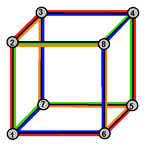





If we look at a cube from the correct angle, its outline will trace a hexagon rather than a square.
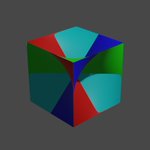
Instead of building the cube out of square sides, we can build it out of these hexagons.
This gives us a 4-sided, hexagon-faced, self-intersecting 'cube'... 😅 (1/3)

1
1
112
We can do a similar thing for each platonic solid - these are called "Petrials".
Is this useful? Probably not, but it sure took a lot of work to make. (2/3)

1
81
Petrials don't have flat faces, so images online show wireframes... But a Petrial cube has the same wireframe as a normal cube! I used minimal surfaces to draw them.
Wireframe from Wikimedia commons.wikimedia.org/wiki/F…
(3/3)

1
78
Bailey Andrew retweeted

Humans can learn general-purpose and meaningful representations from perception by leveraging suitable abstractions. For example, being able to write out numbers involves the generic ability to reason about what strokes to use…
[1/6]


Numpy broadcasting ‘cheat sheet’. Useful trick to know, can often give orders of magnitude speedup, especially if your old solution used for loops [yuck :P]

Bailey Andrew retweeted


Here is a game based on the impossible staircases typical to Nil geometry. The road track here acts like an impossible staircase, so our unicycle, powered only by gravity, can gain speed just by going in counterclockwise circles on it!
(RT to show you want this fleshed out! 1/3)
Many feel as if their actions won't make a difference - and they won't, if they do nothing - so they offer only their thoughts and their prayers.
Email your representative. What does it cost you?
Less than the sin of the bystander costs others: 🇺🇦
What does the number -1 actually mean? I tried making a (1-minute) video to explain; youtu.be/J81UnII6X7w. It's of dubious quality ;)
1
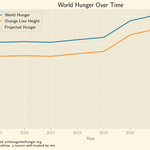
Foolproof plan to end world hunger; just draw some lines on a graph. Since correlation clearly equals causation, the rest will work itself out.

Suppose we had a set of rules describing a type of object, such as "eats grass and has a tail". We might want to know what type of objects follow those rules. For example, the set of all cows follows ("models") these rules, and the set of all sheep also models the rules. (1/3)
1
Thus, it is impossible to *uniquely* define what it means to be a number 0, 1, 2, 3, etc in a "sufficiently nice" way! (3/3)
1
Maximum Modulus Principle: For any "holomorphic" function, the maximum value in *any* region of that function will always appear on the boundary of said region. (For regions in the complex plane). (1/2)
"Holomorphic" is a technical condition, but it basically just means "sufficiently nice"; most functions you can think of, such as polynomials, trig functions, etc are holomorphic. (2/2)
1
Bell curves show up all the time when one talks about statistics. Some classic examples are height and IQ. But why should this happen? Let's look at a few examples of different real-world(ish) processes that end up bell-curvy. (1/10)
1
For example, we described the set of height genes with the Binomial distribution, and the set of eureka moments with Erlang. Of course, it is possible to create non-bell-curvy sets - but under reasonable assumptions, many sets become bell-curvy as they grow. (9/10)
1