

Assistant Professor at Georgetown University, Chemistry Department, grad school @ Notre Dame, Postdoc @ CU Boulder, microscopy of fluorescent RNA, German 🇩🇪
Washington, DC
Joined March 2019
- Tweets302
- Following703
- Followers781
- Likes1.5K





Pinned Tweet
I'm incredibly proud to share the first publication from the Braselmann lab, out today! We use fluorescence lifetime imaging microscopy to visualize two different RNAs live simultaneously, with minimal tag size.
@GUChemistry
rdcu.be/c5J1b
Esther Braselmann retweeted

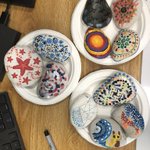
Braselmann Lab Thanksgiving potluck was a hit!
Grateful, thankful, and blessed. 🧡
Happy Thanksgiving !

Esther Braselmann retweeted
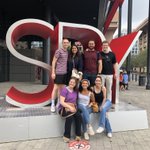
Our whole lab pulled up to ACS Fall 2025. Presented cool science, made new connections, and even caught up with old grad school friends and folks from back home. What a week. #ACS2025 #BraselmannLab #ProudChemist

Esther Braselmann retweeted
Come meet us tomorrow at the Division of Biochemistry and Chemical Biology poster and Sci-mix session to explore the exciting RNA visualization research we’re doing at the Braselmann Lab!
#acsfall2025 #RNABiology #Riboglow


I had the great honor to hood my first PhD student! Happy graduation weekend!
@GUChemistry @CASGeorgetown @NadiaSarfraz_

Esther Braselmann retweeted

🌷🌼🌸🌻April showers bring May flowers! 🌻🌸🌼🌷
I painted the flowers with E. coli expressing EGFP & mTangerine.🖌️🎨
#FluorescenceFriday #SciArt #Bacteria #Microbiology #AgarArt #SciComm 🧬🦠🧫


Esther Braselmann retweeted

This past weekend I attended the Chesapeake Bay Area Single Molecule Meeting and presented there. It was so nice to meet with old friends and make new connections. Thanks Rodrigo Maillard and @EBraselmann for organizing! cbasmb.org


Esther Braselmann retweeted

We are excited to introduce first-of-a-kind immunofluorescent probes to visualize RNA in cells! @NAR_Open
Synthetic anti-RNA antibody derivatives for RNA visualization in mammalian cells academic.oup.com/nar/article…

Such a fun lab activity!

Pumpkin painting is going to be my favorite FALL lab activity! #BraselmannLab 🥼🎃👻
@EBraselmann
@GUChemistry

Congratulations! Looks super cool

1/A picture is worth a thousand words but what if they can say more?! We developed live-cell FLIM approaches to track protein interactions within RNA-protein condensates – Our first paper is now out in @JCellBiol! doi.org/10.1083/jcb.20231110…

Congrats!

#Listeria never ceases to amaze me! In water Listeria sheds its cell wall to become #VBNC, potentially forming undetectable reservoirs of pathogenic bacteria. Thanks to @AgenceRecherce and all collaborators. A big shout out to @ffchc84 who led this work.
nature.com/articles/s41467-0…

Esther Braselmann retweeted

@NIHDirector Bertagnolli featured our new study on surprising effects of synonymous codon substitutions on the regulation of transcription and translation on her blog!
directorsblog.nih.gov/2024/0…
@NDscience @NotreDame @UNDResearch @NIH @NIH_CommonFund
„When my three-piece restriction cloning works on the first try.“
My students from now til the end of time will never stop having to hear the end of what was clearly my most memorable postdoc experiment.
This Post is from an account that no longer exists. Learn more
Esther Braselmann retweeted

the lab is recruiting scientists @HHMIJanelia! we are particularly excited about engineering fluorescent proteins and biosensors using high-throughput assays and machine learning. questions? please get in touch!
Esther Braselmann retweeted

What a beautiful end to a phenomenal era
We made a great team @EBraselmann - Thank you for everything! Next stop.. Boston!

What a full-circle-moment: my first grad student @NadiaSarfraz_ gave her exit seminar towards earning her PhD in my lab in the room where I gave my interview job talk - this feels like yesterday and a lifetime ago at the same time. Such a #ProudPI moment!

Such a #proudPI moment! Congratulations to Morgan Rice from my lab, she’s currently in her junior year, and just earned a Goldwater scholarship!
college.georgetown.edu/news-…

Congratulations to @NadiaSarfraz_ for well-deserved recognition at #BPS2024


This will look so nice as decoration on my office wall! Congrats to the artist (twitter-less Luke) and first author of this, @NadiaSarfraz_

Esther Braselmann retweeted

When we published the first #enzyme to MAKE carbon-silicon bonds back in 2016, some people asked us to BREAK them, so these man-made compounds would not persist in the environment. We finally made the first steps toward that: science.org/doi/10.1126/scie…