

Official Twitter account of Equality, Diversity and Inclusion: An International Journal (@EmeraldGlobal). Tweets by @Juliet_Kele
Joined June 2016
- Tweets1.4K
- Following834
- Followers1.1K
- Likes695



Pinned Tweet
Hi @EDI_Journal community!👋See our 2025 #stats!
#Submissions: 864 (new)
# R&Rs invited: 279 (24%)
#Accepted: 116 (10.4%)
Average time to decision: 31 days (incl. desk rejects)
SJR Q1 (Sociology/Political Science, Cultural Studies, Gender Studies); JCR 3.0 (5 yr IF); Scopus 5.2
New Issue @EDI_Journal! 🎉
Exploring women leaders & layoffs, mentoring immigrant job seekers, inclusive leadership & team behaviour, DEI activism & backlash, culturally responsive assessment, & how inclusion shapes organisational outcomes.
Read more: emerald.com/edi/issue/45/7

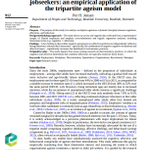
Paper spotlight @EDI_Journal: Per H. Jensen - 'Workplace practices towards older jobseekers: an empirical application of the tripartite ageism model'.
See thread for key takeaways (1/4).
Paper here: doi.org/10.1108/EDI-11-2024-…

Findings highlight the need to address emotional #bias, not just stereotypes. Labour shortages, formalised hiring procedures & age-diverse #leadership teams can constrain discriminatory behaviour > organisational contexts can disrupt the translation of bias into exclusion💪(4/4).
Findings: Negative #stereotypes alone do not predict discrimination. Rather, negative #cognitive evaluations alongisde negative #emotional preferences increase exclusionary #hiring. Negative emotional reactions to older applicants triple the likelihood of not hiring them (3/4).
Why does #ageism persist in #recruitment? This study examines how employers’ #stereotypes about older applicants, emotional responses & hiring behaviour interact and influence #exclusion, drawing on survey & vignette data from a representative sample of Danish employers 🇩🇰(2/4).
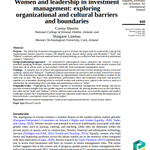
Paper spotlight @EDI_Journal: Corina Sheerin @CorinaShee & Margaret Linehan - 'Women and leadership in investment management: exploring organizational and cultural barriers and boundaries'. See thread for key takeaways (1/4).
Paper here: doi.org/10.1108/EDI-10-2024-…

Findings show how boys’ clubs, presenteeism & performance cultures reinforce men’s #privilege & position women as ‘other’. The study calls for organisations to change the systems, structures & norms that restrict access to opportunity, rather than expecting women to adapt (4/4).
Drawing on 19 semi-structured interviews with 16 women and 3 men working, or previously working, in Irish investment management, the study uses social closure theory and #Bourdieu’s concepts of field, habitus and capital to explore gendered #barriers to #progression (3/4).
Why do women continue to face #barriers to senior leadership in #investment management? This study explores how workplace cultures, org structures & unwritten rules in Ireland 🇮🇪 sustain gender #inequality, showing how the system shapes who belongs and who gets left out (2/4).
Paper spotlight @EDI_Journal: Osama Khassawneh @CUDUAE - 'Silenced and stigmatized: how leader exclusion fuels disengagement and resistance among neurodivergent employees'.
See thread for key takeaways (1/4).
Paper here: doi.org/10.1108/EDI-06-2025-…

The study advances understanding of #neurodiversity at work in the Middle East, showing why inclusive leadership matters. Its message for companies: reducing stigma & building psychological safety into everyday leadership (not just policy) is vital to meaningful #inclusion (4/4).
Using cross-sectional survey data and structural equation modelling, the study finds that perceived exclusion predicts #disengagement intentions and #resistance behaviours. Stigmatisation mediates these relationships, while #psychological unsafety intensifies the harm (3/4).
Why do #neurodivergent employees disengage or #resist at work? This study examines how perceived #exclusion by leaders shapes these outcomes among 427 neurodivergent employees across tech, education, finance & govt in the #UAE, drawing on social exchange & stigma theories (2/4).
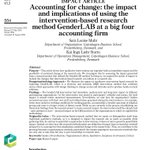
#Impact article spotlight @EDI_Journal: Sara Louise Muhr & Kai Inga Liehr Storm - 'Accounting for change: the impact & implications of using the intervention-based research method GenderLAB at a big four accounting firm'. See🧵for takeaways (1/4).
Paper: doi.org/10.1108/EDI-12-2023-…

The study expands how research #impact can be understood. Impact is not only measurable #outcomes: shifts in #awareness, norms and practices matter too. Participatory research can create impact while gathering data, giving #knowledge back rather than simply extracting it (4/4).
Using #GenderLAB, the authors combine norm-critical reflection with #design thinking to help participants identify challenges & co-create practical, relevant D&I solutions. The intervention generated immediate, medium- & longer-term changes across participating firms (3/4).
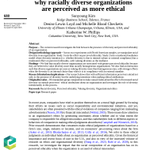
Paper spotlight @EDI_Journal: Sunyoung Kim; Denise Lewin Loyd; Michelle Blood Checketts & Katherine W. Phillips - 'Presumed to value diversity: why racially diverse organizations are perceived as more ethical'. See thread for key takeaways (1/4).
Paper: doi.org/10.1108/EDI-11-2024-…

The study shows that diversity can signal organisational values & #ethical commitment. Notably, observers consider not only whether diversity is present, but why: diversity carries greater ethical value when seen as genuine organisational #commitment rather than compliance (4/4).
Across two experiments with North American samples, the authors manipulated #racial #diversity and the perceived reason for it. Diverse organisations were seen as more #ethical, especially when #diversity reflected internal #choice rather than external compliance (3/4).
This paper examines how the presence of #racial #diversity shapes perceptions of an organisation’s ethicality. It asks whether diverse organisations are perceived as more #ethical, why this might be the case, and whether perceptions depend on why an organisation is diverse (2/4).