

An independent, non-partisan, not for profit organization
Islamabad
Joined December 2024
- Tweets886
- Following81
- Followers1.5K
- Likes362




Pinned Tweet
Pakistan’s economy has a story.
We put almost 75 years of it in one place.
From 1950 to 2026, explore the numbers behind Pakistan’s GDP, inflation, debt, trade, energy and more, with every chart traceable to its source.
𝗗𝗼𝗻’𝘁 𝗷𝘂𝘀𝘁 𝗿𝗲𝗮𝗱 𝘁𝗵𝗲 𝘀𝘁𝗼𝗿𝘆. 𝗘𝘅𝗽𝗹𝗼𝗿𝗲 𝘁𝗵𝗲 𝗱𝗮𝘁𝗮.
epbdt.org.pk/dashboard/

Economic Policy & Business Development retweeted
#Pakistan's chronic trade deficit is not simply a matter of rising imports. The deeper problem is that the country has been unable to generate enough diversified, high-value exports to finance its external needs.
Over more than four decades (FY1980-FY2026), the #trade deficit has widened from $3.11 billion to an estimated $35.51 billion, after peaking at $40.90 billion in FY2021. In FY2026, #imports reached $76.39 billion against #exports of $40.88 billion, leaving a deficit of $35.51 billion.
This structural weakness stems from an import-dependent, consumption-led growth model, combined with low-value, undiversified exports and entrenched structural constraints.
@mincompk @MoIB_Official @GovtofPakistan

Pakistan’s #inflation is increasingly being driven by rising fuel costs, with #petrol prices up 46% and #diesel 42% between February and October 2026. Avg inflation surged from 5.5% before the Middle East crisis to 10.2% after its onset, highlighting the growing impact of energy-price shocks.
Meanwhile, Pakistanis paid an average of Rs 4.3 billion every day in Petroleum Development Levy (PDL) during FY26. When unjustified high taxation fuels inflation, higher interest rate only deepens the economic squeeze on businesses, industry and consumers.
Raising interest rate cannot address the root cause of cost-push inflation. Instead, it risks further suppressing industrial activity, investment, and economic growth. Hold the rate. Cut #PDL. Put production and growth first.
@Financegovpk @Official_PetDiv @PBSofficialpak @StateBank_Pak

Economic Policy & Business Development retweeted
Once hailed as White Gold, #Pakistan’s #cotton sector is losing ground. Production has fallen from 14 million bales in FY15 to just 5 million in FY26, while ginning value added has declined by 20% since FY2000.
Farmers are shifting to more profitable #crops, while cotton #imports are projected to reach 5.2 million bales in #FY27, adding pressure on foreign exchange reserves and the textile value chain.
Shouldn’t #policymakers explore measures such as crop zoning and targeted incentives to boost cotton cultivation and revive the sector’s potential?

#Pakistan's chronic trade deficit is not simply a matter of rising imports. The deeper problem is that the country has been unable to generate enough diversified, high-value exports to finance its external needs.
Over more than four decades (FY1980-FY2026), the #trade deficit has widened from $3.11 billion to an estimated $35.51 billion, after peaking at $40.90 billion in FY2021. In FY2026, #imports reached $76.39 billion against #exports of $40.88 billion, leaving a deficit of $35.51 billion.
This structural weakness stems from an import-dependent, consumption-led growth model, combined with low-value, undiversified exports and entrenched structural constraints.
@mincompk @MoIB_Official @GovtofPakistan
Economic Policy & Business Development retweeted
Pakistan’s SOEs are draining public money.
They lose Rs 3.1 bn every working day, and 1 in every 6 federal rupees goes to them. In FY2025, support to #SOEs equaled 29% of the federal deficit.
It’s time to prioritize privatization, stop the losses and take the government out of commercial activity.
How long can #Pakistan afford to keep paying for losses?

Economic Policy & Business Development retweeted

Pakistan’s bank deposits doubled in four years!
Total deposits held by scheduled banks increased to Rs 40.83 trillion in September 2026, up from Rs 21 trillion in September 2022
A significant increase in deposits reflects a growing pool of funds within the banking system.
Now this money must reach businesses and industry, because growth comes from productive economic activity, not from lending to the government.
#Growth #Banking #Economy #Business #Pakistan
Pakistan’s SOEs are draining public money.
They lose Rs 3.1 bn every working day, and 1 in every 6 federal rupees goes to them. In FY2025, support to #SOEs equaled 29% of the federal deficit.
It’s time to prioritize privatization, stop the losses and take the government out of commercial activity.
How long can #Pakistan afford to keep paying for losses?
Pakistan ranks 106th out of 122 countries on the Global Hunger Index
Behind this ranking are millions of lives affected by hunger and malnutrition. Food security is not just a welfare concern; it is fundamental to human development, productivity, and economic growth.
A hungry nation cannot reach its full potential.
Find the Pakistan Scorecard here:
epbdt.org.pk/pak-score/
@UNDP_Pakistan @MNFSR_OFFICIAL @MoIB_Official
Economic Policy & Business Development retweeted
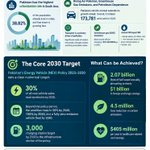
#Pakistan’s transition toward electric mobility is gaining momentum, with the National Energy Vehicle (#NEV) Policy 2025–2030 setting a clear pathway for cleaner, more efficient, and energy-secure transportation.
With a target of 30% of new vehicle sales being electric by 2030, alongside 3,000 charging stations, the roadmap highlights the potential of #EVs to reduce fuel dependence, emissions, and transport-related costs while supporting local manufacturing and sustainable economic growth.
@ClimateChangePK @MinistryofST @Official_PetDiv

Economic Policy & Business Development retweeted
Pakistan’s inflation rate climbed to 10.3% in September 2026, with rural inflation at 10.5% and WPI rising sharply to 13.3%, outpacing regional peers such as Bangladesh, India, and China. Driven by higher fuel and electricity costs, transport expenses, and persistent supply-chain bottlenecks, rapidly rising prices are eroding household purchasing power as stagnant incomes struggle to keep pace.
At the same time, high public borrowing and rising public debt are adding to inflationary pressures while crowding out credit to the private sector, creating a cycle of lower demand, weaker growth, and declining household welfare—deepening the low-income trap.

Once hailed as White Gold, Pakistan’s cotton production has fallen from 14 million bales in FY15 to just 5 million in FY26.
A worrying trend for a sector central to the country’s textile industry.
#PakistanEconomy #Pakistan #Agriculture #Textile
Once hailed as White Gold, #Pakistan’s #cotton sector is losing ground. Production has fallen from 14 million bales in FY15 to just 5 million in FY26, while ginning value added has declined by 20% since FY2000.
Farmers are shifting to more profitable #crops, while cotton #imports are projected to reach 5.2 million bales in #FY27, adding pressure on foreign exchange reserves and the textile value chain.
Shouldn’t #policymakers explore measures such as crop zoning and targeted incentives to boost cotton cultivation and revive the sector’s potential?
Economic Policy & Business Development retweeted
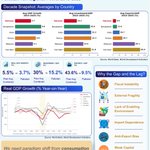
Between 2015 and 2025, Pakistan grew by an average of 3.7% a year, the slowest of the six economies benchmarked and well below the 5.5% average of its five peers: Bangladesh, India, Türkiye, Malaysia and Viet Nam.
The same gap shows up in investment, at 15.2% of GDP against a peer average of 30%, and in exports, at 9.5% of GDP against 43.6%. The shortfall is not a pandemic artefact: Pakistan's 2020 contraction (-1.3%) was milder than that of several peers (down to -5.8%), yet its growth still trailed over the decade.
This points to a structural rather than cyclical divergence, rooted in fiscal instability, external fragility, a weak enabling environment, high taxation, an anti-export bias, weak capital accumulation, and a high cost of doing business.
Closing it requires a shift from consumption-led growth and a net-importing economy to investment-led growth and an export-oriented economy.

Pakistan’s inflation rate climbed to 10.3% in September 2026, with rural inflation at 10.5% and WPI rising sharply to 13.3%, outpacing regional peers such as Bangladesh, India, and China. Driven by higher fuel and electricity costs, transport expenses, and persistent supply-chain bottlenecks, rapidly rising prices are eroding household purchasing power as stagnant incomes struggle to keep pace.
At the same time, high public borrowing and rising public debt are adding to inflationary pressures while crowding out credit to the private sector, creating a cycle of lower demand, weaker growth, and declining household welfare—deepening the low-income trap.
Economic Policy & Business Development retweeted
Pakistan’s trade deficit continued to widen in Q1 FY27, driven by stronger growth in imports than exports.
Exports increased by 10.8% YoY, while imports rose by 13.2%, expanding the quarterly trade gap by 15.1%.
External trade position remains under pressure as import growth continues to outpace export expansion. The widening trade gap points to persistent structural imbalances in the country’s trade account.
Sustaining export growth will require greater competitiveness, lower production costs, and stronger integration into global value chains.
Without a durable shift toward export-led growth, rising import demand will continue to constrain external-sector stability.

Between 2015 and 2025, Pakistan grew by an average of 3.7% a year, the slowest of the six economies benchmarked and well below the 5.5% average of its five peers: Bangladesh, India, Türkiye, Malaysia and Viet Nam.
The same gap shows up in investment, at 15.2% of GDP against a peer average of 30%, and in exports, at 9.5% of GDP against 43.6%. The shortfall is not a pandemic artefact: Pakistan's 2020 contraction (-1.3%) was milder than that of several peers (down to -5.8%), yet its growth still trailed over the decade.
This points to a structural rather than cyclical divergence, rooted in fiscal instability, external fragility, a weak enabling environment, high taxation, an anti-export bias, weak capital accumulation, and a high cost of doing business.
Closing it requires a shift from consumption-led growth and a net-importing economy to investment-led growth and an export-oriented economy.
Pakistan’s low Investment to GDP ratio lags behind even the regional peers, due to:
38%Lack of Incentives?
50%Policy Inconsistency?
12%High CoDB?
8 votes • Final results Economic Policy & Business Development retweeted
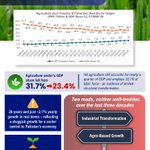
Over 26 years, agriculture grew by just ~2.7% annually in real terms, far too little for a sector so central to #Pakistan’s economy.
Its share of #GDP fell from 31.7% to 23.4%, yet agriculture still accounts for nearly a quarter of the #economy, pointing to limited structural transformation.
Countries have transformed by raising agricultural productivity while simultaneously building new engines of growth in industry and other productive sectors. Pakistan similarly trod the two paths, but somehow could not go far enough.
After 26 years, the country appears to have achieved neither a major agricultural productivity breakthrough nor a decisive expansion of new engines of growth.
Perhaps it is time to go deeper and address the structural constraints holding the #agriculture sector back.

Pakistan’s trade deficit continued to widen in Q1 FY27, driven by stronger growth in imports than exports.
Exports increased by 10.8% YoY, while imports rose by 13.2%, expanding the quarterly trade gap by 15.1%.
External trade position remains under pressure as import growth continues to outpace export expansion. The widening trade gap points to persistent structural imbalances in the country’s trade account.
Sustaining export growth will require greater competitiveness, lower production costs, and stronger integration into global value chains.
Without a durable shift toward export-led growth, rising import demand will continue to constrain external-sector stability.