

Multidisciplinary group aiming to understand the links between environmental variation, infectious diseases and wildlife health
UAB, Barcelona, Spain
Joined June 2022
- Tweets204
- Following232
- Followers211
- Likes183


Pinned Tweet
Our logotype summarizes our real nature:
The fox represents wildlife.
The leaf symbolizes environmental variation.
The DNA helix symbolizes pathogens and diseases.
The histogram represents the need for modelling for understanding complex interactions in the natural world.
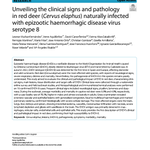
Red deer are highly susceptible to EHDV-8 developing severe vascular, respiratory and neurological lesions with a high case fatality rate. Our findings improve understanding of EHD pathogenesis and reinforce the need for wildlife surveillance
rdcu.be/fuyME

2
30
Evaluating Urban Landscape and Remotely Sensed Vegetation Indices to Explain Wild Boar Presence in Barcelona mdpi.com/3960744 #mdpiremotesensing via @RemoteSens_MDPI
🤖 Made with AI

2
27
Forbes House Business of Hunting 2026: “La caza da empleo, genera economía y mantiene vivos muchos pueblos” forbes.es/forbes-house/95797…

2
93
Spatiotemporal risk analyses of dog and cat vehicle collisions in Portugal sciencedirect.com/science/ar…
🤖 Made with AI

2
30
First Detection of Human- and Dog-Associated Demodex Mites (Acari, Arachnida) in Southern European Wolves (Canis lupus) mdpi.com/3800536 #mdpipathogens via @Pathogens_MDPI
🤖 Made with AI

Red deer don’t just eat what’s available—they choose what’s best. Plant nutrition (especially protein & fibre) matters more than toughness in shaping feeding preferences in Mediterranean ecosystems.
link.springer.com/article/10…

1
58
Temporal insights into RHDV2 (GI.2) reveal rapid turnover and complex dynamics in wild lagomorph populations of NE Spain. Understanding these patterns is key to predicting outbreaks and managing disease spread in wildlife ecosystems.
link.springer.com/article/10…
🤖 Made with AI

African swine fever returns to Spain after >30 years ASF-free. First cases detected in wild boar near Barcelona. Researchers from SEFaS contributed to the investigation.
bvajournals.onlinelibrary.wi…

At #EcoFlor2026 our group presented two studies on pollinator ecology: bee diversity across grazing landscapes and the resilience of plant–pollinator networks under red deer overabundance. Proud that our MSc student Júlia Coromina received the Best Oral Presentation Award!


2
28
Too many deer = more parasites? Not always.
In Mediterranean ecosystems we found the opposite: even at very high densities, gut parasites declined over time. Diet and habitat mattered more than numbers. Sometimes ecology beats crowding, more at: link.springer.com/article/10…

Single and Co-Infections by Tick-Borne Pathogens in Synanthropic European Hedgehogs (Erinaceus europaeus) in Northwestern Italy mdpi.com/3713592 #mdpivetsci via @Vetsci_MDPI

13
Molecular detection of zoonotical Giardia duodenalis, Cryptosporidium spp. and Blastocystis in wild mesocarnivores from Eastern Spain
frontiersin.org/journals/vet…

New records of Lipoptena andaluciensis (Diptera: Hippoboscidae) in Iberian ungulates, more at:
sciencedirect.com/science/ar…

2
24
Our last work support the monophyly of Cephenemyia and place Pharyngomyia as its closest sister genus, forming a well-supported clade with Oestrus and Rhinoestrus.
rdcu.be/eZjlb

1
34
Caza y vigilancia de la fauna, dos claves frente a la Peste Porcina Africana – WE&H share.google/5VQKIQiErwlWdPq…

1
26
New study: Deer grazing affects soil—but only in certain habitats. Subtle changes in bulk density & microbes depend on landscape type.
link.springer.com/epdf/10.10…

2
17
Molecular survey and risk factors of Trypanosoma pestanai in Eurasian badgers from the northern Iberian Peninsula | Parasitology | Cambridge Core - bit.ly/47M2NWL

1
12
On 14 Nov 2025, María Escobar González defended her PhD at the Vet School on how to understand and manage urban wild boar. Using camera traps, citizen reports and control data, her work offers practical tools to reduce conflicts in cities. Congrats, Dr Escobar! 🐗

Spectral indices to evaluate the physiological response of Mediterranean shrubs to browsing, more at
sciencedirect.com/science/ar…

1
24
Our last work published in @ejwr_cm shows that nearly 30% of wild boars in Catalonia tested positive for PCV3—but showed no lesions or disease symptoms. PCV3 may be subclinical in wildlife, unlike in pigs. A key insight into viral ecology!
rdcu.be/eDB6w
33