

EE → HW → Systems → Signals → Quant Me building real Quantitative Finance systems. In public. Mistakes preserved.
United States
Joined March 2026
- Tweets43
- Following60
- Followers37
- Likes44
Pinned Tweet
Experienced EE building into quantitative finance systems and infrastructure, in public, in sequence.
Showing my work, not hiding any missteps, no shortcuts.
Seven projects. Pricing engines, data pipelines, risk systems, execution infrastructure, and an FPGA capstone.
What I'm building and why:

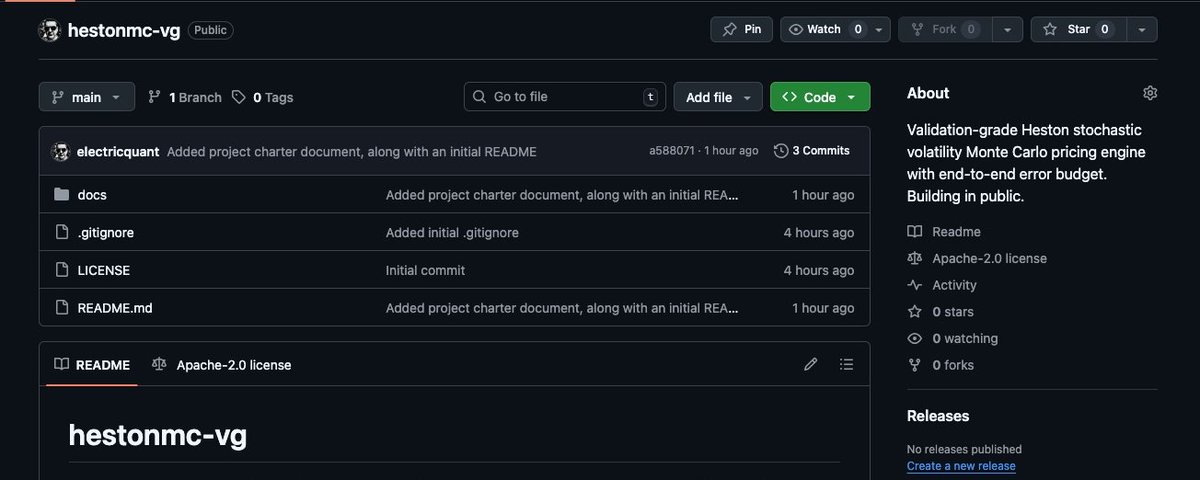
I included the FPGA in Project 1 to show off. The project didn't care.
It combined two things that don't belong together, a speedup story the hardware couldn't credibly deliver, sitting on top of correctness and validation work that doesn't need it.
What's left is cleaner. HestonMC-VG is a Monte Carlo pricer for path-dependent equity derivatives under Heston stochastic volatility. Templated numeric core and defended error budget. Two independent oracles.
And an independent validation report on a published third-party implementation written to a standard a model risk committee would recognize.
That last piece is the one I care most about. Public work sample of an activity that's normally confidential.
Repo is live. Build log starts now.
github.com/electricquant/hes…

1
44
Shreve just broke my brain a little.
I've been in probability theory review for about a week.
Today he dropped one result, and I said "whoa" out loud.
One random variable can have two completely different distributions on the same sample space just by changing the probability measure.
That's the conceptual unlock for risk-neutral pricing.
Girsanov and measure change in derivatives pricing are just the formal version of this. The paths don't change, the weights do.
Whoa! Most Excellent!
1
32
I caught something today I wasn't expecting to...
Infinite coin tosses this time. Toss a fair coin infinitely many times — any specific sequence you can name has probability zero. But one of them still occurs.
I've seen this before. The unit interval broke my intuition the same way a few weeks ago.
teapawt.net/ElectricQuantX/status/…
What stopped me this time wasn't the result. It was recognizing it.
Probability zero doesn't mean impossible. I knew that. But the reason it has to be zero — that's where the two cases lock together. Uncountable spaces can't assign weight to individual outcomes without the whole framework collapsing. So it doesn't. It moves the weight somewhere else.
Same principle. Completely different mathematical territory.
How is it that something can have a probability of ZERO — but still be possible? This took me much longer to understand than I care to admit.
Spent yesterday deep in Shreve's first chapter on infinite probability spaces. Dense material. The kind where you think you're following along until a single line stops you cold.
In finite probability, zero probability means impossible. That equivalence feels airtight. It's been sitting in my intuition unchallenged.
Continuous spaces break it. Completely.
When the space is uncountable, every individual outcome must carry probability zero — the math forces it. But those outcomes still exist. Still occur. But the framework can't assign them weight without collapsing.
I had to sit with that for a while. Longer than I expected.
Moving into the rest of the chapter now.

1
23
Bad distractions are easy to leave. Good ideas can be dangerous.
They're much harder to walk away from.
I spent an hour on one yesterday. I could have spent the whole day on it.
I already knew my reference trading strategy would be pairs trading. Still needed a market.
Spent time on that decision — decided on Polymarket. Real money, live API. Documented it.
Then closed it and went back to the math review.
Project 1 doesn't need a reference strategy yet. Math review isn't done. The sequence exists for a reason.
Bad ideas don't threaten the plan. Good ones can.
1
39
How is it that something can have a probability of ZERO — but still be possible? This took me much longer to understand than I care to admit.
Spent yesterday deep in Shreve's first chapter on infinite probability spaces. Dense material. The kind where you think you're following along until a single line stops you cold.
In finite probability, zero probability means impossible. That equivalence feels airtight. It's been sitting in my intuition unchallenged.
Continuous spaces break it. Completely.
When the space is uncountable, every individual outcome must carry probability zero — the math forces it. But those outcomes still exist. Still occur. But the framework can't assign them weight without collapsing.
I had to sit with that for a while. Longer than I expected.
Moving into the rest of the chapter now.
33
I actually agree with this — theory alone doesn't produce edge.
But my account isn't a study account - it's about building real projects in public. I'm an experienced EE pivoting to contract HW/SW work for HFT, Quant Fi, and other trading firms.
The books are a 7-10 day math refresh before the next build. Not a semester.
"Building in public" here means posting what I'm building. The work is visible.
You're not going to see me posting about some lame vibe-coded Python trading algo that has never run real money.
No fluff. Just signal
Next up: FPGA-Accelerated Monte Carlo SDE Path Generator.
This quoted post is unavailable.
53
These showed up early.
Now I have to show up.
Next up:
- Probability review, properly
- Information & Conditioning - σ-algebras included
- Tighten up Brownian motion
- Then right into Stochastic Differential Equations
No shortcuts from here.

A matrix is not a table of numbers.
I’ve used matrices for years in many HW and SW contracts, and if I’m honest, I was still treating them that way.
Rows, columns, multiply, sum. It works, but it always felt a little arbitrary to me. I was following a rule instead of understanding what was actually happening.
Today, that finally snapped into place.
A matrix is a linear transformation, and matrix multiplication is the composition of transformations.
Apply one, then the other.
Each column defines where a basis vector ends up. Once I saw that, the whole row-times-column thing stopped feeling arbitrary and started feeling right.
It’s not just combining numbers. It’s what happens when you apply one transformation and then another.
That’s why order matters. That’s why swapping them breaks things.
It isn’t bookkeeping. It’s geometry.
I’ve used this machinery for a long time, including in contexts where the interpretation actually matters. But I was still holding the wrong mental model.
This feels like one of those small shifts that quietly changes a lot of things downstream.
We’ll see.
As The Smiths famously sang: “You Just Haven’t Earned It Yet, Baby.”
I’ve officially picked my first “build in public” project.
And… It’s not a small one.
It’s an FPGA-accelerated Monte Carlo SDE path generator.
The goal (on paper): generate millions of stochastic differential equation paths with proper discretization, layer in variance reduction, and close the loop with hardware-in-the-loop verification.
I’ll start clean in C++ on my MacBook, then port the hot paths to FPGA — that’s where the magic happens.
I really wanted to jump straight into the hardware.
But I’m not going to.
“You just haven’t earned it yet, baby.”
So I’m forcing myself to finish a proper deep SDE review first (another 7–10 days). That call has already paid off — this week’s Brownian motion rabbit hole proved it.
The full post on that dive (with the Python sim I built by hand) is here →
teapawt.net/ElectricQuantX/status/…
On the hardware side, I’m leaning toward AMD Artix-7 (Arty A7-100T) + Vivado HLS/Vitis so I can port C++ instead of raw RTL. Faster iterations matter most right now.

I'm preparing to jump into a refresher on Stochastic Differential Equations (SDEs) for a real-world project that I'll build here in public.
While waiting for the Shreve textbook to arrive, I started reviewing Haugh's lecture notes.
That's when I saw the Brownian motion term.
I was familiar with it, but I knew I needed to go deeper.
I never worked through the math or built it myself before.
So, I did.
And one thing immediately jumped out at me:
Brownian motion is not "random lines," it's a distribution evolving over time.
A few points that I think will matter going forward:
1. Brownian motion is not “random lines” — it is a distribution evolving over time
2. The process has no well-defined slope anywhere — this is why it is not differentiable.
3. Brownian motion simulation is exact at the sampled points (Gaussian increments), but everything between those points is guessed — so the path is still an approximation.
4. Across many simulations, the variance grows with time. If we collect the final W(T) values across runs, the mean tends toward 0 and the standard deviation toward sqrt{T}, so when T=1 the standard deviation is 1.
Notes:
- After I solidified a mental model of the math, I created a Python simulation by hand (no LLMs for coding - except for plotting). This really solidified the concepts for me. The attached plots are from that simulation.
- Stochastic Calculus for Finance II" by Steven Shreve
- Simulating Stochastic Differential Equations (Columbia lecture notes) by Martin Haugh (Columbia University) columbia.edu/~mh2078/MonteCa…


1
51
I'm preparing to jump into a refresher on Stochastic Differential Equations (SDEs) for a real-world project that I'll build here in public.
While waiting for the Shreve textbook to arrive, I started reviewing Haugh's lecture notes.
That's when I saw the Brownian motion term.
I was familiar with it, but I knew I needed to go deeper.
I never worked through the math or built it myself before.
So, I did.
And one thing immediately jumped out at me:
Brownian motion is not "random lines," it's a distribution evolving over time.
A few points that I think will matter going forward:
1. Brownian motion is not “random lines” — it is a distribution evolving over time
2. The process has no well-defined slope anywhere — this is why it is not differentiable.
3. Brownian motion simulation is exact at the sampled points (Gaussian increments), but everything between those points is guessed — so the path is still an approximation.
4. Across many simulations, the variance grows with time. If we collect the final W(T) values across runs, the mean tends toward 0 and the standard deviation toward sqrt{T}, so when T=1 the standard deviation is 1.
Notes:
- After I solidified a mental model of the math, I created a Python simulation by hand (no LLMs for coding - except for plotting). This really solidified the concepts for me. The attached plots are from that simulation.
- Stochastic Calculus for Finance II" by Steven Shreve
- Simulating Stochastic Differential Equations (Columbia lecture notes) by Martin Haugh (Columbia University) columbia.edu/~mh2078/MonteCa…
28
This paper was immediately useful for me.
Locked in sections 3.8–3.10 (pairs trading + single/multi-cluster mean-reversion) as my reference strategy payload for the projects I will be building in public.
Documenting the raw process + mistakes on @ElectricQuantX.

This paper unlocks every algorithm used by hedge funds.
151 trading strategies.
Get it here (361 page PDF):

1
1
54
A vector is not its coordinates.
I knew that intellectually.
But.
Last night, reviewing vector space basis, it actually clicked.
Change the basis → coordinates change.
Same vector.
Getting so much out of this review.
11
I had one of those “wait… what?” moments last night.
Set theory looks like... Python?
While reviewing set-builder notation:
even numbers = {n ∈ Z : n % 2 = 0}
This Python line slaps me in the face:
even_numbers = {n for n in range(10) if n % 2 == 0}
Credit to @TivadarDanka - The Mathematics of Machine Learning! (Appendix C)
1
14
I'm an experienced EE (complex systems, signal processing, ASIC/FPGA) transitioning into high-value quantitative finance systems and infrastructure.
I'm building real production-grade systems in public — raw journey only, no polished content.
Along the way, I'll document struggles, mistakes, interesting findings, and war stories in real time.
Some of what I'm building:
• FPGA-accelerated Monte Carlo & microstructure signals
• Tick data pipelines with Kalman filtering
• Purged walk-forward backtesters
• Risk engines, portfolio overlays & low-latency execution
Started March 30, 2026
Current status → Project 0 (math ownership refresh)