

Professor at @MITSloan working on finance, macroeconomics, international economics, economic history, and other fun stuff
Cambridge, MA
Joined December 2014
- Tweets1.8K
- Following645
- Followers5K
- Likes3K





Pinned Tweet
New paper on bank runs with Correia and Luck:
"Bank Runs With and Without Bank Failure"
Questions:
- What are the determinants of runs?
- When do bank runs result in bank failure?
- Can runs trigger the failure of healthy banks and amplify small shocks into large crises?
- Are runs themselves the initial cause of financial distress or are they a symptom of deeper fundamental solvency problems in the financial system?
What we do:
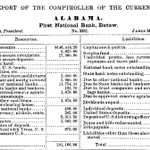
- Apply LLMs to historical newspapers to uncover over 4,000 runs on individual banks in the pre-FDIC US banking system from 1863 to 1934. Capture the most famous runs (Bank of the US
- Merge data on runs and other bank-level events discussed in newspapers (suspensions, failures) to bank-level fundamentals (harder than it sounds!)
What we find:
(1) Runs are considerably more likely in weak banks, but can also occur in strong banks, especially in response to negative news about the real economy or the broader banking system.
(2) However, runs typically only result in failure for banks with weak fundamentals [see figure below]. Strong banks survive runs through various mechanisms, including interbank cooperation, equity injections, public signals of strength, and suspension of convertibility
(3) At the local level, poor fundamentals necessary for runs to translate into large declines in lending. Moreover, bank failures (with and without runs) translate into substantially larger declines in deposits and lending than runs without failures.
Overall takeaways:
- Poor fundamentals are key for whether runs pass through into failure and have severe consequences for the broader economy.
- The findings temper the view that small shocks can result in large jumps to bad equilibria via runs on demandable debt.
Full paper here. Comments welcome. Given the methodology and evolving AI tools, we expect to make refinements to the runs database over time. Any input is welcome.
static1.squarespace.com/stat…

Emil Verner retweeted

I have already done that fraserinstitute.org/studies/…


Perhaps I should write an essay on "The Surprising Macroeconomic Orthodoxy of Denmark"
Denmark learned the costs of unsustainable fiscal policy in the 1970s and early 80s, when a very costly fiscal crisis changed the political equilibrium.
It seems each country must go through its own crisis, rather than learn from the mistakes of others

Denmark is raising its retirement age to 70. French election candidates pledge to reducing it to 60 or 62.
Denmark's debt to GDP ratio is 27%; France's is 117%.
You reap what you sow.
cnn.com/2025/05/23/business/…

A classic and valuable resource for classifying country exchange rate regimes--now updated!

The ilzetzki, reinhart, and rogoff exchange rate regime and anchor currency classification update through 2025 is now available here:
ilzetzki.com/irr-data
Emil Verner retweeted

The ilzetzki, reinhart, and rogoff exchange rate regime and anchor currency classification update through 2025 is now available here:
ilzetzki.com/irr-data
Emil Verner retweeted

I've lost track of how many times I've been lucky enough to be @DavidBeckworth's guest on @Macro_Musings. (Never enough!) But this recent podcast was a special treat because, instead of being confined to one topic, I did some free roaming. mercatus.org/macro-musings/g…

Emil Verner retweeted

GMD news: You can now ask your AI agent for hundreds of years of macro data.
The September 2026 update of the Global Macro Database is out, with plugins for Claude Code and Codex. 🧵
Emil Verner retweeted

Bank runs are almost always justified ft.trib.al/yoPtT7H

Thanks to @FTAlphaville for covering our work on bank runs, based on a large-scale project to uncover nearly every bank run recorded in US history
finhist.com/bank-runs/

Bank runs are almost always justified ft.trib.al/yoPtT7H
Emil Verner retweeted

Hanno's ending, yikes!


The U.S. is in the midst of one of the largest investment booms it's experienced in its history, fueled by the arrival of a new general-purpose technology: AI. The U.S. is projected to invest roughly 3.6% of GDP in AI infrastructure (think data centers etc) per annum between 2025 and 2032. That is about three times the size of the US telecom and fiber investment boom in the late 90s. And it’s roughly 50% larger than the railroad investments of the late 19th century.
What do you have to believe about future cash flows if you're building data centers right now? In his new BPEA paper "Financing the AI Buildout" @SVNieuwerburgh ran the numbers for us. For US data center owners to break-even with a 10% required return, you'd have to expect that total gross revenue of data centers exceeds 9% of projected US GDP by 2032
thetwocents.substack.com/p/n…


Emil Verner retweeted

I think Ezra (inadvertently) proves Jenson’s point here. The reason financial firms behaved so irresponsibly pre-2008 is not because liability incentives failed to check them. It is because we diluted those incentives for decades, through growing implicit & explicit guarantees.


Tomorrow on the show: @JensenHuang, the CEO of NVIDIA, who thinks A.I. fear is getting way out of hand.
Emil Verner retweeted

India produced 11% of the world’s tomatoes in 2022–24, but accounted for just 0.2% of processed tomato exports by volume.
Across many crops, agricultural abundance has not translated into processing strength. What needs to change? 1/8

Emil Verner retweeted

In case you're excited about labor economics and are considering a predoc: please come and work with my wonderful colleagues and me at the @Princeton @PrincetonEcon Industrial Relations Section. Please spread the word! 🙏👇 irs.princeton.edu/senior-res…

Excellent piece from Roland Fryer: "The failure isn’t that some families can choose a good school, but that too many can’t."
wsj.com/opinion/the-educatio…

Emil Verner retweeted

there is none. my gut feeling - and its not much more than that now - is that anthropic and openai will go belly up, and the current period will join tulips, south sea, 1929 and dotcom in the history books...
Even with 77% annual revenue growth, Open AI expects $ 278bn (!) of cumulative negative free cash flow from 26 to 30. Big part is compute and infrastructure spending. What is the path to profitability when these models are becoming commoditized?
ft.com/content/6011d061-eee3…

Even with 77% annual revenue growth, Open AI expects $ 278bn (!) of cumulative negative free cash flow from 26 to 30. Big part is compute and infrastructure spending. What is the path to profitability when these models are becoming commoditized?
ft.com/content/6011d061-eee3…
China’s financial system is going through what Baron, Xiong, and I termed a “quiet crisis”—a banking crisis where panic is forestalled by policy backstops, but where unrecognized losses and undercapitalization impairs the banking sector’s ability to service the economy. No salient panic, but costly and more protracted because of the lack of market discipline.
wsj.com/articles/china-can-a…

It’s semantics, but I would still refer to this as a financial crisis. For the nerds, it’s a crisis in the Holmstrom Tirole sense.
Here’s an ungated link to the paper:
wxiong.mycpanel.princeton.ed…
