

delving real content https://teapawt.net/t.co/TS8pYH9cIq
Austin. TX
Joined January 2022
- Tweets15.5K
- Following1.4K
- Followers1.4K
- Likes29.2K






i hope jensen start a new start up base in taiwan

absolutely astonishing how fast everything moves these days. it took roughly a week for all of these events to unfold with a rapidly approaching conclusion to boot.
the sheer compression of time is remarkable & it applies to every single event too.

56


its time moebius Jean Giraud

Fable 5.5 its over for video and image models 🤯
THIS IS PURE CODE
one shotted this video holy shit , how this is more beautiful than ai video models
Two ways to check this yourself:
Ask: “Where did @karpathy go in 2026?” with web search and memory turned off. Only the new Fable knows the answer. Then give it the prompt.
Run the same prompt I used for the test (it’s in the screenshot) and see for yourself.
Don’t rely on Grok for basic reasoning like this. Grok doesn’t have up-to-date knowledge of niche stuff. Either join the community or run the test yourself.
Also, a knowledge cutoff doesn’t mean a model knows everything before that date. Sometimes a model doesn’t know about an event even if it happened before its cutoff. This test shows that too.
Run the same prompt on regular Opus 5.5 and the quality drops. On Fable 5.1 it’s worse.
1
52

what is this @claudeai @ClaudeDevs
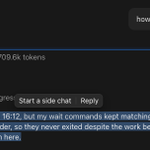
Both jobs actually finished at 16:12, but my wait commands kept matching their own process text instead of the actual render, so they never exited despite the work being done. I’ll kill those stale waits and continue from here.

40

gfy sam, go beat opus first

sam: local inference is a terrible allocation of scarce resources
“a lot of people want local inference, and somehow they assume that the problem is solved now because we have open-source models, we're going to be able to run them on our computers, and so we're not going to need all the stuff in the data centre
but from a global allocation perspective, actually it's quite terrible to have everybody, like, have a bunch of the world's limited supply of DRAM sitting in their own computer and being used five percent of the time
you want maximum utilisation in the cloud if you're trying to deal with this very supply-constrained environment
somehow many people's intuition is the opposite of that”
1
35
a different version of
You Can See Everything
by Lance Oppenheim & Nathan Fielder
title: WHAT_IF_YOU_CAN_SEE_EVERYTHING
by: Opus 5.5 not medium
youtube:
youtube.com/@publicdoom
2
102
MOAI retweeted

been working on my elemental fighting game again & decided to do some UI explorations
this is a "vibe UI" using Claude and GPT for images, one of my frustrations of UI with agents is that it adds too many details but I like the direction
teapawt.net/trq212/status/21053334…

Slopie 4

Had early access to Genie 4 from @GoogleDeepMind.
This is a fully generated, interactive world from a single starting prompt (environment + character) 🤯
Feels like a massive step forward - you can now prompt to change the world and interact with it. With native audio!
1
43
your core thesis is half-right in practice, but fundamentally misdiagnosed in theory

I have killed more channels than I have grown, dozens of them, and every dead one taught me the same lesson:
The algorithm evaluates a CHANNEL before it ever evaluates the videos it publishes.
Here is the 7 step framework built from those failures.
1. The impression test. Boring 3 minute horizontal video, film the floor, title nobody would search.
72 hours. 300+ impressions from browse or suggested means functional, 500+ means strong, 1,000+ means blessed.
If under 250, test another channel.
2. The fraud score. Your proxy IP carries ONE.
High score tanks channel trust with no warning. Check browserleaks from inside the anti-detect profile before uploading.
One IP per channel, never shared.
3. Fingerprint integrity. Your anti-detect browser reports what computer you are on. So if your profile claims a Mac but reports an Nvidia graphics card, there’s a chance you get in trouble with YouTube.
I lost a validated channel to this.
4. Posting cadence. Weeks 1 and 2, one upload every 48 to 72 hours, never batched.
Weeks 3 to 6, move to every 24 to 48 hours if the data looks healthy.
Week 7 onward, optimize on CTR and APV.
5. Upload timing. For English content hitting the 55+ US audience: 7 to 10am, 6 to 10pm, and 10pm to 1am EST.
Publishing at 2pm on a Tuesday means your test impressions land in a dead window and weak early data stops the algorithm scaling the video.
6. Playlists into podcasts. Group content into themed playlists, then convert the playlist into a podcast.
Session time climbs and you surface in YouTube Music feeds most faceless operators ignore completely.
7. The collaboration transfer. Invite one established channel in the same niche to collaborate on a new channel's video. Algorithmic trust transfers.
Once per new channel, no more, or you damage the strong channel's credibility in the eyes of YouTube.
Full walkthroughs for all 7 steps are inside elevate(.uno)
Or DM me "ALGO" if your channel is stuck at 0 views
1
39
