

North East England 👉https://xitter.cf/t.co/0PiOsLza3r👈 #history #culture #Northumberland #Durham #Newcastle #Sunderland #Tees #NorthYorkshire Dave Simpson
North East, England
Joined July 2015
- Tweets7.3K
- Following726
- Followers6.6K
- Likes37.2K





Pinned Tweet
Try out our North East History searchable map here: 👉 englandsnortheast.co.uk/hist… Click (or tap) on a selected place/area on the map to find out a little about its history. #Northumberland #Durham #Newcastle #Sunderland #history


Scenery and views at Pontop Pike which overlooks the Pont Burn valley (the 'op' or 'hope'). The prominent transmitter mast was built here for the BBC in 1953. Its construction was pushed forward so that TV viewers in the region could watch the coronation of Queen Elizabeth II.


Quaking Houses near South Moor, Stanley served South Moor Colliery’s ‘Billy Pit’. Close by was Quaking House Hill and Quaking House farm, possibly named from a Quaker meeting house. 'Billy' may be rail pioneer William Hedley (of 'Puffing Billy fame), one of the colliery owners.


Pontop Hall near Dipton in County Durham. Pontop was home to Catholic families such as the Swinburnes and Salvins. In the 1790s during the French Revolution, English priests in training fled here from Douai in Flanders, later moving to Crookhall (near Consett) and later to Ushaw.

Cyclists and walkers of old railway routes can sometimes be spoilt for choice here in the North East.

One of my favourite views. When you head to the Lake District from North East England via Alston in South Tynedale. The view from the Hartside Pass in the Pennines across the Eden valley to the Lakeland fells and beyond the Solway Firth into Scotland is sublime.


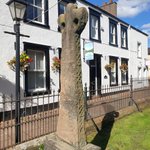
1 of 2 'Giant's Grave' Penrith churchyard, Anglo-Saxon/Viking era. Features 2 carved Anglian crosses (lost cross heads) 15 ft apart with 4 tomb-like carved Viking 'hogback' sculptures between. In legend said to mark grave of 'Owen Caesarius', a 10th century king of Cumberland.


Hebburn, South Tyneside like nearby Jarrow, was home to a huge Irish community. Its cultural mix reflected in a Catholic church of St Aloysius; a Protestant Orange Lodge and St Andrew's Presbyterian church. Hebburn was also known as 'Little Aberdeen' from influx of Scots workers.


An excellent and extremely interesting twelve-piece thread on the origins of the Anglo-Scottish border from the knowledgeable and somewhat underappreciated Dr Neil McGuigan. Includes a link to new research.

The enigmatic Freebrough Hill in the North Yorkshire Moors near Guisborough. Named from the Norse goddess of fertility, Freya. The ‘brough’ part of the name signifies a hill or a fortified place. Not too far from Roseberry Topping which was named from Odin (see preceding posts).

Roseberry Topping one of the region's famous natural landmarks and a backdrop to Teesside. Seen from miles around. Here is a close view from the north along with views from County Durham (Ferryhill and Woodland in Teesdale/Weardale) and a view from Battersby Junction to the south


Roseberry Topping, Cleveland. Originally Odins-Beorge (Odin’s Hill) from a Norse god. Over the years, the name changed to Ohenseberg, Ounsberry and Ouesberry. Association with Newton undeR ouseberry at the foot of the hill led to the present name Roseberry with a 'topping' added.

The church of St Oswald at Newton under Roseberry, a village at the foot of Roseberry Topping in the Cleveland area of Yorkshire. The south east corner of the church features an Anglo-Saxon or Viking age carving of a dragon attacking an unidentified four-legged beast.


Penrith is one of a number of Brittonic or 'Welsh' place-names in historic Cumberland. It's now in the newly created 'county' of Westmorland and Furness, although historically the River Eamont to its south was the Cumberland-Westmorland border.


Penrith: Its museum is a former school where evacuee children from the North East studied during WW2. More welcome than Newcastle man Andrew Hodgson who brought plague to Penrith in 1597-1598 wiping out a third of the town's population. Also shown: castle and Musgrave monument.


