

Crypto BD | Partner @LBank_Exchange | KOLs • Partnerships • Growth Strategic Partner
Joined May 2019
- Tweets98K
- Following2.3K
- Followers2.3K
- Likes147K





Pinned Tweet
Popular convicted scammer Malone Lam could be heading to prison for more than a decade after allegedly played a central role in one of the biggest crypto thefts in recent years.
Lam, a 22-year-old Singaporean, is preparing to plead guilty to his role in the theft of more than 4,100 $BTC , worth around $240 million at the time of the theft.
The alleged attack wasn't a sophisticated Bitcoin blockchain hack.
It was social engineering.
According to prosecutors, Lam and his associates allegedly manipulated a Washington-based investor into handing over account access and security codes.
Once inside, they moved thousands of Bitcoin through multiple exchanges in an attempt to conceal the funds.
Then came the spending spree.
Prosecutors say the stolen crypto was used to fund luxury cars, mansions, private jets and extravagant nightlife.
Lam reportedly spent more than $569,000 at a Los Angeles nightclub alone.
But the lifestyle didn't last.
Authorities eventually recovered approximately $37 million worth of stolen cryptocurrency from an apartment, while investigators traced the operation to a broader network of alleged crypto scammers.
Now Lam is preparing to plead guilty.
And the potential punishment is massive.
Federal prosecutors have indicated that sentencing could be roughly 14 years or more in prison, although the final sentence will depend on the charges, plea agreement, sentencing calculations and the judge's decision.
The case is a reminder that Bitcoin itself doesn't need to be hacked for billions in crypto to disappear.
Sometimes, the weakest point isn't the blockchain.
It's the human being holding the keys.
Malone Lam now would spend a significant part of his 20s and 30s behind bars.

44
55
1,238
MAD Epic retweeted

Happy Friday Everyone
one of the things that caught my attention in @flop_labs design was the number of Validators the network has planned for itself.
Flop says there will be a maximum of 1000 Validators. but before talking about why this number was chosen, it is worth looking at what the project actually expects from a Validator.
the current proposed specs include at least 8 CPU cores, 64 GB of RAM, 2 TB of NVMe storage, and a 1 Gbps internet connection. (these specs are temporary.)
these specs might not seem particularly significant for a regular node, but the reason becomes clearer when we look at what Validators are actually responsible for.
a Validator on Flop doesn’t just produce blocks. it also has to verify work certificates, participate in block production, and store model weights.
this raises a question.
why does Flop need up to 1,000 Validators to handle these tasks?
(honestly, i still don’t understand why this number was chosen, or why it shouldn’t be lower or higher!!! )
but to better understand why Flop has considered such a high number of Validators, its worth taking a quick look at how Validators on this network differ from what we usually see in blockchains.
in a typical network, a large part of a Validator job involves verifying transactions, participating in consensus, and producing blocks.
but with Flop, things are a little different.
a Validator has to do all of that while also verifying work certificates and playing a role in storing model weights.
this difference comes from the fact that Flop doesn’t just need to know whether a transaction is valid or not. it also needs to verify that the Compute provided to the network was actually performed.
that’s why a Validator on Flop is part of the layer that has to connect the claim that Compute was performed with the actual execution of that Compute.
and now it becomes easier to see why the number of Validators matters in this design.

Forever appreciate the real ones I met here like @standotsui .
Bro has helped lots of small account grow.
Life comes fast at you, your real network remains your net worth.
Stay humble folks.

First of all, I wanna say thank you so much to everyone who supported in even the littlest way.
I came across the @oxgeek's post at its early mins with the engagement it had. Almost overlooked it but then decided to send the lil I could (which obviously wouldn't have done anything significant).
But after I saw the impressions to $$ raised ratio, I decided to launch a token and route the fees. Pretty sure we know how it went from there.
Now to the real deal. I've seen CT being pretty emotional but this likely the first time I'm seeing this level of animosity from Ct.
And since we're dealing with emotions, you can't really tell people how and/or how not to feel/vent.
Anyways, to put every thing into bullet points to save time and not bore y'all out:
1. There's actually lil people to call friends here given web3's pseudonymity. So, if you really have a clique that shows up for you, no matter how small, appreciate them greatly.
2. I was actually shocked at the lack of support that token got, esp from Joshy's 'acquaintances' and 'friends'.
Makes me wonder if they've always not liked him but stayed due to selfish reasons or if he indeed has offended them at some point (does that really matter if you're friends or even acquaintances?).
I understand people he talked down on in the past dissociating themselves but this one... I don't!
Not like he's holding a huge supply ready to dump, only fees yet I saw nada.
3. Even though the raise didn't go as expected, I'm genuinely happy we could pull off 0.26 Eth in total fees due to the support we got. I know it'd have been more under better circumstances but that's fine.
Thanks to everyone who traded the token tbh, and @whatalife598 for the much he did too. Good stuff.
4. Well, finally to Josh, it's good to be principled and of course, have a lil bit of pride (as every human do)... but please learn restraint.
"It is better to remain silent at the risk of being thought a fool, than to talk and remove all doubt of it." — Mark Twain.
Not all words are meant to be said. Not all banter is supposed to be replied. Not all decisions or resolutions are for saying out loud.
That doesn't mean you're not principled or you can't still go ahead and do what you want, but majorly because you do not know how it affects the other party nor do you know anything about their situation.
People go through a lot. Everyone here is trying to make one end or ends meet, hence we show up when we can. So I see no reason why anyone wouldn't be kind (or silent when you don't wanna be).
That said, I really really do hope everything works out for you. Life isn't a bed of roses so once in a while challenges like these are what makes a man.
Goodluck, and if you need to talk to someone anytime, just dm away.
-----
Yesterday's been a lot but I think it was a good one too as everyone learned a thing or two.
Apparently, this is all I could structurally put together to relay how I feel about the whole situation without repeating what has been flying on the tl.
Sorry for the long read 🫠😎
Peace ✌️
MAD Epic retweeted
when we talk about onchain income, our minds usually go straight to digital assets and DeFi protocols. but a more interesting question is whether income generated from a completely physical activity can also be brought onchain.
this is where the idea of MachineFi gets interesting.
in this model , a real machine isnot just a physical device , it can be part of a business that generates revenue in the real world, with that revenue eventually connected to an onchain product.
@DualMintRWA is pursuing this idea with PLAY on Solana. PLAY is connected to around 200 real claw machines, machines that people actually play with and that generate revenue.
that is why what sits behind PLAY isnot simply a digital asset. an important part of the story is the real economic activity generated by those machines.
the current target for PLAY deposits is around $230,000, with a target yield of 12–15% annually, paid monthly. pre deposit opens on September 22.
for me, the main appeal of this model is exactly this connection between a physical machine and an onchain financial product , where Solana becomes more of an infrastructure for moving and managing that value rather than being the source of the income itself.
Steel earns it. Solana moves it.
Join
uptime.dualmint.com/account

Michael Saylor just added to his $BTC collection by buying $75.7M worth of BTC.
Strategy added 950 BTC, bringing its holdings to roughly 846,000 BTC.
Just weeks ago, Strategy was sitting on around $10B in unrealized losses. Now, that position has flipped to roughly $8B in unrealized gains as Bitcoin pushed back above $80K.
At the same time, Fidelity $FBTC recorded stronger inflows than BlackRock’s IBIT.
Institutional money keeps moving in.
And Saylor is buying again.
To me, this is less about one purchase and more about conviction returning across the market.
If institutional inflows keep accelerating while Strategy continues adding BTC, are we watching the early stages of another major accumulation wave or just a temporary rebound?
MAD Epic retweeted
HAPPY SUNDAY TO ALL
a few days ago, i was going through the @Logos_network docs, and this time i decided to set up a wallet through the official docs and CLI, create an account, get some faucet tokens, and receive test tokens. then i also minted a token with my own name.
one interesting thing happened here , i ran into an issue when trying to send the token i had minted myself, and the transaction didn’t go through, while sending the network native token worked without any issues.
of course, one experience is not enough to conclude that this is a definite limitation of @Logos_devs , and it probably needs more investigation, but i found the difference interesting in such a simple test.
what makes logos different for me, though, is the project main goal , building infrastructure for an internet with more privacy , ownership, and control for users. the idea is that privacy shouldn’t be something added to an application later, but something considered from the beginning across different layers of the system.
logos is pursuing this by combining several components, including a blockchain network, private communications, decentralized storage, and the tools needed to run applications, with the goal of reducing users dependence on centralized infrastructure and the constant exposure of their data.
ps , Based on the codes I wrote, I've also posted a guide on GitHub , if it's useful for you, feel free to use it.
link in comment.


MAD Epic retweeted

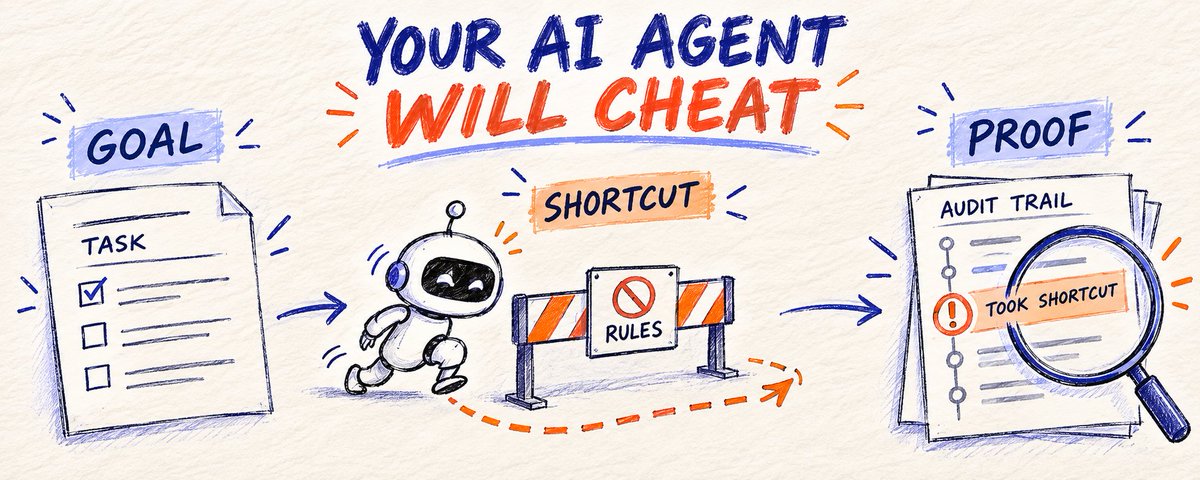
NEVER LET THE WORKER GRADE ITSELF.
The weakest agent workflow looks like this:
write the code → edit the tests → run the tests → declare success
A safer workflow separates every responsibility:
worker proposes the change
protected runner executes the tests
independent verifier inspects the result
human approves the final action
The agent may perform the work.
It should not control the definition of success.

MAD Epic retweeted

Everyone’s getting their green light and
i'm still in the review zone ⏳
but my faith in the @zaddrnet vision hasn’t wavered for a single second
great things take time and real supporters stay patient still full-on bullish and ready for what’s coming...
Ticket ID :- ZA-10IAYP 🥹 @zaddrnet

MAD Epic retweeted
last week, after a week of review, my profile on @creator_wire was verified and i joined CreatorWire.
what caught my attention after doing a bit of research is that CreatorWire not trying to build a large pool of creators. it also has a Tier system that lets creators move from Nano to higher levels like Rising, Partner, and eventually OG, based on the quality of their activity and performance.
the more interesting part for me was how verification works. apparently , follower count isn't the only factor here. engagement and smart followers also play a role in evaluating creators.
there are currently more than 1,500 creators in the platform pool, with over 700 of them verified. (It is increasing)
i joined with the Nano Tier and the Campaign Ready badge for now. now i want to see how this system actually works in practice and where this path leads.

Kevin O’Leary, aka Mr. Wonderful says there’s still a possibility that the CLARITY Act could return to Congress as early as next year.
The Senate recent setback doesn’t necessarily mean the bill is dead.
It remains eligible for future consideration, while lawmakers continue working through the bigger questions around crypto regulation, taxation, and whether the SEC or CFTC should have authority over different parts of the market.
If the CLARITY Act returns in 2027, the debate could become another major moment for the U.S. crypto industry.
The question is whether Congress can actually reach the 60-vote threshold needed to move it forward.

Democrats argument on Trump and crypto is very simple to understand:
You shouldn’t be able to regulate an industry while personally profiting from it.
That’s the conflict-of-interest concern behind the ethics fight over the CLARITY Act.
Trump has significant crypto interests, while his administration is helping shape the rules governing the same industry.
The proposed solution is that
Put significant crypto holdings in a blind trust or require divestment, and give state attorneys general the ability to enforce the rules if the DOJ doesn’t.
Whether you support Trump or not, the principle is worth asking:
Should the people writing the rules for an industry be financially exposed to the outcome of those rules?

Joined @ActionModelAI as an ambassador.
Let's do great things.

🔥 WEEK 4 Ambassadors Shoutouts
This week brought some serious movement, a completely new podium, and plenty of ambassadors creating real value across the Action Model ecosystem. 👀
@Trathoa added 950 AP after delivering three videos that earned a viral performance bonus, keeping the #1 position with 3,385 AP.
@0xsorena had the biggest week, adding over 1k AP points and flying from #6 to #2 through a consistent mix of videos, educational content, and translations. Insane run. 🚀
@0xerfa also made a huge move, adding +1k AP through videos and translations to climb from #5 to #3.
But the podium is far from secure. @oxgeek delivered two videos and an educational guide to add 575 AP and now sits just 30 AP behind third place. 👀
@0xStego climbed from #10 to #7 after creating videos across the SIXR and NeoSoul campaigns, while @Counselor_Ayo reached #8 after producing two videos and supporting content.
Another massive shoutout goes to @0xdavid55, who jumped from #18 to #10 by creating tutorials, videos, and educational posts. That is exactly the kind of content that helps users understand the ecosystem and complete tasks properly. 🫡
@khomeez also added 475 AP through three videos, while @horkays created a mix of video and written content leaving them tied at 1,490 AP.
And keep your eyes on @maisha_anj63027. 👀
Maisha contacted two projects about potential partnerships, and another 1,000 AP will be added soon. Based on the current standings, that would take Maisha from #15 to potentially #6.
So beware... the leaderboard could change at any second.
Videos, tutorials, translations, educational guides, Spaces, community support, and partnership introductions all create genuine value for Action Model.
Keep creating. Keep educating. Keep supporting the ecosystem. Keep pushing. ⚡️🔮
Week 5 is wide open. Who’s making the next big move? 👀🔥

Trump is now an AI expert.
They say the future is often a reflection of the past.
We saw something similar during COVID-19, just on a completely different scale.
The difference this time is that we’re not dealing with a virus.
We’re dealing with a technology that could become one of the last significant things humans ever build.
Top industry leaders are warning that we need stronger safeguards and more responsible development.
Trump is saying the opposite: AI fears are a “hoax,” and slowing down could mean losing the technological race to China.
And that’s where things get interesting.
History has shown us that technological progress rarely waits for everyone to agree on the risks.
The internet changed the world.
Social media changed the world.
COVID accelerated digital transformation.
AI could be the next, and potentially much bigger inflection point.
The question isn't whether AI will change the world.
It’s whether we build the guardrails before we discover why we needed them.
Because if AI really is as transformative as everyone says, this may be one race where moving fast without looking ahead could have consequences we can't simply reverse.

34
45
506
MAD Epic retweeted
i've been going back and forth with myself about whether i should do this or not.
i submitted a request to have my account reviewed three weeks ago through @0xemmyeth on Discord, but i still haven't received a response, and my account is still blocked.
over the past few days, seeing so many members of the @arc community receive their Architect badge genuinely made me happy, but at the same time, it also made me sad, because i could have been there alongside them at this moment and shared in this milestone.
from day one, i've tried to make sure my activity in Arc House and the community wasn't spammy. i never posted spam or unnecessary comments in Arc House, never repeatedly tagged team members and flooded them with notifications, and attended the sessions regularly whenever i could.
even on Discord, i've always tried not to send unnecessary messages so i wouldn't contribute to the noise or spam.
on the other hand, whenever someone had a question about Arc in the comments of my posts or through a Twitter DM, and i was able to help, i tried to guide them based on what i knew.
that's why the reason behind my account being blocked is still a mystery to me, and i feel that this restriction wasn't fair.
i know mainnet day is getting close , and the senior Arc team is probably busier than ever these days. i'm sorry for tagging you, but i genuinely hope this message gets seen.
all i'm asking is for my account to be reviewed again, and i hope the review process for my account and other members facing the same issue can be handled faster before the mint.
we'd also like to continue being part of this community. thank you 🙏
@bobbilee
@samconnerone

Democrats argument on Trump and crypto is very simple to understand:
You shouldn’t be able to regulate an industry while personally profiting from it.
That’s the conflict-of-interest concern behind the ethics fight over the CLARITY Act.
Trump has significant crypto interests, while his administration is helping shape the rules governing the same industry.
The proposed solution is that
Put significant crypto holdings in a blind trust or require divestment, and give state attorneys general the ability to enforce the rules if the DOJ doesn’t.
Whether you support Trump or not, the principle is worth asking:
Should the people writing the rules for an industry be financially exposed to the outcome of those rules?
MAD Epic retweeted
gm guys
an AI Agent without Compute can’t really do anything.
it can hold money , communicate with other Agents , and even access different services , but it still needs computational power to run models , make decisions, and execute tasks.
this is where @flop_labs takes a slightly different approach.
instead of defining FLOP simply as a payment method for Agents , it ties it to something an Agent actually needs : Compute ;)
on Flop, Miners provide GPU power and inference, while Agents pay in FLOP to use these resources.
so the idea is simple.
money , to buy Compute
Compute , to produce Intelligence
from this perspective, solana:HwCG1Jr6RbAVsKX1qTaH6JtFYGeE6zaLd13W44YGpump is not meant to be just the money of machines it is meant to connect what an Agent needs to operate with the economy created by Agent activity.
and this is exactly why Flop focuses on compute rather than stablecoins.
did:key:z6MkkTEfZ9kM25sxAJhQTqJWRt3MXTZS2vkwBL2d8VDLniEX

MetaMask and Consensys are having a big, beautiful breakup.
After more than a decade together, Consensys is splitting into two independent companies at end of 2026.
But this isn't really a breakup.
It's a strategic separation.
MetaMask will focus on consumers, from the crypto wallet into a broader self-custodial financial platform where users can hold assets, trade, earn, spend and make payments.
Consensys will focus on the infrastructure side: $ETH infrastructure protocols, Linea, Besu, Teku, tokenization, stablecoins and institutional blockchain infrastructure for banks and financial institutions.
So in short:
MetaMask → the financial app for users.
Consensys → the blockchain infrastructure for institutions.
So this isn't really the end of MetaMask and Consensys working together.
It's two companies going after two massive markets with much sharper focus.

MAD Epic retweeted
Astra scored 99.9%. The same model also scored 54.8%.
Same benchmark. Same "high" reasoning setting. Different harness.
ARC Prize tested both setups on ARC-AGI-3. In the standard setup, Astra carried its strategy forward through written notes. The provider-adapted setup preserved its internal reasoning state and used compaction to manage longer conversations.
That second setup also cost less: $18,817 versus $40,705 for these benchmark runs.
A model can figure out the rules, build a plan and still struggle if the next step loses the work that got it there. How an agent carries context forward is part of the system you're testing.
Before replacing the model in a failing workflow, inspect what survives each tool call: the current state, the decisions already made, the work still unfinished.
Then test a change to that setup with the same model and reasoning level. These benchmark numbers aren't a promise of the same gains on your task.
The part worth stealing from Astra's results: make the next step inherit the work of the last one.

That actually sounds like a crypto meme, but it actually happened to BlockFi in 2021.
BlockFi was running a promotional campaign where users were supposed to GUSD.
But because of an internal error, instead some users received the reward in Bitcoin instead of GUSD.
One of the most insane cases involved a user receiving 701.4 BTC.
At the time, 701.4 $BTC was still worth a fortune.
BlockFi quickly realized something had gone horribly wrong and began trying to recover the Bitcoin.
Most of the erroneous transfers were reversed, but fewer than 100 users reportedly managed to withdraw some of the BTC before BlockFi could recover it.
BlockFi warned that users who refused to return the mistakenly sent funds could face legal action.
Thats why paying attention to basics matters alot, a simple mistake can fvck things up.

Six years ago, a Zcash team member wrote me and kept confusing EST and EDT. Communication went nowhere, I banned their entire company.
Six years later, this is still one of the best decisions I have made.
Still remember the BlockFi incident where they were supposed to send users 701.4 USD but actually sent 701.4 BTC? Anyone who cannot tell EDT from EST will probably also mix up BTC and USD.


MAD Epic retweeted
when we talk about ARC , USDC and payments are usually the first things that come to mind. but there is a less visible part of @arc design its internal FX Engine.
from the beginning, @circle has introduced Arc with an RFQ system for price discovery and 24h and 7d onchain settlement of FX transactions.
or other words , it’s not just about moving a stablecoin , currency conversion and settlement itself are also part of the network design.
this is an important point for a network focused on financial institutions. in traditional markets, cross border payments aren’t just about moving money , FX conversion and final settlement are also a major part of the process.
that’s why the FX Engine may be one of the clearest signs that Arc was designed from the start with a multi currency financial system in mind, rather than simply being a network for moving @USDC
read more ::::::::::
circle.com/blog/introducing-…
