

Minimum bits, maximum intelligence.
SF
Joined June 2026
- Tweets360
- Following85
- Followers2K
- Likes627


Pinned Tweet
Today we are introducing Escha-W2 quantization.
A 2-bit Qwen3.6-35B-A3B model built for fast, local inference. The complete model is 12.3GB on disk—small, enough to run on a single consumer GPU — while averaging ~100% of FP8 performance across 12 benchmarks, including:
MMLU-Pro: 80.9
MATH-500: 93.8
GPQA-Diamond: 77.8
LiveCodeBench v6: 62.6
BFCL tool use: 88.9
RULER 8K–128K: 89.9
Commonsense-6: 76.1
On a single RTX 4090, the model runs:
225 tok/s single-stream generation
on 12.3GB on-disk model size
Compressing a 35B MoE model this far without collapsing its capabilities required more than a standard quantization pass.
We built an end-to-end compression system combining state-of-the-art low-bit quantization with model-aware fine tuning and recovery to preserve capabilities most vulnerable to low-bit error.
Quantizing the Qwen 3.6 35B model - from the base model to the final deployable checkpoint — took approximately 10 hours to complete.
Escha-W2 runs through a custom Qwen3-MoE runtime, which includes the weight loader, low-bit decoding kernels and serving integration required to execute the Escha format efficiently. The runtime currently supports SGLang and ZML deployment. vLLM and llama.cpp will be supported in the next release.
No retraining from scratch. No specialized accelerator. One consumer GPU.
Model download: huggingface.co/EschaLabs/Qwe…
Runtime download: huggingface.co/EschaLabs/esc…
Apache-2.0 model and runtime.

Model specific inference engine is the next frontier

🚀 Introducing DeepInfer, our in-house inference framework, now fully open source!
Powering DeepSeek-V4.1-Flash at scale with high throughput and low latency. We’re sharing our production stack to help the community lower compute costs, reduce energy use, and make AI more affordable.
🔗 github.com/deepseek-ai/DeepI…
1/4

3
426
Nice one from @seanhighness!
Haven’t tried it ourselves - would love to hear what folks find.
Love seeing the community keep pushing what’s possible on local hardware 🔥

If you have a 12gb 40 or 50 series card I have something dope for you ! Also amazing / even better for 16gb cards.
12gb =qwen-27b 4bit quality at 96k context with dflash2 - Fast
16gb =Qwen3.8-27b running at full context 256k + Dflash2
Model is 8.65gb based on @Eschalabs
1
3
925
Excellent post. It’s also why we chose trellis as the quantizer foundation at Escha.
For a little more context: at 2 bits per value on normalized Gaussian data, QTIP’s trellis achieves compression error at about ~0.068. The theoretical floor is 0.0625. An optimized scalar quantizer, Lloyd–Max, gets ~0.118 - about 74% higher.
Same bit budget, substantially less distortion.
The neat part: trellis can jointly compress hundreds of weights without storing an enormous codebook of every possible combination.
Of course, there are tradeoffs. QTIP-style methods add decoding overhead compared with simple scalar quantization. Better kernels and runtime engineering can reduce or amortize those costs, while moving fewer bytes can also help offset the latency in memory-bound workloads.
Good to see more attention on trellis, and credit to the QTIP researchers and the EXL3 team.

EXL3 is the biggest paradigm shift in local LLMs right now, and most people still have not understood it.
Not because it is new. Because everyone filed it as "another quant format" next to GGUF and AWQ, tried it once, and moved on. It is not another quant format. It is a different compression algorithm, and the difference compounds at every tier of hardware.
I mapped every EXL3 implementation I could find, and the result is one lane per VRAM tier. Here is the best recipe for each tier, so you do not have to build it.
WHY TRELLIS IS NOT JUST ANOTHER QUANT
The formats you grew up on round each weight to the nearest low-bit value independently. Every weight introduces its own rounding error, and those errors stack. That is why Q4 feels dumber than Q8.
EXL3 does not round weights. turboderp built it into ExLlamaV3 from QTIP's trellis coding. It encodes each weight vector as a path through a constrained codebook and spreads the error across dimensions with a Hadamard transform. The rounding debt gets distributed instead of stacked.
What that means in practice: your model runs closer to full precision at a fraction of the size. On the independent teacher-logit panel for GLM-5.3-Flash, EXL3 at 4 bits per weight sits 0.004 nats from the uncompressed BF16 teacher. That is nearly lossless. Official FP8 at double the size sits at 0.002 nats. NVFP4 at a higher bit width sits at 0.06, which is 2.5x further from the teacher than either. EXL3 matches FP8 intelligence at roughly half the file size.
The fun fact that sells it: Llama-3.1-70B is coherent at 1.6 bits per weight. A 70B model in under 16 GB. No rounding-based format produces that because it mathematically cannot.
THE MAP
One best recipe per VRAM tier. Every number is either my own bench or a named public receipt.
8 to 12 GB — RTX 4060, 4070, 3060
Qwen3.8-27B EXL3 2.2bpw — 25 tok/s on a 3060 12GB, 64k context, Q4 KV, vision on. A real user receipt (SC_2.20bpw_H3_V3 pack), not a vendor claim. Full 27B on a 12GB card is a much stronger map row than the 9B — it's the trellis thesis doing its job at the bottom of the ladder. The 9B stays as the 8 GB fallback mention in the sub-line.
16 GB — RTX 4080, A5000, 5060 Ti
Qwen3.8-27B at 3.0 bpw with the built-in MTP head. About 55 tok/s code decode with 110k context, owner-measured on a 16 GB A5000. A frontier-tier dense model on a laptop GPU.
24 GB — RTX 3090, 4090
My own bench. Qwen3.8-27B at 3.5 bpw plus the DFlash2 5.0 bpw drafter. 130 to 150 tok/s short-context ceiling, 94 to 105 sustained, full native 262k context resident on a 22 GB budget. Same card, same model, roughly triple your old Q4_K_M llama.cpp speed.
32 GB — RTX 5090
The malaiwah K5K6-hydrated pack. Native 262k with vision intact, or drop the vision tower and MTP3 text-only serves 155 to 212 tok/s decode, verified on a 250k-token prompt on an RTX 5090. This card is the new sweet spot.
48 GB — RTX 6000 Ada, A6000
GLM-4.6 on mratsim's tuned-K packs. 3.84 bpw tuned at 202k context across four 48 GB cards. The tuned mix beats uniform quants at the same size on his measured KLD ladder. This is the quality-first tier.
96 GB — RTX PRO 6000
Two recipes depending on what you want. Fastest single card on the map: DeepSeek-V4-Flash K2 at 133.6 tok/s with dSpark drafting. Most reach: the anoane 2.32 bpw pack fits the MTP drafter AND a full 1M context at 114.5 tok/s. One card.
128 GB — one DGX Spark
My own bench. Cruz's Flash-Next 176B at 3.05 bpw decoding 102.6 tok/s of code, context ladder holding past 200k. For a 320B-class model, the GLM-5.3-Flash 2.05 bpw pack runs 64 tok/s structured with a DFlash2 K7 drafter.
2x DGX Spark, TP2
My dual-Spark bench: DeepSeek-V4.1-Flash at 2.9 bpw, 45.5 to 51.5 tok/s per stream. The community recipe for GLM-5.3-Flash at 4 bpw holds 62.9 tok/s single stream and 146.5 aggregate at four streams, with 900k context. This is my daily driver. Peak local intelligence on a desk.
Two quiet boxes, a 320B-class frontier model, 900k context that holds, tools clean at depth.
If you own two Sparks and you want the smartest thing you can run, this is the loadout.
4x DGX Spark, TP4
The Pollard pack. DeepSeek-V4.1-Flash experts at 3.5 bpw mixed K. 54.7 tok/s single stream, 178.7 at six streams, 1M context, KV pool at 2.56M tokens. Four Sparks out-serve the vendor's own checkpoint on the same nodes.
96 to 128 GB unified — Mac M4 Max, M5 Max
Flash-Next 125B hybrid EXL3 at 49GB residence on a 64GB M5 Max, near-4bit quality, 70+ tok/s — posted by the PonyExl3 author this morning with a demo video (verified direct, not a relay). That slots as its own "64 GB uni" tier between 4x Spark and the 96-128 Mac row, and it's a banger for the map: a 125B frontier-class MoE on a laptop chip at 70+.
PonyExl3 ported the EXL3 codec to Metal in June. Qwen3.6-35B-A3B at 4.0 bpw decodes 68.5 tok/s on an M5 Max against 52 on an RTX 4090, same weights, both measured. MoE loves unified memory. Dense models do not, and prefill is the Apple tax, but the decode row stands.
WHAT EVERY WINNING RECIPE SHARES
The drafter is part of the pack now. MTP heads ship inside checkpoints, DFlash2 drafters get their own EXL3 quants, and a quantized drafter added 33 percent end-to-end because draft weight reads dropped from 16 bits to 5.
And numerics stability IS performance. The fork I run kept the same reduction order, moved mixers to int8 inside a 3-bit pack, and bought 40 percent more decode in four days. That number is my own before-and-after bench, same protocol both sides. Speculative decoding made quantization quality a speed problem. Every recipe above wins because its drafter accepts.
If your card fits an EXL3 pack and you are still on Q4_K_M, the map says you are leaving measurable speed and measurable intelligence on the table. It is the cheapest upgrade in local AI right now, and it is not even close.
Sources, how to run and models in reply 👇

Bonsai 2 27B dropped on Thursday.
PrismML reports 98.2% aggregate performance retention versus Qwen3.8-27B FP16: 83.9 vs. 85.4 across a 20-benchmark suite.
That is an improvement from the 95% aggregate retention reported for the previous Bonsai 27B generation (note the underlying benchmark suite changed).
The accompanying whitepaper provides substantially more detail on individual benchmarks and evaluation methodology - this makes the results easier to examine beyond the headline average.
Looking through the 20 benchmarks in granularity, performance retention varies meaningfully by task.
Some of the larger drops include:
OCR Bench v2: 93.3% retention
BigCodeBench: 94.4%
GPQA Diamond: 94.8%
At the same time, a few benchmarks like IFBench and HumanEval scored above 100% which partially offset the underperformance to get to the 98.2% average.
One important, overlooked part of the whitepaper is that PrismML also separately reports two longer-horizon agent evaluations:
Terminal-Bench 2.1
Bonsai 2: 52.8
FP16: 69.7
75.8% retention
SWE-bench Verified
Bonsai 2: 60.8
FP16: 80.6
75.4% retention
These two benchmarks are not included in the 20-benchmark suite used for the 98.2% headline. The paper reports them separately and does not explain why they were excluded from that aggregate.
What sets these two benchmarks apart is that they test long-horizon, multi-step engineering and terminal-agent tasks where the model repeatedly reasons, acts, observes results, updates state, and continues over many turns.
That matters at extreme compression levels because small model errors can accumulate across long generation trajectories.
PrismML itself notes that these workloads are particularly sensitive to model degradation because small errors can compound over many steps.
That makes the ~75% retention on these two benchmarks an important data point for anyone considering heavily compressed models for running long-running agents.
One other metric that would be useful to see in future releases is output-token efficiency.
It has been widely reported and observed that low-bit reasoning models can increase reasoning length, retries and semantic repetition. This makes tokens-per-success and reasoning-token counts useful metrics to report alongside accuracy.
Overall, Bonsai 2 is a good progress in extreme compression.
For those looking to deploy extremely quantized models for real world tasks, please evaluate the performance carefully so you are getting the most out of the model for your specific use case and needs.

Today, we’re announcing Ternary Bonsai 2 27B.
Based on Qwen3.8 27B, Bonsai 2 27B is 9x smaller than its full-precision counterpart while retaining 98.2% of its aggregate benchmark performance.
Two months after the first Bonsai 27B release, the biggest change is quality. The footprint remains 5.9 GB, but the gap to full precision has narrowed materially, with particularly strong gains in agentic coding, multimodal reasoning, and long-horizon tool use.
Ternary Bonsai 2 27B is available today under Apache 2.0.

A little delayed, but MTP is now out for our Qwen3.8-27B MLX runtime.
We’re seeing about a 1.3× speedup vs. no MTP.
We did our best, but there’s definitely more performance to unlock here. For now, treat this as a reference implementation - community contributions, optimizations, and PRs are very welcome.
GitHub:
github.com/EschaLabs/escha-m…
Hugging Face:
huggingface.co/EschaLabs/Qwe…
And what else are we working on? A lot.
Stay tuned for Escha 2.0.

Incredible (and sensible) encoder / decoder architecture, will be a fun one to work on!
🚀 Introducing DeepSeek-V4.1-Flash: smarter, faster, more efficient.
🔹 Introducing the smallest model in our new architecture family, with native visual understanding.
🔹 Designed for greater capability, faster inference, higher throughput, and scaling to larger models.
1/6

4
26
1,340
One more reason to own your model and code.

You're missing the core drama of the story: Tristan is softly accusing OpenAI of having stolen their result from Codex chat logs.
Tristan then claims OpenAI tried to threaten him to not publicly disclose this, and that they'd give him the Clay Prize ($1M) as the "closest humans to the problem" if he'd agree to disavow his co-author, @__alpoge__ , who is at Anthropic.
This is HBO-level drama, but with math proofs.

13
1,237
Congratulations! For folks looking for a llama.cpp implementation, do give it a try

This is a big personal achievement.
My port gguf for @Eschalabs Qwen3.8-27B-Escha-W2 for llama.cpp just got over 5000 downloads.
I'm incredibly grateful for everyone. 🙏
Last week we got MTP and i added the drafts + support, taking tg to new height.
Today, big fix for prefill will be coming to my llama.cpp-escha fork. You'll be able to run model even more faster.
huggingface.co/aj9o9/Qwen3.8…

3
26
2,311


MTP is now live for Escha Qwen3.8-27B W2!
Decode speed has been one of the bigger challenges with running a dense 27B model, and MTP was at the top of the most requested add-ons.
So we shipped it.
With MTP speculative decoding:
RTX 4090: 67.3 → 129.3 tok/s (1.92×)
RTX 5080 16GB: 61.7 → 109.2 tok/s (1.77×)
RTX 4080 16GB: 52.8 → 93.4 tok/s (1.77×)
Same Escha W2 model, using Qwen3.8’s pretrained MTP head. No separate draft model needed.
MTP is included with the model and supported in the latest Escha SGLang runtime. Turn it on with SPEC=1.
Model: huggingface.co/EschaLabs/Qwe…
Runtime update: huggingface.co/EschaLabs/esc…


Escha 2-bit Qwen3.8-27B is live!
The full model is 10.15GB on disk, runs at 82.6 tok/s on a single RTX 5090 with our custom SGLang runtime, and averages ~100% of FP8 performance across 8 benchmarks we've run so far.
We wanted to get this into people’s hands ASAP, and had limited time to run benchmarks. For the ones we did run, one surprising finding is LiveCodeBench v6:
Escha W2: 86.81
FP8: 85.16
This was the single benchmark that showed crack on the previous 2-bit Qwen3.6-35B MoE (62.6 vs. 67.0 FP8). Nice win as we continue to improve!
Model: huggingface.co/EschaLabs/Qwe…
Runtime: huggingface.co/EschaLabs/esc…
Apache-2.0 model and runtime.
We’re also planning to open-source the full runtime stack, with GGUF releases for both the 27B dense and 35B MoE models coming soon.
As always, please share your results. We want to see the bangers and the flops - both help us make the next one better.
Another banger drop from AJ!
For folks that don't want to wait for the Escha llama.cpp runtime, please do give this a try!
My first model to get 1000 downloads in HF 🥳
This is my Escha Qwen3.6-35B-A3B-W2 gguf with llama.cpp port.
It is a really good model, no need to ncmoe on 24gb vram, better than other Qwen3.6-35B quants where you need to offload experts.
I'm working on @Eschalabs Qwen3.8-27B now, will be ready soon.

We support 100%!

Btw the Redis story repeats itself: I'm working at DwarfStar for free for the community and because I enjoy it. But I'm receiving criticisms, since people are worried that this will break their AI-richness plans. I want to say to everybody thinking that I should stop that each time you tell me this, I'll double down my efforts towards a completely no profit engine for local inference. Better to shut up basically.
1
18
3,082
The Qwen architecture has been very friendly to quantization.
Very excited to see what the new architecture brings!

The next-gen architecture powering Qwen4 is now here! ✨
Get ready for the open release of Qwen3.8-Flash-Next 🚀
The countdown starts now! ⏳🔥modelscope.cn/models/Qwen/Qw…

6
48
2,817
Good news for local AI!
Pair a box like this with Escha quants and folks can run surprisingly capable models locally inside a small memory and power envelope.
Xiaomi just showed its AI Cube Prototype and this could become a serious GB10 competitor from China 👀
- 3 custom chips: Xring O3, O100, D100
- 200 TOPS NPU
- 1.22 TB/s AI memory bandwidth
- Up to 160GB unified memory
- 150W sustained power
- 120B models running locally
Xring O100: 1.22TB/s + 330 t/s on a 150w AI box is 🔥
Once it hit's the marked, going to sell like hot cakes.


3
29
3,150
Escha 2-bit Qwen3.8-27B is live!
The full model is 10.15GB on disk, runs at 82.6 tok/s on a single RTX 5090 with our custom SGLang runtime, and averages ~100% of FP8 performance across 8 benchmarks we've run so far.
We wanted to get this into people’s hands ASAP, and had limited time to run benchmarks. For the ones we did run, one surprising finding is LiveCodeBench v6:
Escha W2: 86.81
FP8: 85.16
This was the single benchmark that showed crack on the previous 2-bit Qwen3.6-35B MoE (62.6 vs. 67.0 FP8). Nice win as we continue to improve!
Model: huggingface.co/EschaLabs/Qwe…
Runtime: huggingface.co/EschaLabs/esc…
Apache-2.0 model and runtime.
We’re also planning to open-source the full runtime stack, with GGUF releases for both the 27B dense and 35B MoE models coming soon.
As always, please share your results. We want to see the bangers and the flops - both help us make the next one better.
Llama!!!! 🦙
One more awesome community port just landed - big shoutout to @ItsmeAjayKV for making it happen!
Love seeing Escha get pushed onto more models and runtimes by the community.
Check it out 👇
I ported @Eschalabs Escha-Qwen-3.6-35b-W2 to llama.cpp
Started this process around the time they announced it, hoping to complete this quickly, but it was not easy, had to abandon few tries. But learned a lot and got it to work with good speed.
This is not a requant. First try was fold the rotations out to a dense matrix, Q4_K_M, ~20GB. Wrong direction so dropped it.
Now it decodes their native 2-bit format in-kernel, so the compression survives. 14.5 GB on my 24GB 3090 getting ~43t/s decode.
PPL 6.0997 vs Escha's own runtime's 6.0988 on the same tokens, + 0.015 %, inside the run's own error bar.
Their runtime is still ~2.6% faster, my gguf is also around 18% larger. MTP is dropped, so no speculative decoding.
Needs my llama.cpp fork.
huggingface.co/aj9o9/Qwen3.6…

Love seeing such strong results on real-world workloads - especially on a fun one like this!
Poll is over, we got 118 votes, and it's time for the reveal.
A bit of context:
Th poll asked people to guess which local model was used to make that Three.js fps game. It was run entirely on my 3090 using @pidotdev coding harness.
teapawt.net/ItsmeAjayKV/status/208…
It' not Qwen-3.6-27b or Muse-Glimmer-30B or DSFV4
It's @Eschalabs Escha-Qwen-35B-A3B-W2🎖️
It is also the model that works with least amount of vram, fits the full context easily on my 3090, and still leaves a few GB of vram to spare.
From my testing, it is really good in terms of both quality and speed. I have been using it for a while now, and it genuinely surprised me with how well it handles agentic coding tasks.
Give this model a try, you'll be surprised by result.
I cannot wait to see the next version from @Eschalabs

1
17
2,599
🍎Escha 2-bit is finally native on Apple Silicon.
Today we’re open-sourcing escha-mlx, our MLX runtime for Escha-compressed models.
MLX was a tough port for us. A huge shoutout to @dusterbloom, who got Escha running on a MacBook before our own MLX runtime was ready. Seeing people in the community push the format in directions we hadn’t finished ourselves gave us a lot of motivation to keep going.
You can now run Qwen3.6-35B-A3B in just 12.3 GB on a stock 24 GB Mac, loading the same published Escha checkpoint directly with no conversion.
Built for MLX:
→ Custom bit-exact Metal kernels
→ OpenAI-compatible serving
→ Continuous batching + prefix caching
→ M1 through M5 support
On an M5 Pro:
→ 59.7 tok/s single-stream decode
→ 240 tok/s @ batch 16
→ 539 tok/s @ batch 128 aggregate
This is a reference implementation. There is still plenty of room to make this faster and better. We welcome the community to hack on it with us to push performance further for everyone.
github.com/EschaLabs/escha-m…
Today we are introducing Escha-W2 quantization.
A 2-bit Qwen3.6-35B-A3B model built for fast, local inference. The complete model is 12.3GB on disk—small, enough to run on a single consumer GPU — while averaging ~100% of FP8 performance across 12 benchmarks, including:
MMLU-Pro: 80.9
MATH-500: 93.8
GPQA-Diamond: 77.8
LiveCodeBench v6: 62.6
BFCL tool use: 88.9
RULER 8K–128K: 89.9
Commonsense-6: 76.1
On a single RTX 4090, the model runs:
225 tok/s single-stream generation
on 12.3GB on-disk model size
Compressing a 35B MoE model this far without collapsing its capabilities required more than a standard quantization pass.
We built an end-to-end compression system combining state-of-the-art low-bit quantization with model-aware fine tuning and recovery to preserve capabilities most vulnerable to low-bit error.
Quantizing the Qwen 3.6 35B model - from the base model to the final deployable checkpoint — took approximately 10 hours to complete.
Escha-W2 runs through a custom Qwen3-MoE runtime, which includes the weight loader, low-bit decoding kernels and serving integration required to execute the Escha format efficiently. The runtime currently supports SGLang and ZML deployment. vLLM and llama.cpp will be supported in the next release.
No retraining from scratch. No specialized accelerator. One consumer GPU.
Model download: huggingface.co/EschaLabs/Qwe…
Runtime download: huggingface.co/EschaLabs/esc…
Apache-2.0 model and runtime.
🔥🔥🔥!!!

Numbers on @Eschalabs qwen3.6 35b ROCmFP2 MTP in an rx7900xt 20gb.
Ctx= 128k
Prefill= ~847 tks
Decode= 87-91tks
vRAM= 79%
Needle in a haystack trial= 3/3
Harness= OMP
Driver= deepseek v4 pro
Mate, this is killer since with normal qwen I have to ncmoe 5...
Keep cooking boys!

20
2,447
Part 2 of our Terminal-Bench 2.1 results.
Once again, with help from @hara_shimpei, @aiand_, and @jwu323, the team independently evaluated Escha 2-bit and BF16 across all 89 tasks, using:
• Native 262K context
• A 4-hour agent timeout
• Daytona backfills for every infrastructure-caused failure
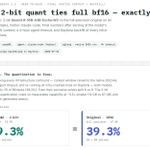
After removing infrastructure confounders, Escha 2-bit matched BF16 exactly: 39.3% task success.
The more surprising result: in the 128K-context run, Escha used 24% fewer output tokens - 4.53M versus 5.97M for BF16 - while solving the same number of tasks.
We’re grateful to the team for the rigorous evaluation and permission to share the results.
More to come!


Part 1 here:
teapawt.net/Eschalabs/status/20830…
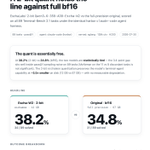
Our friends @hara_shimpei and the team at AI& independently evaluated Escha's 2bit Qwen 3.6 35B on Terminal-Bench 2.1, a challenging benchmark for agentic coding, and kindly agreed to share their findings.
AI& will also test the model at longer context lengths, including 128K+, where quantization quality becomes more difficult to preserve. We’ll share those results when they are available.
We’re grateful to AI& for the rigorous independent evaluation - and welcome others to share their findings!


6
1,029