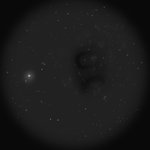
M 20 or Trifid Nebula for it internal shape of dark lanes full of dust. It’s an emission and reflection nebula where the emission is embedded in the reflection part. Therefore under pristine skies it not recommended to use filters, because the reflection part will be blended out.
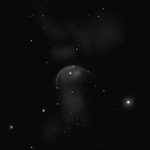
The so called “Bubble-Nebula” seen through a 20” Dobson from the isle of La Palma last December. No filter was used. Interestingly the whole Bubble could no be seen.
Curves adjusted to bring out the #comet better. Hopefully you can see it better now.
5
341
And another shot of the Moon & C/2023 A3 (Tsuchinshan-ATLAS). Sony A6000 using E70-350mm zoom lens @f4.5, f=70mm, 1 sec exposure.
1
3
420
Barnard 142 & 143 is a dark cloud in Aquila. The sketch shows the visual appearance of that beautiful nebula seen through my 4 inch Apo using a 3 inch 100° ES eyepiece.
Sh 2-294 is also known as the octopus nebula. Visually it’s not so obvious but a relatively large nebula can be spot with a 25” Newton without filters at 100x. UHC can be used to enhance contrast but is not necessarily needed. Finally I observed the nebula at 178x & 125x.
NGC 6563 is a small planetary nebula that shows some structure inside using a 25 inch telescope. Two stars inside the nebula itself can als be spot. 670x.
IC 349 was discovered visually by famous observer E. Barnard. With modern telescopes and high magnification the nebula appears as shown in this sketch as a tiny oval shaped disk very close to Merope. I used a 20” Dobson at 1200x.
This is M 95 a barred spiral galaxy which I was able to observe on my December trip to La Palma. I used a 20 inch telescope at 350x.
This is the view to south in Namibia 🇳🇦 (at Tivoli Astrofarm) when the historic geomagnetic storm of May 10-11, 2024 hit the earth.
And another picture showing the entire sky that night. Tivoli Astrofarm S 23° 27' 40" / E 18° 01' 5"
Estelar retweeted
Sketch of #orionnebula made by 20" telescope. To make this sketch I had to observe for 4h totally during 3 different nights.
The Fornax Galaxy Cluster can be spot very easily. At 100x using a 20 inch Dobson I could see a dozen galaxies, most of them bright with starlike centers. Most of them can be observed even in smaller telescopes I would guess a 8 inch 🔭 is sufficient.