

We are creating the future.
Joined October 2022
- Tweets304
- Following349
- Followers18.5K
- Likes69




Pinned Tweet
TON618 v1.1 reports a parameter-free cosmological solution producing:
• H₀(local) = 73.52 km/s/Mpc
• H₀(CMB) = 67.39 km/s/Mpc
• fσ₈(z=0) = 0.4224
• Δχ² = −69.85 vs ΛCDM in tested sectors
Most notably, the framework produced H₀ = 73.52 months before a major independent 2026 observational result converged on H₀ = 73.50 ± 0.81.
Open-source cosmology, reproducible computation, and testable thermodynamic gravity models may become increasingly important in the next generation of cosmological research.
Read more:
dispatch.com/press-release/s…
#Cosmology #HubbleTension #Astrophysics #OpenScience #Physics

From cosmological physics to algorithmic decision-making: An executive Q&A with Joel Almeida - CEO ExtractoDAO Labs
msn.com/en-us/technology/gen…

132

0.618: The Number That Explains How Galaxies Grow
New paper published in Quantum Reports:
The Almeida Growth Index — γA = 0.618 — emerges as a fixed prediction of the Dead Universe Theory, not as a fitted parameter
The asymptotic attractor and stability conditions developed in this work provide the constant that was missing from General Relativity.
📄 mdpi.com/2624-960X/8/4/102
📄 PDF: mdpi.com/2624-960X/8/4/102/p…
#cosmology #DUT #GrowthIndex
144
Effective Ξμν Closure and the Almeida Growth Index: γA = 0.618 as a Distinct Alternative to the ΛCDM Growth Index (γ ≈ 0.55) mdpi.com/4114462 #mdpiquantumrep via @QMdpi

New paper published in Quantum Reports:
The Almeida Growth Index — γA = 0.618 — emerges as a fixed prediction of the Dead Universe Theory, not as a fitted parameter.
📄 mdpi.com/2624-960X/8/4/102
The asymptotic attractor and stability conditions developed in this work are now applied in DUT Financial for decision-making.
📄 mdpi.com/2624-960X/8/4/102
📄 PDF: mdpi.com/2624-960X/8/4/102/p…
#cosmology #DUT #GrowthIndex
121
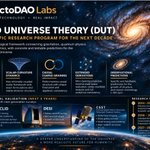
2027 marks the next phase of the Dead Universe Theory (DUT) research program.
Since its first publication in 2024, DUT has evolved from a cosmological hypothesis into a broader theoretical and computational research program, with new derivations connecting scalar-curvature dynamics, thermodynamics, causal coarse-graining, and the parameter-free Almeida Growth Index, γA ≈ 0.618.
The next stage is clear: deepen the microscopic foundations, expand computational testing, and confront DUT predictions with the new generation of cosmological observations from Euclid, DESI, and CSST/Xuntian (Chinese Space Station Telescope) over the coming years.
The equations make predictions. The observations will decide.
ExtractoDAO Labs | Science • Technology • Real Impact

168
In 2027, ExtractoDAO Labs intends to fund researchers interested in contributing to this research program.
Researchers interested in participating should begin by examining the preprint:
preprints.org/manuscript/202…

228
Official Statement
ExtractoDAO Labs does not have a cryptocurrency, token, ICO, DUT Token, DEFI, or any crypto asset available on the market.
We are a DeepTech company developing proprietary technologies in Scientific Computing, Computational Physics, and Quantitative Technology.
We are not affiliated with any token, exchange, or third party claiming to represent ExtractoDAO Labs.
Please do not purchase any cryptocurrency or digital asset using our name.
Official information is published only at:
🌐 extractodao.com

1
263

TON618 v1.1 OPEN-SOURCE COSMOLOGY ENGINE CONSISTENT WITH LATER HUBBLE TENSION OBSERVATIONS- reports a parameter-free cosmological solution producing:
• H₀(local) = 73.52 km/s/Mpc
• H₀(CMB) = 67.39 km/s/Mpc
• fσ₈(z=0) = 0.4224
• Δχ² = −69.85 vs ΛCDM in tested sectors
Most notably, the framework produced H₀ = 73.52 months before a major independent

he Hubble tension is real — and it’s not going away.
A collaboration of 37 researchers (H0DN, 2026), using local distance ladder methods (Cepheids + Type Ia supernovae), reports:
H₀ ≈ 73.5 ± 0.8 km/s/Mpc (~1% precision)
Meanwhile, early-universe predictions from ΛCDM (CMB-based analyses) remain at:
H₀ ≈ 67 km/s/Mpc
That’s a discrepancy of over 6 km/s/Mpc — far beyond statistical uncertainty.
After years of cross-checks (Cepheid calibration, selection bias, photometry, extinction models), the tension persists — and is becoming increasingly robust.
We are left with two possibilities:
• A subtle, unidentified systematic error
• New physics beyond ΛCDM
This is no longer a small anomaly — it’s a structural inconsistency in modern cosmology.
Any consistent framework must reconcile both regimes: local expansion and early-universe constraints.
Ignoring it is no longer scientifically defensible.
1
151


Einstein’s physics is no longer a complete theory of the Universe.
And the scientific community knows it.
General Relativity remains one of the most successful theories ever written — locally. It predicts planetary motion, gravitational waves, and lensing with extraordinary precision. But as a global theory of the Universe, it is no longer sufficient.
This is not a controversial statement inside physics. It is simply one that is rarely said out loud.
Cosmology today survives through layers of effective fixes: inflation to repair initial conditions, dark matter to stabilize structure, dark energy to force expansion. None of these arise naturally from Einstein’s equations. They are add-ons, not consequences.
More tellingly, the cracks are widening, not closing:
the Hubble tension persists,
structure growth tensions remain,
early massive objects appear too soon,
and increasingly complex parameters are required to maintain consistency.
When a theory needs more assumptions every decade to explain the same Universe, it is no longer fundamental — it is phenomenological.
This does not mean Einstein was wrong.
It means his theory reached its domain of validity.
The real problem is not scientific — it is institutional. Admitting that General Relativity is incomplete at cosmological scales forces a deeper question: what replaces it? And that question has consequences for careers, pipelines, and decades of accumulated interpretation.
So the system prefers delay over rupture.
Over the next ten years, physics will likely change its language before it changes its foundations: more talk of emergence, entropy, information, and effective geometry — without openly declaring a paradigm shift.
But make no mistake:
the shift is already happening.
Not because of belief.
Because the Universe no longer fits inside the old frame.

1
71
TON 618 IS NOT A “RECENT PROBLEM.”
identification in the Tonantzintla catalogue (1957) and its recognition as an extreme quasar (1970), its size has been incompatible with slow hierarchical growth. In 2004, when its mass was estimated at ~10¹⁰ M☉, the crisis became explicit — 18 years before JWST.ΛCDM has never explained TON 618.
SOLUTION ARTICLE: zenodo.org/records/18776015
It only reacted:
• ad hoc super-Eddington accretion
• improbable merger histories
• post-hoc parameter adjustmentsThe Dead Universe Theory (DUT) does the opposite.
It predicts objects like TON 618 as primordial direct-collapse structures, regulated by viscoelastic dissipation of the vacuum — not by accretion time.The same framework that:
• explains TON 618
• predicts mature SMBHs at high redshift
• anticipated GN-z11 and JWST z > 10 results
• fixes γ = 0.618 without fittingwas mathematically complete before recent observations.TON 618 is not an anomaly.
It is a cosmological fossil.
And fossils do not form “too late” — they survive.ΛCDM reacts.
DUT anticipates.#TON618 #Cosmology #JWST #BeyondLCDM #DeadUniverseTheory #OpenScience #DeSci

1
94
"The Dead Universe Theory (DUT) predicted since the 2016draft ( formalized 2024+): the universe is asymmetric due to irreversible thermodynamic retraction—not eternal symmetric expansion. zenodo.org/records/18704702 create thermodynamic cavities in the dead substrate (Ξ_{\mu\nu}), generating directional dipole and cosmic infertility (dN/dt < 0). Now corroborated! Nathan Secrest et al. (Rev. Mod. Phys. 2025) confirm cosmic dipole anomaly >5σ: matter dipole 2–3× larger than expected kinematic from CMB, direction aligned with Axis of Evil. DUT explains it as an entropic signature of a structurally decaying cosmos. ΛCDM in serious check! Secrest paper: arxiv.org/abs/2505.23526 #DeadUniverseTheory #DUT #CosmicDipole #AsymmetricUniverse #Cosmology #JWST"

73
The Death of the Genius
It is undeniable that technology has overtaken the genius of the blackboard, and looking to the past, we see an era of myths—names like Einstein, Friedman, and others. In the past, the limitation of science was mental processing; today, the bottleneck has shifted to asking the right question. Before, the genius was the one who could solve the equation on paper; now, the genius is the one who knows which equation should be built and how to interpret what algorithmic intelligence delivers. We are living through the transition from "paper-and-chalk science" to "processing science."
A formal education in astrophysics based solely on the blackboard is, in a very specific sense, becoming obsolete for cutting-edge research. There is little reason to invest time and resources in mastering obsolete calculations that are no longer necessary, as they exist ready-made to be executed by an algorithmic intelligence. Manual calculation, which was once the "arm" of mathematics, has been surpassed in the realm of high-level scientific production. No one manually calculates a black hole orbit to publish a paper anymore. The blackboard today serves primarily a pedagogical role—to build fundamental intuition. But for actual progress, it has been overtaken by the speed of silicon.
So, the future belongs to computational physics, and this will allow men and women who might not have been considered geniuses in the past to achieve results that were once the exclusive domain of a few brilliant minds. Computing and AI function today as a true exoskeleton for the mind. If before we needed an exceptional IQ to grasp the curvature of spacetime through complex tensors, today visualization and simulation tools allow a person of average intelligence to comprehend the phenomenon visually and experimentally. Knowledge is ceasing to be an individual gift and is becoming an available computational resource.
However, this new era brings with it a significant danger: the risk of mental laziness. The temptation to have everything ready and wait for answers provided by algorithms can lead the human mind toward a regression. If we abdicate the effort of thinking, we risk a new kind of dark age, where we become intellectually dependent on our own creations. It is essential to remember that, even with all the power of computation at our fingertips, the true glory and greatest conquest of humanity lies in the very act of studying and exercising the mind. The certainty of having the results pre-calculated should not be an excuse to stop learning, but rather an opportunity to ascend to higher levels of questioning.
Perhaps this is the great leap for humanity: to make the complex uncomplicated for the common man. This removes physics from the pedestal of the "sacred" and brings it into the realm of a practical tool. The modern challenge will no longer be "being a genius" in the classical sense, but rather being creative and having critical thinking to guide the machines. The genius of the blackboard is dying so that science can finally belong to everyone—but only if we remain vigilant, ensuring that the tool does not atrophy the very mind it was meant to empower.
Article: zenodo.org/records/18544627
Article: zenodo.org/records/17752029
Joel Almeida, Ph.D - Cosmologist, Computational Astrophysicist, and Software Architect

1
1
77
The Physical Foundations of the Viscoelastic Continuum (DUT)
Preprint: preprints.org/manuscript/202…
Most importantly: DUT makes a sharp, testable prediction for structure growth:
👉 γ = 0.6180339887 (golden ratio) — a fixed, parameter-free line of falsification.
With Euclid, DESI, and Roman, the verdict is coming. If γ → 0.55, DUT falls. If γ → 0.618…, a new paradigm stands.
Preprint: preprints.org/manuscript/202…
What if the universe didn’t “begin” with a hot Big Bang — but emerged from a silent, coherent state Ψ₀?
In DUT, the observable cosmos arises through quantum decoherence of a primordial, non-dynamical substrate. This transition unlocks time, generates a viscoelastic structural tensor Ξₘᵥ, and hierarchically gives rise to geometry, matter (as topological defects), and light itself.
No fundamental dark energy. No singularity. No arbitrary micro-chronology — only a minimal, physically derived instability scale.
Most importantly: DUT makes a sharp, testable prediction for structure growth:
👉 γ = 0.6180339887 (golden ratio) — a fixed, parameter-free line of falsification.
With Euclid, DESI, and Roman, the verdict is coming. If γ → 0.55, DUT falls. If γ → 0.618…, a new paradigm stands.
Preprint: preprints.org/manuscript/202…
#DUT #Cosmology #Decoherence #Euclid #CMB #NewPhysics

76
🚨 HISTORICAL BREAKTHROUGH IN THEORETICAL COSMOLOGY 🚨
For the first time in more than a century of modern cosmology, the Dead Universe Theory (DUT) predicts an exact, mathematically derived value for the cosmic structure growth index:
γ = (√5 − 1)/2 ≈ 0.6180339887
zenodo.org/records/18448863
No free parameters. No empirical fitting. It emerges directly from the thermodynamic attractor of the viscoelastic substrate Ξ_μν, unifying gravity, thermodynamics, and the arrow of time within a single theoretical framework.
While the ΛCDM model predicts γ ≈ 0.55 based on General Relativity, DUT offers an equally rigorous yet radically different alternative — one that emerges from a primordial universe without singularities, without inflation, and with an extended chronology (~180 Gyr).
Now, the ball is in the data’s court. Next-generation observations — DESI, Euclid, the Roman Space Telescope — will have the precision needed to decide between these two paradigms.
If γ converges to 0.618..., we will have strong evidence that the universe does not expand — it relaxes thermodynamically.
If it converges to 0.55, DUT will be falsified, and ΛCDM will be strengthened.
This is the kind of clear, falsifiable prediction that moves science forward. DUT does not seek to replace the standard model through parameter tuning, but through internal logic and testable consequences.
Cosmology stands once again at the threshold of a possible revolution. And this time, the answer will come not from conjecture, but from a simple equation:
γ² + γ − 1 = 0
The future of data will tell which vision of the universe remains standing.
Source: Almeida, J. (2026). The Physical Foundations of the Viscoelastic Continuum (DUT): Quantum Decoherence as the Origin of the Dead Substrate. ExtractoDAO Labs.

1
188