

Monitoring and reporting on the FDLR threat in eastern DRC
Joined January 2020
- Tweets29
- Following14
- Followers1.3K
- Likes103






Floribert Anzuluni presented Kinshasa’s deal with the FDLR as a step toward peace. In practice, it amounts to legitimizing a genocidal militia. Since the 30 May agreement, there has been no tangible disarmament. The deal also sits outside the framework of the Washington Accords. Until the FDLR is neutralised with visible proof on the ground, calls to lift Rwanda’s defensive measures put the sequence in the wrong order. #fdlr #Freecongo #Rwanda
Three months after Kinshasa announced its FDLR protocol, Washington convened DRC and Rwandan military planners in Garmisch to draft an Operations Order for neutralising the FDLR.
The statement makes no mention of the protocol Minister Anzuluni has been presenting abroad as proof of delivery.
Planning a military operation suggests Washington does not see that protocol as a workable path. The Accords require the DRC to neutralise the FDLR, not negotiate the terms of its disarmament.

From October 20 to 22, the United States convened military planners from the Democratic Republic of the Congo and Rwanda @Marshall_Center in Garmisch, Germany, for the Joint Security Coordination Mechanism (JSCM) Operations Order Conference. The African Union, Qatar, and U.S. interagency partners joined the delegations as they addressed the security obligations at the core of the Washington Accords for Peace and Prosperity. Thanks to @USAfricaCommand and @AfricaACSS for helping guide the participants towards a successful outcome.
The delegations followed through on a commitment they made at the sixth JSCM meeting in August, working to finalize a draft Operations Order for approval. The order will guide the neutralization of the FDLR by the DRC and the disengagement of forces and lifting of defensive measures by Rwanda. We welcome their constructive engagement as they work toward achieving lasting peace and shared prosperity under the Washington Accords.
“FDLR is not just a threat to Rwanda, it’s an existential threat.”
South Africa’s High Commissioner to Rwanda, Tinyiko George Hlungwane, affirms Rwanda’s right to defend itself and protect its territorial integrity.
🎥: via @NewTimesRwanda
FDLR Tracker retweeted

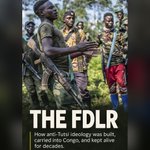
The FDLR rebel group in DR Congo continues to promote anti-Tutsi ideology decades after Rwanda’s 1994 genocide, with former officers revealing how ethnic hatred fuels regional tensions. aljazeera.com/news/2026/10/2…

FDLR Tracker retweeted

The cost of Hating on Rwanda is becoming increasingly high . While they were still drafting the same thread, Amavubi beat Liberia 3-1 and came from behind to win 2-1 in Praia.
Reports landed that Formula 1 is lining Rwanda up for a 2030 race near Bugesera.
MINAFET signed eight deals with Oman, three with Togo, and eleven with Kenya. Malawi’s staff college showed up at RDF headquarters to study how the place is run.
That is the part they never post.
Nyabarongo II, 43.5 MW, is about 75 percent done.
Muvumba dam is at 69 percent.
A steel plant opened in Musanze.
Cabinet cleared a Chery electric-vehicle plant, the next phase of the Kigali dry port, and cold storage in Rubavu.
Bugesera airport is still on track.
New coffee varieties were announced at five to seven tonnes a hectare.
Electricity access is around 85 percent.
So the timeline stays the same. Complaint in the morning, a power plant, a factory, or another agreement by evening.
I really feel sorry for haters!
Good job @UrugwiroVillage @RwandaOGS @PrimatureRwanda @CityofKigali @RDBrwanda
& other institutions working hard everyday and especially the @RwandaMoD2 that safeguards all these achievements

FDLR Tracker retweeted

Point de presse | Corneille Nangaa à propos de leur objectif et de leur vision:“L'objectif déclaré de l'AFC est de contribuer à restaurer la dignité, à réformer l'État et à ouvrir un avenir commun,tout en appelant à la coexistence pacifique entre les différentes communautés” #RDC


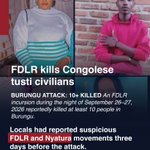
this 26th-27th September, a new FDLR and Nyatura incursion was reported in Burungu, again targeting Congolese Tutsi. The village was already burned in October 2023.
Back in June, the FDLR raided Karenga at night and about ten people were killed, including several Congolese Tutsi. Since January, similar attacks have been reported in Kalehe, Mahanga, Ngungu, Nyiragongo and Rutshuru, with deaths, burned homes and slaughtered cattle. How can displaced Tutsi return when their villages remain exposed?
FDLR is not only waging war in eastern DRC but it is also carrying it's true intention, the extermination of tutsi's
#FDLR #Rwanda #DRC #Freecongo

Where are the weapons surrendered? Where are the units cantoned? Where is the verified end of FARDC-FDLR operational coordination and support?
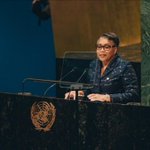
These are the questions Judith Suminwa’s UN speech leaves unanswered.She presented the 30 May agreement with FDLR and the September repatriation of 120 FDLR-associated people as evidence that Kinshasa is dealing with the problem.But nearly four months after FDLR agreed to lay down its arms, those 120 people include dependants, while FDLR’s fighting force is estimated in the 3 to 4 thousands. More importantly, there is still no independent public evidence that the FARDC-FDLR military relationship documented by UN experts has ended.
The latest UN reporting documented FARDC supplying FDLR with military equipment, maintaining liaison officers with its leadership and coordinating operations with its fighters. Previous reporting described FDLR as a key FARDC ally, operating alongside FARDC/Wazalendo and even jointly with FDNB.
Signing an agreement is one thing. Dismantling an armed group and ending the military relationship that sustained it is another.
Until there is evidence of large-scale disarmament, cantonment and an actual end to FARDC-FDLR cooperation, Kinshasa cannot point to a document and a limited repatriation as proof that the FDLR question has been resolved.

President Ndayishimiye told France 24 that FDLR is a “pretext,” suggesting Kinshasa cannot neutralize it because its forces are largely in AFC/M23-held territory.
But the evidence tells a different story.
The UN Group of Experts (S/2025/446) documented FDLR fighters operating “jointly with FARDC, VDP/Wazalendo and/or FDNB”, while describing FDLR as a key FARDC ally, strengthened by transfers of FARDC military equipment.
Today, the same military architecture remains visible in South Kivu.
The latest UN reporting documents FDNB fighting alongside FARDC and Wazalendo on the Uvira–Fizi–Minembwe axis. Meanwhile, on 3 March 2026, the FDLR High Command itself issued a communiqué from Uvira, explicitly reiterating its support for FARDC.
The pattern is difficult to ignore:
FDLR + FARDC/Wazalendo.
FDNB + FARDC/Wazalendo.
FDLR + FDNB previously documented operating jointly.
Same theatre. Same military adversary: AFC/M23.
And when AFC/M23 advanced through longstanding FDLR positions, UN reporting documented FDLR formations being defeated, displaced and retreating toward areas such as Walikale, not becoming allies of the force pursuing them.
The relevant question therefore isn't whether scattered FDLR elements can exist behind M23 lines.
It is why FDLR and FDNB repeatedly appear within the same government-aligned military architecture, fighting the same enemy, when Burundi says its forces are in Congo to fight foreign armed groups such as FDLR.
That contradiction deserves an answer.

FDLR Tracker retweeted
🚨 Mpox au Kasaï 🇨🇩
La province du Kasaï fait face à une épidémie de mpox. Cinq zones de santé sont déjà touchées, dont Kanzala, qui couvre une grande partie de Tshikapa, chef-lieu de la province. #Mpox #Kasaï #RDC #SantéPublique

FDLR Tracker retweeted

Police in Democratic Republic of Congo fired of tear gas and warning shots as hundreds of people protested in the capital Kinshasa against proposed constitutional changes that could allow President Felix Tshisekedi to run for a third term reut.rs/4xv8Vwb
FDLR Tracker retweeted

Commandant Erick Prince, alias « Solution »
En guerre, l’expérience compte…
Surtout quand on a une armée faible de clochards @FARDC_officiel

Rtd Lt Col Emilien Mpakaniye, who handled resource mobilization inside FDLR, details the group's funding streams: support from the Congolese government, contributions from the Rwandan refugee diaspora worldwide, and illicit mining operations FDLR controls in eastern DRC. His account lays out how the group sustains itself financially despite years of military setbacks. #FDLR #RWANDA #DRC #Easterncongo
Rtd Lt Col Emilien Mpakaniye, known inside FDLR as 'Che Guevara Jacob.' For 12 years, he lived inside the group first as a bodyguard protecting senior FDLR leadership, later as an internal evangelist preaching to fighters, and eventually as the officer handling resource mobilization, meaning he knew exactly how FDLR funded and sustained itself. Born in Karongi, Rwanda, he fled in 1994 in the aftermath of the Genocide against the Tutsi. He spent years embedded in the group before finally returning home through the Mutobo Demobilization and Reintegration Center in 2019. Today, he's one of the clearest firsthand voices explaining how FDLR actually functions not as scattered remnants, but as a structured, self-sustaining organization. #FDLR #RWANDA #DRC #Easterncongo

Col Augustin explains FDLR is no longer just ex-FAR. He himself was never part of ex-FAR — proof the group's recruitment has shifted. He says FDLR recruits by ideology, not by age or prior affiliation, showing how the extremist group sustains itself beyond its original founders. #FDLR #Rwanda #DRC #Easterncongo