

The Fluorescent Protein Database. tweets by @TalleyJLambert
Joined January 2019
- Tweets129
- Following1
- Followers1.5K
- Likes121






Hi Fluorescence friends!
Please follow future updates on Bluesky:
bsky.app/profile/fpbase.org
They all retain the alias mStayGold, and so will all still show up when one searches for "mStayGold"

FPbase retweeted

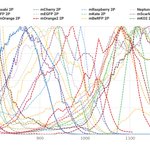
This exercise was less informative than I'd hoped, but perhaps it's interesting to someone else: spectroscopically-inferred estimates of densities of states for a selection of fluorescent proteins spanning the visible spectrum. Data from @FPbase.


FPbase retweeted

Mutagenesis of #FbFP #LOV domain:
🟠 22 variants with 486-512 nm emission maxima
🟠 three-channel imaging via spectral unmixing
🟠 two-channel fluorescence lifetime unmixing
doi.org/10.1101/2022.12.09.5…
Congratulations, @ivangushchin, @Aynya5, and all the authors!
@FPbase

took a look, there are 90 2P spectra currently available in the database. So, this is a user interface problem rather than a data storage problem 😬 ... (GM units are also stored in the database, but easily accessible) my apologies!

If the data has been published but is missing from the corresponding fpbase page, you can add it at fpbase.org/submit/
(User submissions are how FPbase gets populated)
No not each molecule, but Misha Drobizhev contributed the majority of the 2P cross sections he’a collected (🙏!). So if the 2P data is published, it should be available on the respective FP page.
Yeah it’s a common request (so little time). There’s lots of 2P data in fpbase, do you just want like a dedicated page to make it easier to find for example?
FPbase retweeted

Our article reporting hyperfolder YFP (#hfYFP) and other fixative-resistant fluorescent proteins based on #mGreenLantern is now available at @naturemethods. hfYFP enhances electron- and expansion-microscopies, protein purification, and so much more! 🧵nature.com/articles/s41592-0…

Chapter on using FPbase tools out now in the MMB issue on FPs. Thank you for editing @mayankdu!

Happy to share the Methods in Molecular Biology issue on Fluorescent Proteins 🌈🎉😀. Including many “much awaited” protocols on and about Fluorescent Proteins/applications. A big THANKS to authors across the globe for contributing. 👏🏻💐
link.springer.com/book/10.10…

FPbase retweeted

this is genius: @helsinkiuni BioImaging Unit utilizes @FPbase to allow users test their fluorophores
fpbase.org/microscope/u4gqNc…
cc @Daniel_Wa19

That would be 50% of max Extinction coefficient (not QE). If you’re asking whether it “works”, it will be case-specific. Will require more illum power, so more damaging to sample. And may generate more background, depending on sample. But with enough power you’ll get photons :)
FPbase retweeted

🥁 Delighted to announce that our FPCountR paper is now on bioRxiv!
In this paper we describe the development of a method to allow absolute fluorescent protein quantification using microplate readers for synthetic circuit characterisation.
biorxiv.org/content/10.1101/…
🧵

Always nice to see features put to use!
@eszter_cs and @gbstan use the FPbase API (among other things) in a method for the calibration of fluorescence readings on microplate readers; for quantification of FP concentration
biorxiv.org/content/10.1101/…
