

Runciter Cybernetics
Joined July 2020
- Tweets4.1K
- Following6.7K
- Followers1.1K
- Likes7.2K


Pinned Tweet
DragonWing-rs
Rust libraries for the @arduino Uno Q platform
featuring:
* Post-Quantum Cryptography
* Anonymous credentials
* Secure storage
* Phone integration via Arduino IoT Companion App
github.com/FeurJak/DragonWin…

Taras Woronjanski retweeted

I'm open-sourcing my Charizard ESP32-S3 dev board
heypcb.ai/store/charizard

Taras Woronjanski retweeted

Announcing Dagger 1.0 beta.
Replace Jenkins and GitHub Actions with CI that matches the speed and scale of coding agents without wasting compute or tokens.
Featuring: test-native CI, dev shells, local and remote execution, official modules, and more.
dagger.io/blog/dagger-10-bet…
Taras Woronjanski retweeted

微软也加入了开源 sandbox 的战局,跨平台的轻量级 microvm 实现。
无论是 Windows 还是 Linux 都可以跑,应该也是 azure sandbox 的底层开源实现
github.com/microsoft/nvx

Taras Woronjanski retweeted

btw leaf can open readable webpages too. Paste an article link and read it like a doc.

Taras Woronjanski retweeted

How do you _guarantee_ your agent's code is correct? You prove it.
Introducing Proof Driven Development Kit (PDD Kit) from @MSFTResearch.
PDD Kit helps turn your plan into a formal spec, then proves the agent's code meets that spec for every input. No vibe verification. PDD Kit is integrated with @GitHubNext's Chopin, so you can plan as a team.
PDD Kit takes an app's login flow from intent to a verified pull request:
It discusses your code, infers your intent as it goes, and proposes a formal spec in Verus, a proof language for Rust.
Once you approve the spec, the Verus verifier automatically proves the code meets it.
Where proof isn't possible, it falls back to empirical verification with tests and computer-use agents (CUAs).
It works on Rust today. No new language, no change in how you produce the underlying code, making formal methods more accessible.
The goal is a verified software factory, where engineers review specifications instead of code.
Come see it in action at GitHub Universe, Oct 28–29. Swing by the Speakeasy and ask for GitHub Next!
Taras Woronjanski retweeted

1/ Today we’re releasing Aerie: fast post-quantum signature aggregation, using lattice-based SNARKs for lattice-based Falcon signatures. On a laptop (CPU only), it aggregates roughly a full Ethereum slot’s worth of signatures (32,768) in 0.65 seconds.
Taras Woronjanski retweeted

An overview of how we think about context graphs at @harvey.
Context graphs are a promising direction for improving agent quality and efficiency. We ran a series of experiments on Legal Agent Bench to evaluate how structured context improves online agent performance.
For each LAB task we evaluated, an agent first reviews each document in its client matter and builds a graph of relevant entities and their relationships – e.g. parties, dates, draft vs. executed status, which versions belong to the same contract.
To evaluate the impact of the graph, we compared the performance of an agent with and without the context graph, using LAB’s standard grading setup. Overall, the agent with the context graph improved rubric pass rate by up to 30% while reducing task cost by up to ~50%.
In some cases the graph led to massive improvements. For example, in one firm-knowledge task, the agent was asked to find the firm’s most recent secured financing and retrieve the executed credit and security agreements as precedents for a new facility.
An agent working from raw files attempted to search through several files sequentially, and looked at many different matters, but ultimately selected the wrong precedent (0% of rubric criteria). With the context graph, the same agent found the relevant matter and its executed agreements immediately (75% of rubric criteria).
We’ll have more to share soon on how we’re building this into Harvey, along with more experiments like this one!
Taras Woronjanski retweeted

Introducing Magnetar from Microsoft Research, the first zkVM that is: (1) general-purpose (RV64), (2) post-quantum from standard hashes alone (no curves, no lattices, no Poseidon), and (3) built for recursion.
Despite its conservative security, it is the fastest zkVM: 7.2–8.7 MHz on a laptop, 10–39× faster than existing zkVMs across 15 workloads! An optimized version reaches 9.5–12.8 MHz.
Links in the thread below.
Taras Woronjanski retweeted

Meet sgrep, a fast, fully local ripgrep extension built to make agents cheaper and more accurate.
on our SWE-bench Verified eval, sgrep reduced LLM API cost by 21.3% versus ripgrep, solving 70 of 100 attempts versus 68.
Taras Woronjanski retweeted

I'm glad to share that our book on zero-knowledge protocols now has a full chapter on post-quantum zero-knowledge proving systems with over 100 pages!
It covers lattice-based Σ-protocols, LaBRADOR, and ZK-STARKs, with all the necessary prerequisites included.
Link below 👇


Taras Woronjanski retweeted

I've published a new, general-purpose terminal specification that gives any program a way to tell the terminal what it's doing: idle, working, waiting, finished, or failed, and why. It is easy to implement on both sides. I've written more about why: mitchellh.com/writing/progra…
The problem this solves is generic and applies in compelling ways to all sorts of use cases (e.g. package managers, build tools), but it really rears a hideous head when it comes to AI and the "agentic inbox" problem.
I found over 250 different agent orchestrators (with various goals) that all individually implement a heuristic based approach to detecting whether things like Claude Code are working, blocked, done, etc.
If you look at @herdrdev's commit history, you can see around 10 compatibility changes to detect Claude Code within just the past 3 months. (This isn't a dig at Herdr! They're doing great work with what they have, and everyone else is doing the same thing).
Heuristics are not the way. And over-indexing on agentic use cases isn't the way, because this problem is really interesting for other tools too: Homebrew, Terraform, Cargo, etc. etc.
Proprietary protocols and out of band APIs are not the way. They have an O(N) integration problem and require extra work to work over SSH or within local VMs/containers.
The program status specification (OSC 7501) solves this in a reliable, deterministic way that is general-purpose and can be easily adopted by the entire industry.
Read more: mitchellh.com/writing/progra…
Taras Woronjanski retweeted

Announcing hashsma.sh! 𝟘 𝟙 ❒ 🔨
Strengthen cryptography with AI.
Cryptography—both current and post-quantum cryptography—depends on hashes. SHA-256? SHA-3? BLAKE3? Nobody knows if they are secure. We're going to find out!
Come help accelerate scientific research!
HashSmash is an open science-acceleration project in collaboration with @yukonresearch, @eigenlabs, @projecteleven, and @ShieldedLabs.
Taras Woronjanski retweeted

Here are some old boring ideas applied differently. And agree that compile/deploy/restart can be compressed. Me and my team at @datadoghq are researching a runtime that has such compressed loop.
xitter.cf/nerdsane/status/210391…
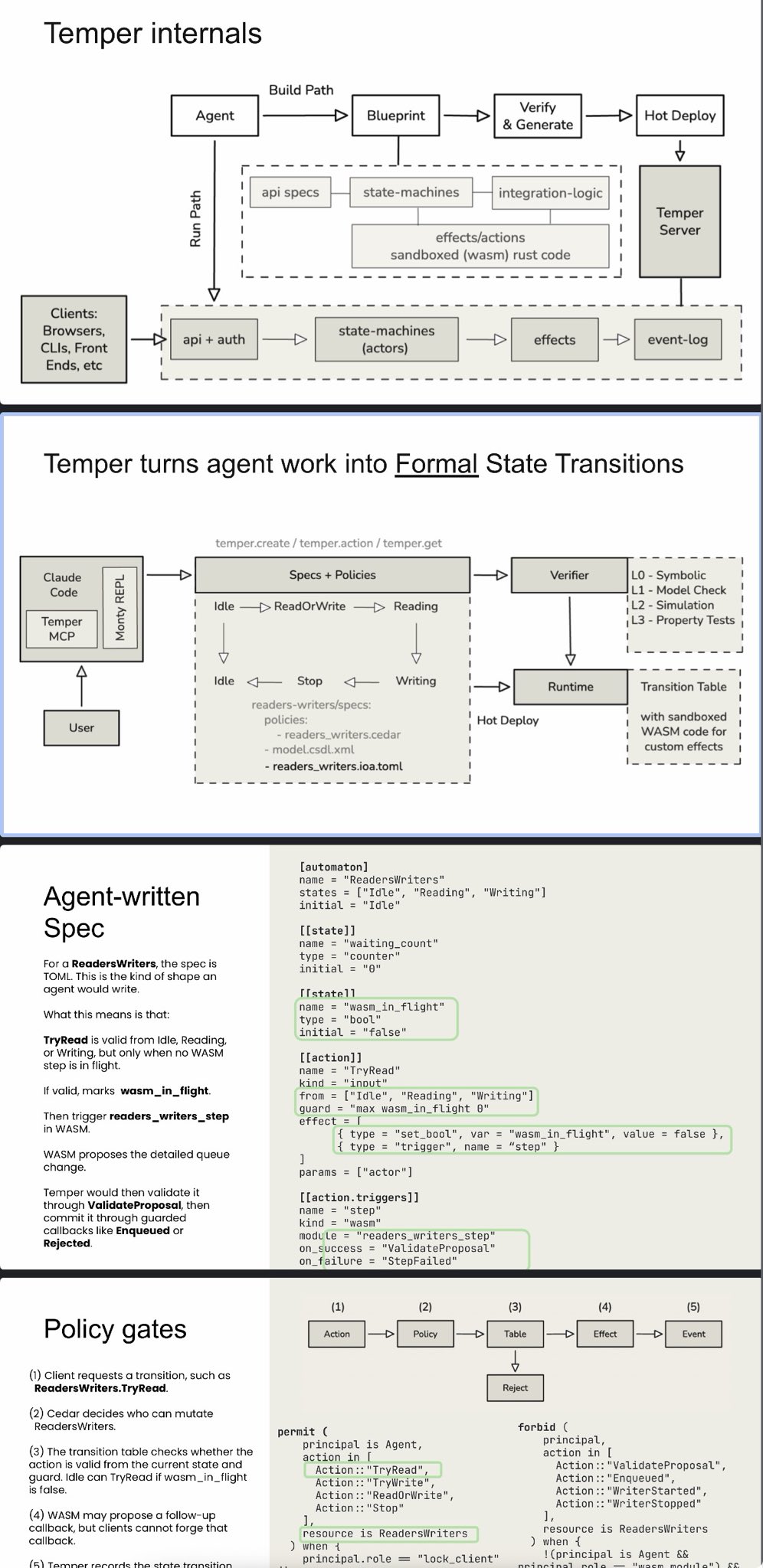

dear young farts out there
who have grown up with Docker/Kubernetes and the compile/restart/deploy phases of CI/CD. Did you know that the entire loop can be squashed but hasn't been because of the VC [1] industrial complex (tm)?
please stop arguging that golang/existing prior will win because it won't. nearly all programming languages are roughly the same idea but in a different bikeshed paint edition. what comes next will be an old [2] idea, [3] applied differently.
[1] lol chuckling here but somewhat directionally true over time.
[2] actors/repair the image (don't rebuild it)
[3] designed for llms as programmers, not humans
Taras Woronjanski retweeted

It's an underappreciated triumph of Ethereum client developers that PeerDAS has now been running for nearly a year with basically no problems.
PeerDAS was a complex task: it's the first large-scale instance of a blockchain that achieves consensus on the availability of data without needing any single node to download the entire block. Decentralized consensus without replication.
And yet, it worked.


Taras Woronjanski retweeted

Your iPhone can now run Python, Node.js, FFmpeg... and even Clang 🤯
Introducing the Wasmer SDK for Swift:
→ Run Sandboxes inside any iOS or macOS app
→ 100% on-device. No servers.
→ Near-native speed
No JIT required. Here's how 👇
wasmer.io/posts/wasmer-sdk-s…
Taras Woronjanski retweeted

GPU architecture | LLM Inference Handbook
handbook.modular.com/kernel-…
Add this to your LLM learning resource bundle.
"Before writing or tuning GPU kernels, you need a working model of how a GPU runs code. Without it, suggestions like “increase occupancy” or "reduce shared memory bank conflicts" are just a set of rules to memorize. You don't fully understand when they apply and when they don't.
This section explains modern GPU architecture at the level needed for kernel work. The details lean toward NVIDIA hardware because CUDA dominates much of the LLM inference ecosystem today. However, the core concepts apply broadly to AMD GPUs and other parallel accelerators as well."

Taras Woronjanski retweeted

LaBinius: Lattice-based Polynomial Commitment Scheme over a Binary Field.
Excited to present LaBinius, my recent work with @gregor_seiler.
We show how to instantiate an Ajtai commitment over extremely efficient cyclotomic power-of-three rings and then connect it with a polynomial opening mod 2, so that R/2R is a binary field.
Such a PCS is bridged with SOTA frontends, including Flock and Binius, to obtain end-to-end proofs of standard hashes with throughput of tens of thousands per second.
osdnk.me/blog/labinius

Taras Woronjanski retweeted

What Is RLCD? The Secret Behind Jev
di-zhang-llm.github.io/blog/…
